

Rare Discoveries Unearthed as Botanists Gather in Adirondacks for Renowned Workshop
Researchers Document Hundreds of Species in Upstate New York During Educational Exploration

Rock foam lichen (Stereocaulon saxatile), one of many species found on rocks along streams across New York

Smooth lungwort (Ricasolia quercizans) which relies on old-growth forests like those in the Adirondack Park
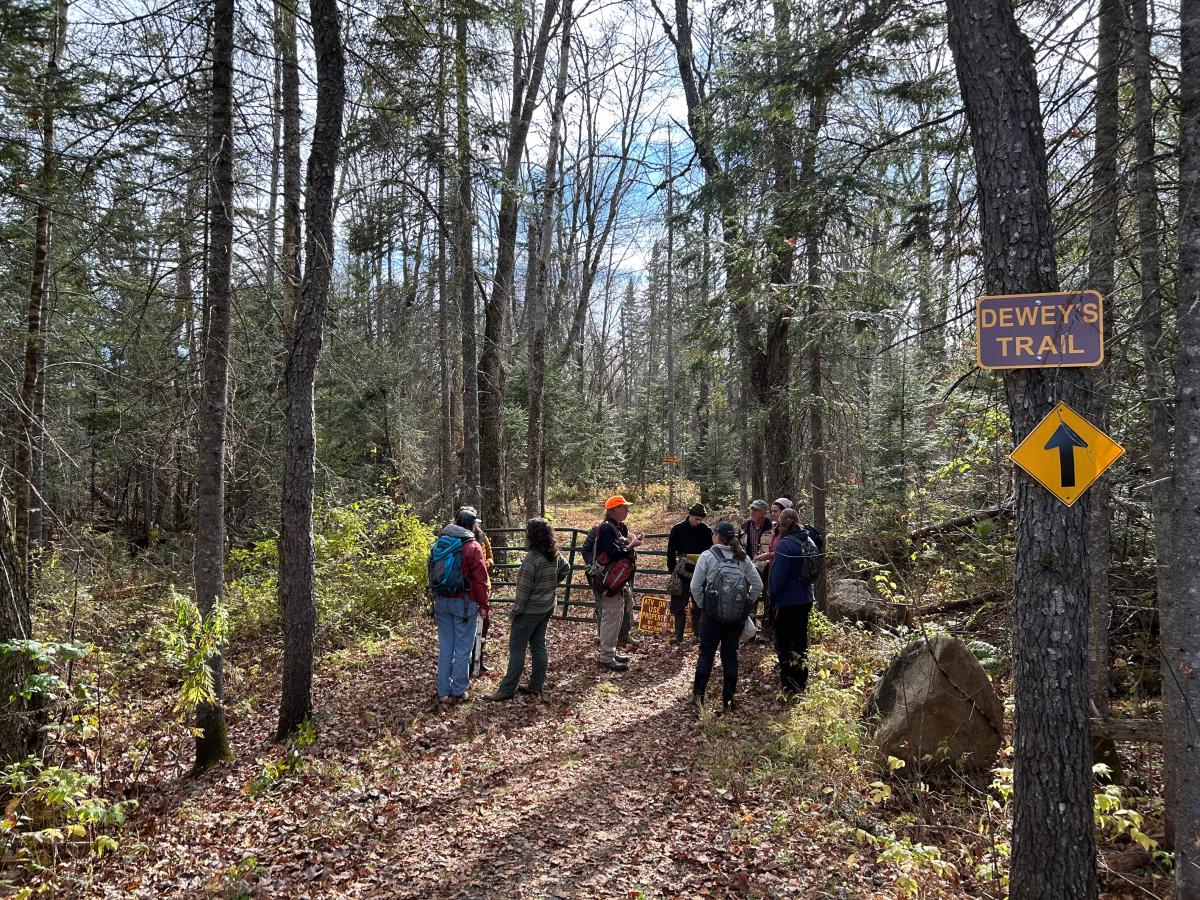
Seventy botanists from across the United States and Canada have discovered species of liverworts, mosses, and lichens not seen in New York State for more than a century. The Crum-Tuckerman Workshop, led by Dr. James Lendemer, curator of botany at the New York State Museum, was held over the course of five days at the Huntington Wildlife Forest in Newcomb, N.Y.
The workshop is part of ongoing education and outreach for a National Science Foundation grant awarded to Dr. Lendemer. These workshops bring together students, professional scientists, educators, and naturalists to share knowledge about the vast diversity of the tiny life forms that make up the backbone of forest ecosystems.
Participants documented hundreds of species across the SUNY ESF Newcomb Campus and Huntington Wildlife Forest. Discoveries included the Eastern candlewax lichen (Ahtiana aurescens), which was thought to have been lost from New York, Long-stalked hair-cap moss (Polytrichum longisetum), a rare species newly found in Hamilton County, and the endangered Bubbling witch’s hair lichen (Alectoria fallacina).
Dr. Lendemer said, “New York’s flowers and ferns are reasonably well documented, but there is still so much to discover about the smaller side of botany, which is why workshops like these are incredibly important. They allow people to learn not only how to recognize rare and unusual species, but also how to responsibly compile and administer museum collections that can be studied for generations to come.”
These discoveries highlight the value of bringing together experts and enthusiasts to intensively study small but ecologically crucial organisms. Lichens, mosses, and liverworts play vital roles in forest ecosystems, from nutrient cycling to providing habitat for countless invertebrates. The workshop's success in documenting rare and rediscovered species underscores the importance of continued botanical exploration, even in well-studied regions. Many of these organisms serve as indicators of old-growth forest conditions and ecosystem health.
Caroline Witherspoon, a graduate student at SUNY ESF said, “At first glance it seems like there are only a few kinds of lichens and mosses, but when you look closer it turns out there is a whole world hidden right in front of us.”
The workshops have been ongoing for more than thirty years. Starting in New York, they have since been held in nearly every state and province east of the Mississippi River. This year's participants included students, post-doctoral researchers, and faculty from institutions including the City University of New York, State University of New York, Cornell University, Rutgers University, Morehead State University, Drexel University, George Mason University, and Duke University.


About the New York State Museum
Established in 1836, the New York State Museum is the oldest and largest public museum in the United States. Home to leading scientists, historians, archeologists, and anthropologists, its collections represent the State’s rich cultural and natural heritage from the past and present, including a staggering 20+ million artifacts spanning 1.1 billion years ago to today. Located at 222 Madison Avenue in Albany, the Museum is open Tuesday through Sunday from 9:30 a.m. to 5 p.m. It is closed on the Fourth of July, Thanksgiving, Christmas, and New Year's Day. Admission is free. For additional information, visit the New York State Museum website and subscribe to our newsletter.
###
(518) 474-1201
Press@nysed.gov
www.nysed.gov