

New Divisions of Ancient Geologic Time
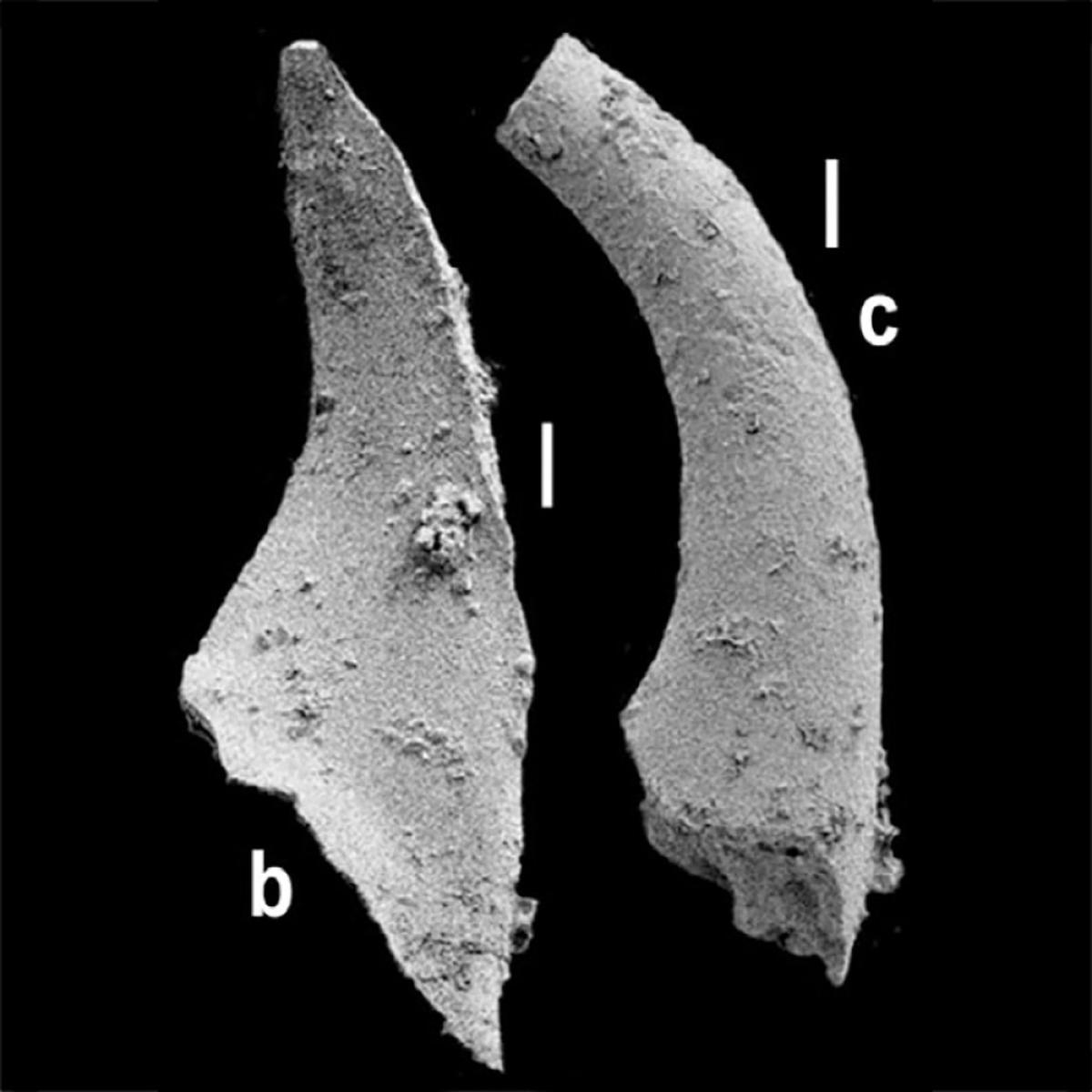
Tooth-like microfossils of the conodont animal Eoconodontus notchpeakensis (scale bars 0.05 mm) from quarry near Whitehall, eastern New York.
Research by Dr. Ed Landing, New York State Paleontologist, emeritus, with the New York State Museum has led to global subdivisions of the Cambrian Period that are used in geology textbooks. The Cambrian (538–497 million years ago) is a key interval in geological time as it featured an evolutionary explosion of multicellular organisms and the origin of modern marine animal groups.
In February 2026, the Cambrian Subcommission (CS) of the International Union of Geological Scientists (IUGS) accepted a proposal made by Landing at a 2010 scientific meeting in Prague. He defined the base of the uppermost Cambrian subdivision at the lowest occurrence (LO) of fossils of a fish-like animal called Eoconodontus notchpeakensis (see figure). The IUGS favored this global horizon, which is right below a major change in oceanic carbon isotope values, over the LO of a trilobite-like form favored by Chinese paleontologists. This uppermost Cambrian subdivision is a ca. 2.7 m.y. interval based on Landing’s precise uranium-lead age dating of ancient volcanic ashes in Wales in the 1990s and revised in 2025.
Other Cambrian subdivisions accepted by the IUGS include Landing as co-author (1987, accepted 1992) of the global standard for the base of the Cambrian. This standard in a sea cliff exposure in SE Newfoundland, Canada, was favored over competing Russian and Chinese proposals that proved to be significantly younger. Landing (2007) named the lowest major divisions of the Cambrian (the Terreneuvian Series with a lowest Fortunian Stage). In 2019, he and co-researchers determined a ca. 519 m.y. uranium-lead age on the top of the global Terreneuvian (which is about the age of the oldest trilobites) based on field work in southern Morocco. Most recently (January 2026) he proposed to the CS, with Drs. Damien Pas, Liège University, Belgium, and Gerd Geyer, Universität Würzburg, Germany, standards for the top of the Terreneuvian based on the peak of a carbon isotope excursion determined at his field areas in Morocco and Siberia.