

Introduction
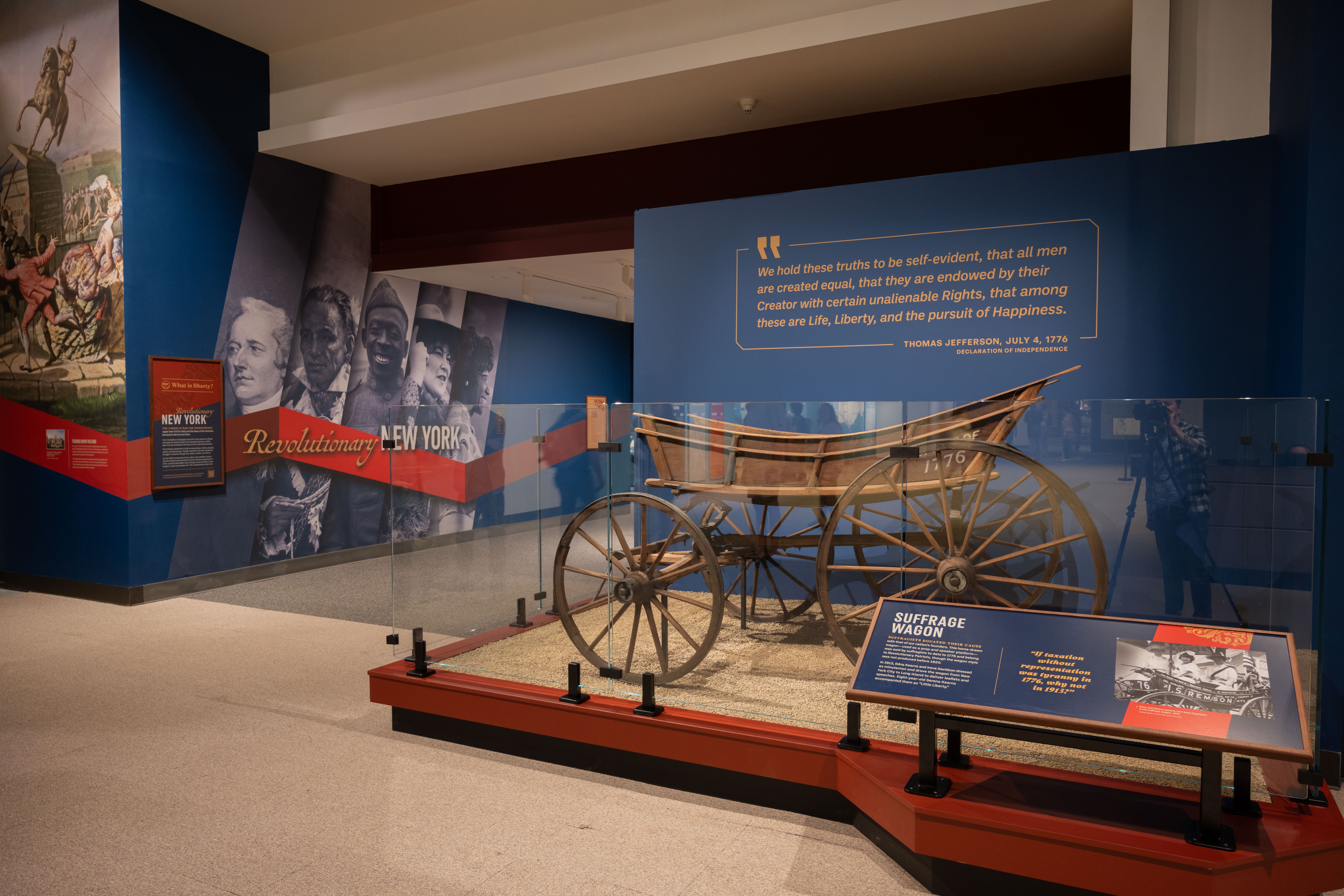
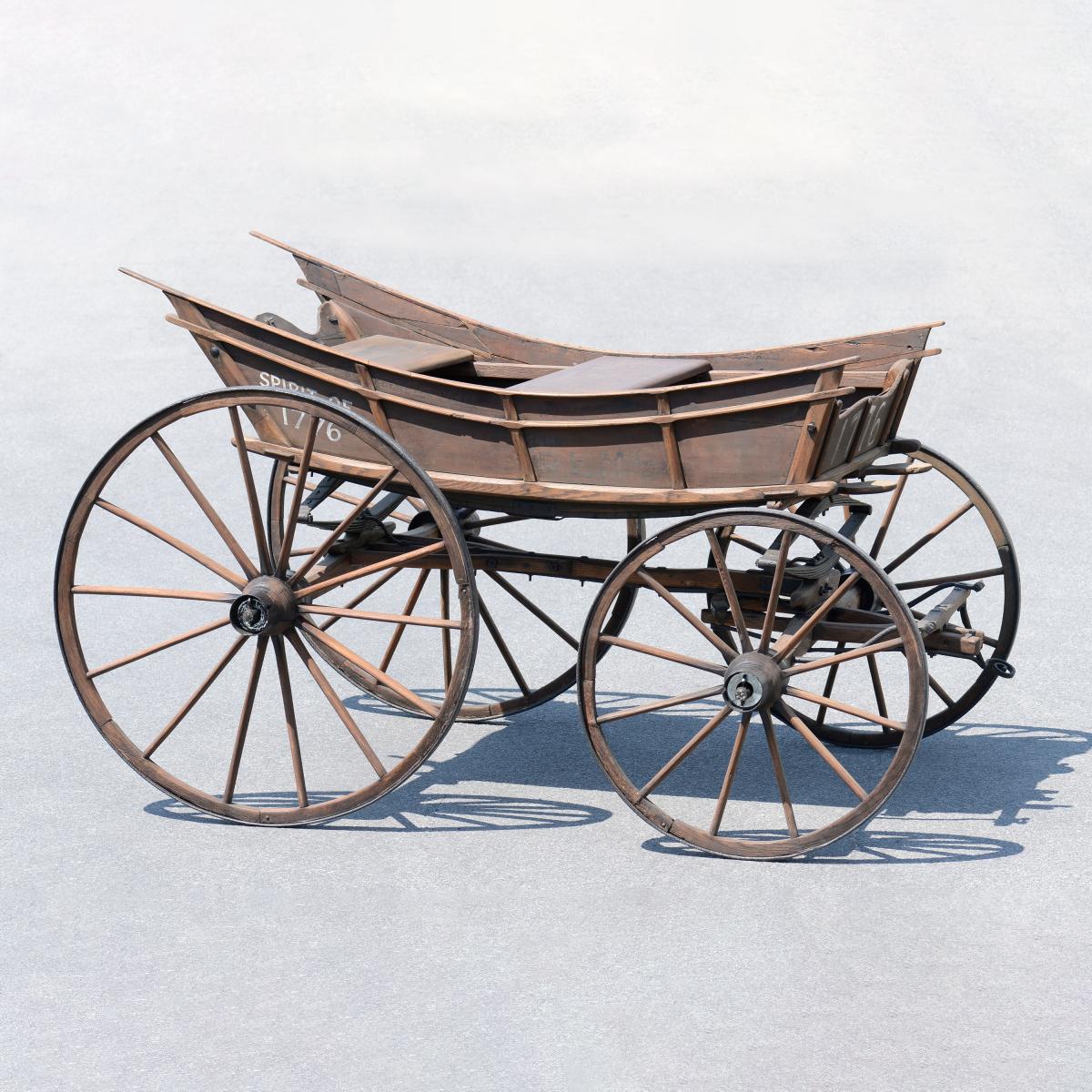
As you move down the corridor outside Exhibition Hall, next to the Cohoes Mastodon skeleton, you will encounter a wooden wagon displayed on a raised platform. This Suffrage Wagon served as a mobile platform for women advocating for voting rights. The wagon is about eight feet long and a little over four feet high. Constructed of wood and supported by four large, spoked wheels with iron rims, it bears the words “Spirit of 1776” painted in white lettering. Inside the wagon, there are two plank bench seats. Behind the wagon is a quote on the wall by Thomas Jefferson from the Declaration of Independence, July 4, 1776: “We hold these truths to be self-evident, that all men are created equal, that they are endowed by their Creator with certain unalienable Rights, that among these are Life, Liberty, and the pursuit of Happiness.”
To the left of the wagon and exhibition entrance is a large wall graphic illustration showing a crowd pulling down a statue of King George. Tearing down the statue symbolically ended his rule over New York and the other colonies.
Above this area, the entrance header has three recessed soffits painted deep blue, cream, and crimson—a color palette continued throughout the exhibit.
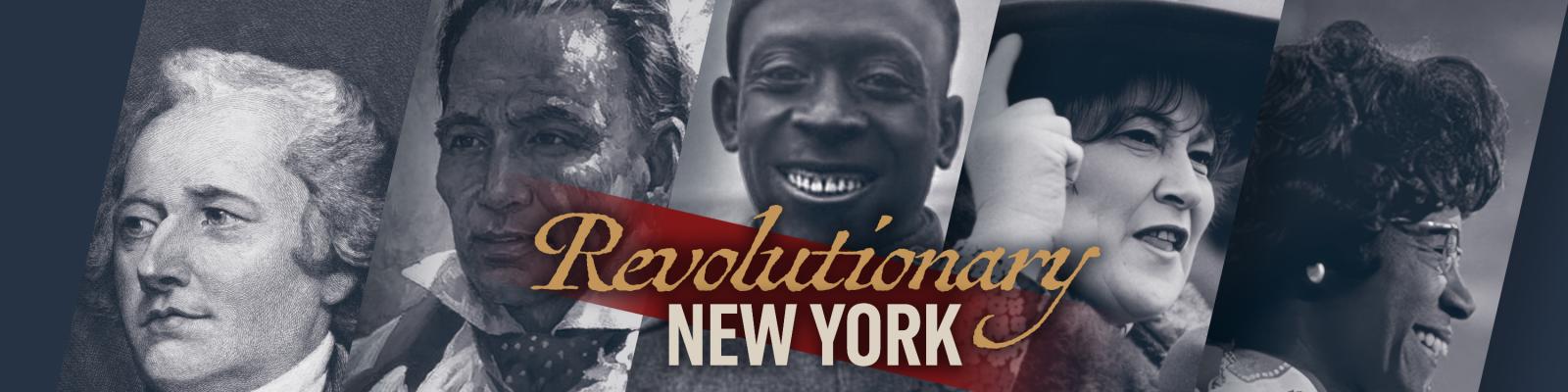
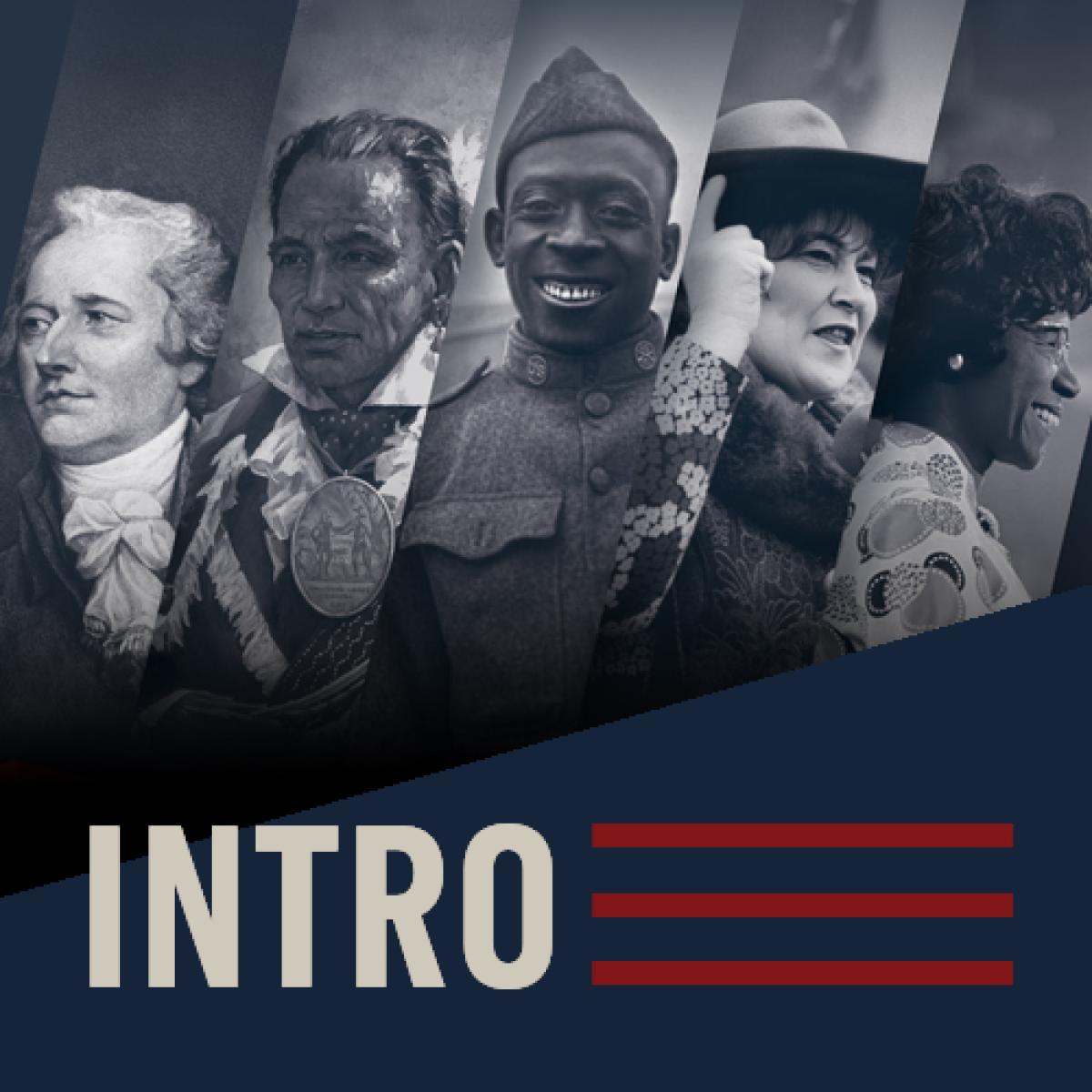
Just inside the entryway, on the left, introductory text presents Revolutionary New York as an exploration of how New Yorkers—from the Revolution through successive social movements to today—have carried forward and interpreted the nation’s founding ideals of liberty, equality, justice, and democracy. The first of a series of dialogic questions is introduced here: “What is liberty?” To the right of this, a large wall graphic presents close-up portraits of influential figures from New York’s revolutionary history—Alexander Hamilton, Red Jacket, Henry Johnson, Bella Abzug, and Shirley Chisholm. They gaze in different directions, engaging visitors as they enter. A red band—suggesting a timeline and repeated as a motif throughout the gallery—runs across the graphic and displays the exhibition title, Revolutionary New York. “Revolutionary” is rendered in an aged, script-style font, while “New York” appears in a bold, modern sans serif, establishing a design aesthetic blending historic character with clean, contemporary lines.
The overall gallery configuration guides visitors along a broad U-shaped path, subtly encouraging a leftward start that loops back along the far back wall of the space.
Revolutionary New York
The American War for Independence raged from 1775 to 1783, but the ideas of the American Revolution did not end there. From the Battles of Saratoga to the birth of the Women’s Suffrage Movement at Seneca Falls to the Stonewall Uprising in 1969, New York has remained at the heart of this continuing Revolution.
The American experiment is built on shared ideals—liberty, equality, justice, and democracy. Though imperfect and often marked by struggle, it endures through civic action, protest, and reform.
On the 250th anniversary of our nation, this exhibition honors the New Yorkers who launched the great American experiment in 1776—and the bold leaders who, through social revolutions, have fought to make its promises real. This is Revolutionary New York.
“If taxation without representation was tyranny in 1776, why not in 1913?”
Suffragists equated their cause with that of our nation’s founders. This horse-drawn wagon—used as a prop and speaker platform—was said by suffragists to date to 1776 and belong to Revolutionary Patriots, though the wagon style was not produced before 1820.
In 1913, Edna Kearns and Irene Davidson dressed as minutemen and drove the wagon from New York City to Long Island to deliver leaflets and speeches. Eight-year-old Serena Kearns accompanied them as “Little Liberty.”
New York State Museum H-2007.21.1
Acknowledgments:
As Revolutionary New York commemorates the 250th anniversary of our nation, we honor not only the history of our state and its people but also the partnerships that made this exhibition possible.
We extend our sincere thanks to the New York State Education Department, the New York State Board of Regents, and the New York State 250th Commemoration Commission for their support in bringing this project to life.
The New York State Museum worked closely with partner institutions within the Office of Cultural Education—the New York State Archives and the New York State Library—and collaborated with cultural organizations, historians, and Indigenous Nations to enrich the stories shared here.
This exhibition was developed in consultation with Indigenous Nations through a dedicated Indigenous Advisory Council, as well as staff at the Underground Railroad Education Center. We deeply appreciate the insight, expertise, and partnership these consultants provided.
We are also grateful for our lenders—private individuals, museums, and cultural institutions—for their contributions to this exhibition.
We extend our deepest gratitude to all who contributed their time, knowledge, and resources to make Revolutionary New York possible.
Funding provided by the New York State 250th Commemoration Commission
OCE Partners
Consultants
Indigenous Advisory Council
- Christine Abrams, Tonawanda Seneca
- Wayne Abrams, Tonawanda Seneca
- Darren Bonaparte, St. Regis Mohawk Tribe
- Jeremy Dennis, Shinnecock Indian Nation
- David George-Shongo, Seneca
- Richard Hill, Tuscarora, Six Nations of the Grand River
- Clarissa Jacobs, NYSED Office of Indigenous Education
- Jeremy Johnson, Delaware Tribe of Indians (Lenape)
- Dehowähda•dih - Bradley Powless, Onondaga Nation Eel Clan
- Robin Maxkii, Stockbridge-Munsee Band of Mohican Indians
- Vince Schiffert, Tuscarora Nation
- Stockbridge-Munsee Band of Mohican Indians (citizen)
Underground Railroad Education Center
- Paul Stewart
- Mary Liz Stewart
- Marcus Anderson
- Carmen Bivens
- Amelia Paul
- Lacey Wilson
American Gunboat Conservation and Reconstruction
- Peter Fix, Center for Maritime Archaeology and Conservation at Texas A&M University
- Funding provided through Lower Manhattan Development Corporation
Film Contributors:
- Darren Bonaparte
- Jennifer Burns
- Frederick Jones
- Pedro Regalado
- Hugh Ryan
- Judith Wellman
The New York State Museum is a program of The University of the State of New York | The State Education Department | Office of Cultural Education.