

We the People
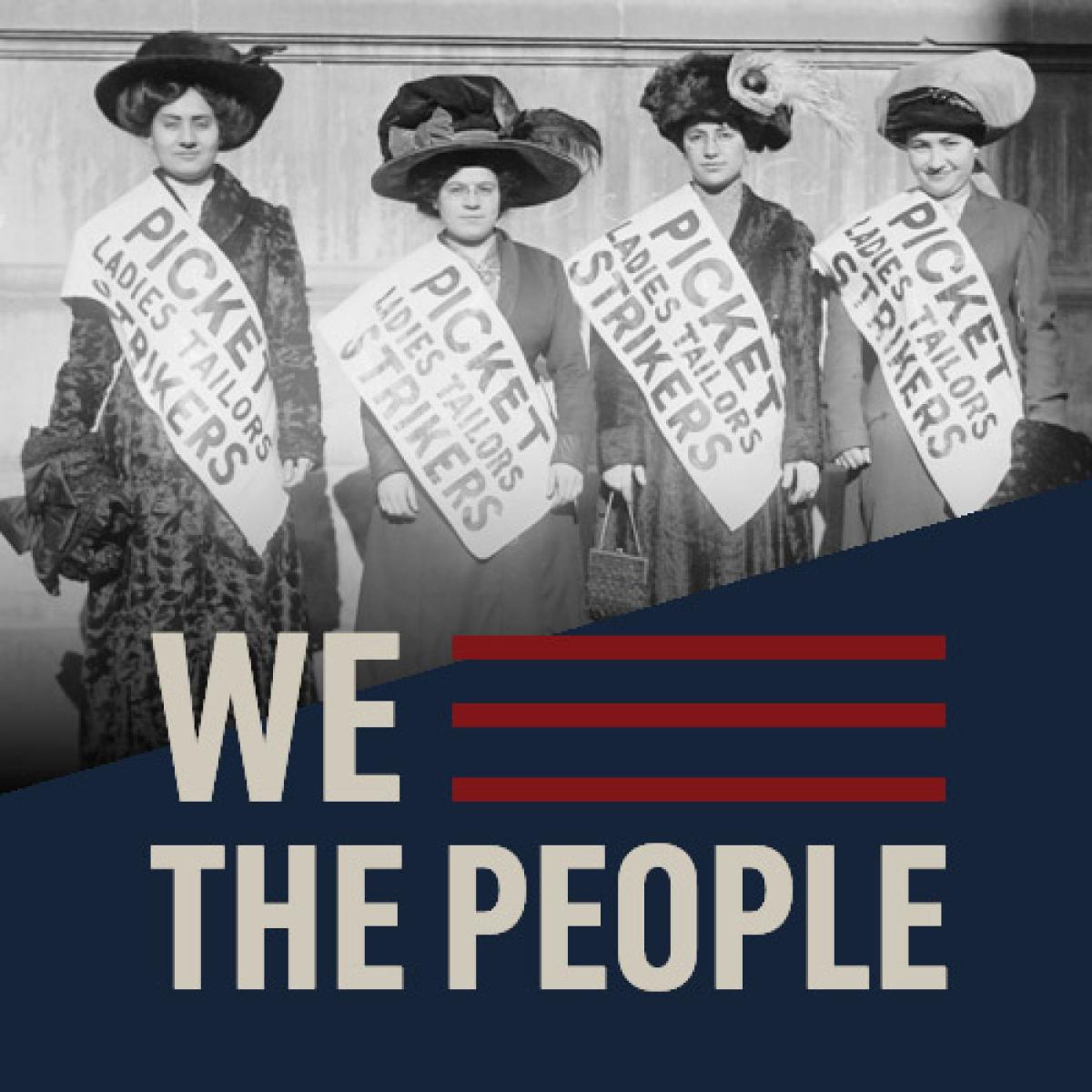
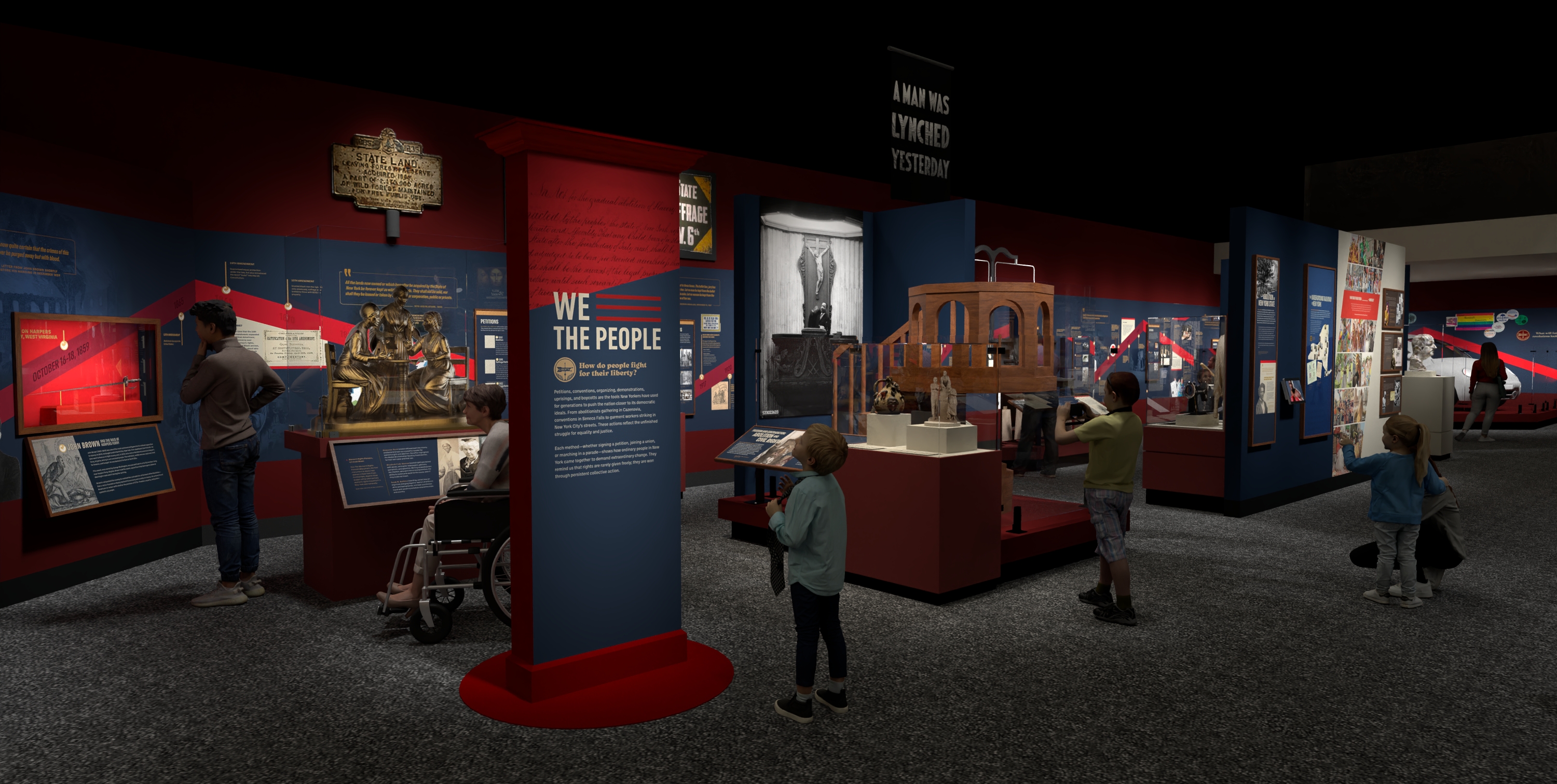
Following the video, visitors enter the final section of the exhibition, titled “We the People." A tall introductory panel poses the question, “How do people fight for their liberty?” This section explores six major movements for social change: Women’s Rights, Abolition and Civil Rights, Labor Rights, Immigration Rights, Environmental Activism, and LGBTQ+ Rights. Each thematic area is anchored by a prominent artifact and supported by additional objects and images, with key moments from each movement placed within a shared legislative timeline.
The timeline stretches nearly 80 feet long across the gallery. A thick red line winds over a dark blue background with imagery, forming a sweeping visual backdrop for the six themes. Beginning in 1799 with the Act for the Gradual Emancipation of Slavery, it traces more than two centuries of activism and social change. Key moments from each thematic area appear along its length, creating a layered approach that allows visitors to explore individual movements while also seeing how they intersect, influence one another, and evolve over time.
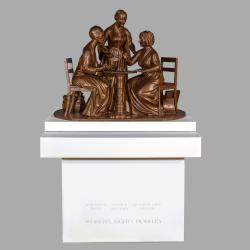
The “Women’s Rights” section features a one-third scale model of the Women’s Rights Pioneers Monument, showing Sojourner Truth, Elizabeth Cady Stanton, and Susan B. Anthony together in bronze-colored form that’s approximately three feet tall by four feet wide and is displayed on a pedestal.
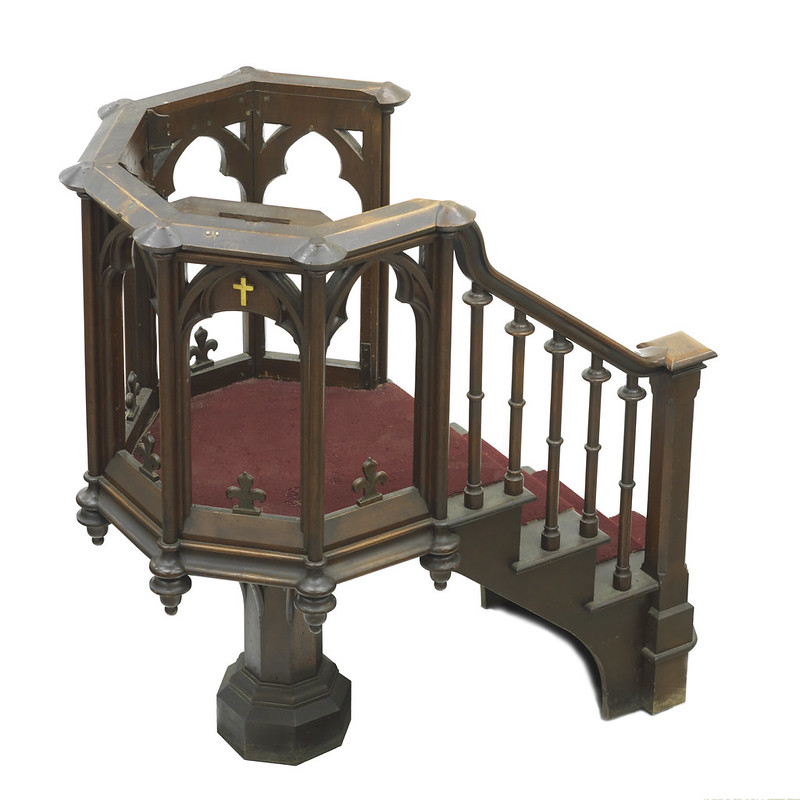
Nearby is an area called “Freedom and Contradiction: Abolition and Civil Rights.” It features a dark wooden church pulpit, roughly six feet by six feet. A small media screen shows a reenactor delivering Frederick Douglass’s famous 1852 speech, What to the Slave Is the Fourth of July, written by Douglass and performed by Frederick Jones.
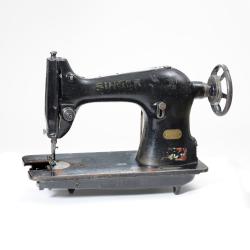
In the “Labor Rights” area, an industrial knitting machine serves as the central object. Measuring more than eight and a half feet tall and six and a half feet wide, the machine is cast and painted, with a four-legged table base and a rectangular top. Two rotary mechanisms extend from the structure, connecting to spools of yarn and emphasizing the machine’s industrial function.
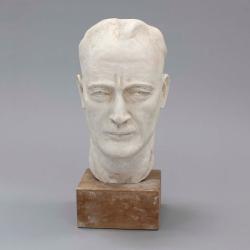
The Immigration Rights section, titled “The American Dream,” includes a sculpted plaster head created by immigrant artist Henry DiSpirito. The sculpture features finely carved facial details and a prominent mustache, while the hair is rendered in a more stylized manner.
Within the “Environmental Activism” area, a highlighted grouping of objects featuring the Bald Eagle motif reflects the bird’s shifting significance—from a symbol of the young American republic to an emblem of conservation as the species itself faced near extinction. The grouping includes a large red coffee mill, nearly three feet tall and two feet wide, decorated with an eagle holding banners bearing the company name Enterprise Mffg. Co. Additional objects include a stoneware crock and pitcher, a wooden clock with painted details, a bronze painted eagle figurine with outstretched wings, and an engraved scrimshaw busk.
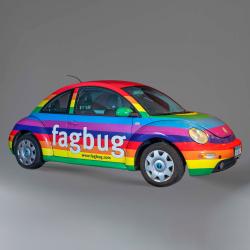
Finally, as you return toward the entryway, “LGBTQ+ Rights” is marked by a full-size Volkswagen Beetle painted in bright rainbow-colored stripes, with the word “fagbug” in bold white letters that span nearly the entire side of the car. It is paired with its original silver hood that bears graffiti in red spray paint that reads “U R Gay.”
The exhibition concludes at the end of the timeline, bringing you to the present day and inviting reflection with a final question: “What will future revolutions look like?” From there, the path leads back to the gallery entrance, completing the U-shaped route through the Exhibition Hall.
Petitions, conventions, organizing, demonstrations, uprisings, and boycotts are the tools New Yorkers have used for generations to push the nation closer to its democratic ideals. From abolitionists gathering in Cazenovia, conventions in Seneca Falls, to garment workers striking in New York City’s streets, these actions reflect the unfinished struggle for equality and justice.
Each method—whether signing a petition, joining a union, or marching in a parade—shows how ordinary people in New York came together to demand extraordinary change. They remind us that rights are rarely given freely; they are won through persistent collective action.
Women's Rights
From the American Revolution through the early 20th century, women who were denied political, educational, professional, and religious equality organized through reform movements to secure the right to vote and ultimately pursued constitutional equality through the Equal Rights Amendment.
Freedom and Contradiction: Abolition and Civil Rights
From the era of slavery through emancipation and beyond, enslaved people and their allies, many in New York, fought for freedom and civil rights, a struggle that led to the Thirteenth Amendment to the United States Constitution and continues today in the ongoing pursuit of liberty and equality for all.
Labor Rights in NYS
From the early 19th century to the present, working people in New York, including immigrants, women, and people of color, have organized for labor rights and social justice, shaping laws and movements that advanced workplace protections, civil rights, and economic equality.
Environmental Activism
From the growth of industry to modern environmental activism, people in New York have worked to protect natural resources and public health, culminating in the 2021 adoption of the Green Amendment to the New York State Constitution guaranteeing the right to clean air, water, and a healthful environment.
The American Dream
Immigrants to the United States have pursued opportunity, safety, and democracy despite discrimination and hardship, while playing key roles in movements for labor reform and equal rights.
LGBTQ+ Rights
Activists in New York and across the United States have fought for LGBTQ+ rights in courts, legislatures, and communities, a movement commemorated each year during Pride in honor of the Stonewall uprising.
We the People: Environmental Activism
New York’s landscape, rich in natural resources and beauty, has long attracted people and industry alike. However, population growth and industrial pollution have led to habitat and species loss, and at times, threats to human health. In response, citizens have responded through activism and progressive environmental legislation.
On November 2, 2021, voters in New York approved a new constitutional amendment, the “Green Amendment,” to enshrine environmental rights in the Bill of Rights of the New York State Constitution. It asserts that “each person shall have the right to clean air and water, and to a healthful environment.”
Highlights
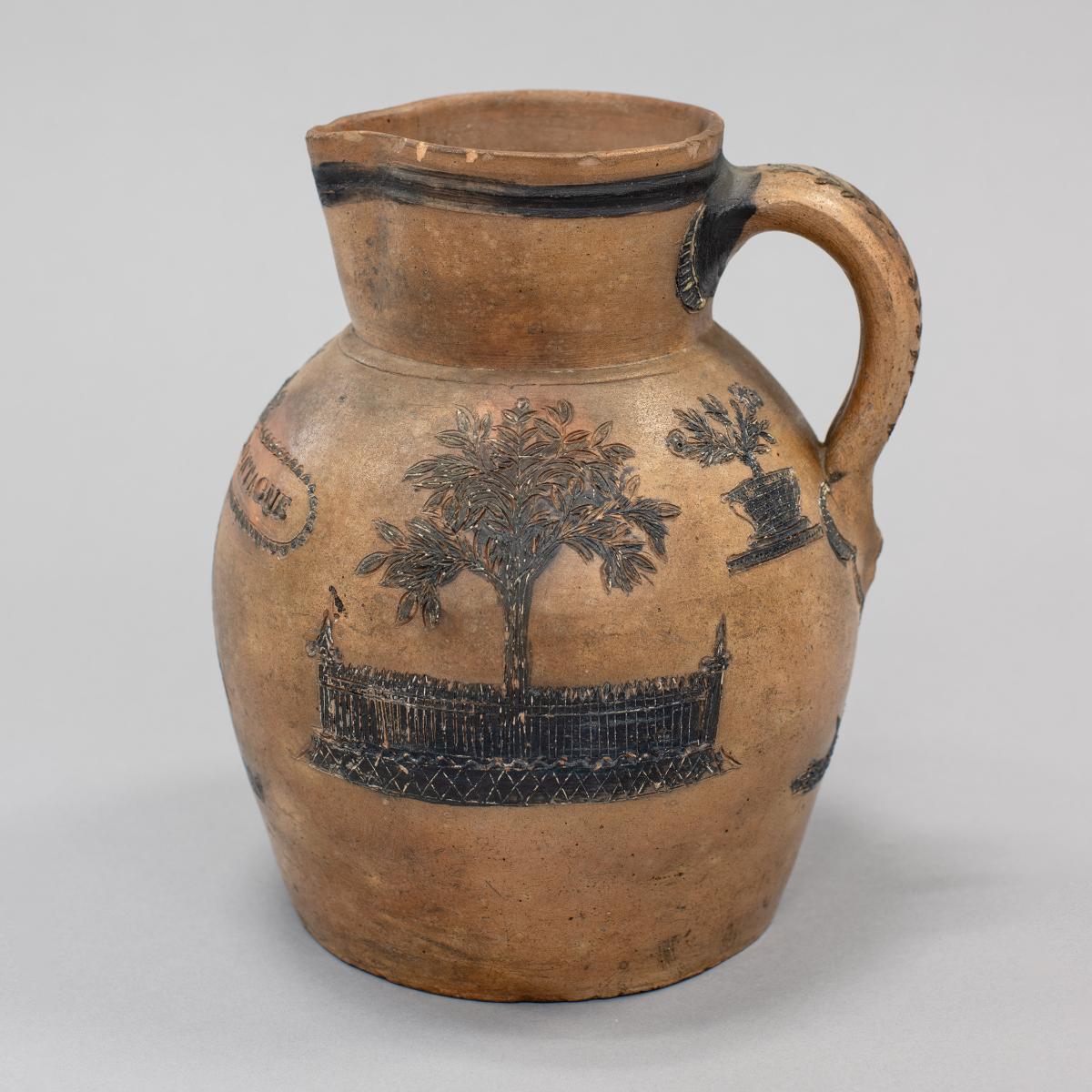
Daniel Goodale
Decorations on this pitcher include a Bald Eagle and a Sturgeon. The Bald Eagle became a symbol of the new republic when it was placed on the United States seal in 1782, but by the mid–20th century, it was in danger of disappearing altogether. Widespread use of the pesticide DDT thinned the eggshells of raptors and fish-eating birds, lowering their survival rates. Sturgeon were reported in the Hudson River during colonial times. These accounts were contrasted with the state of the fisheries in the mid-20th century as activists observed fish kills and declining populations and called for greater protections against pollution and development.
New York State Museum H-2015.35.13
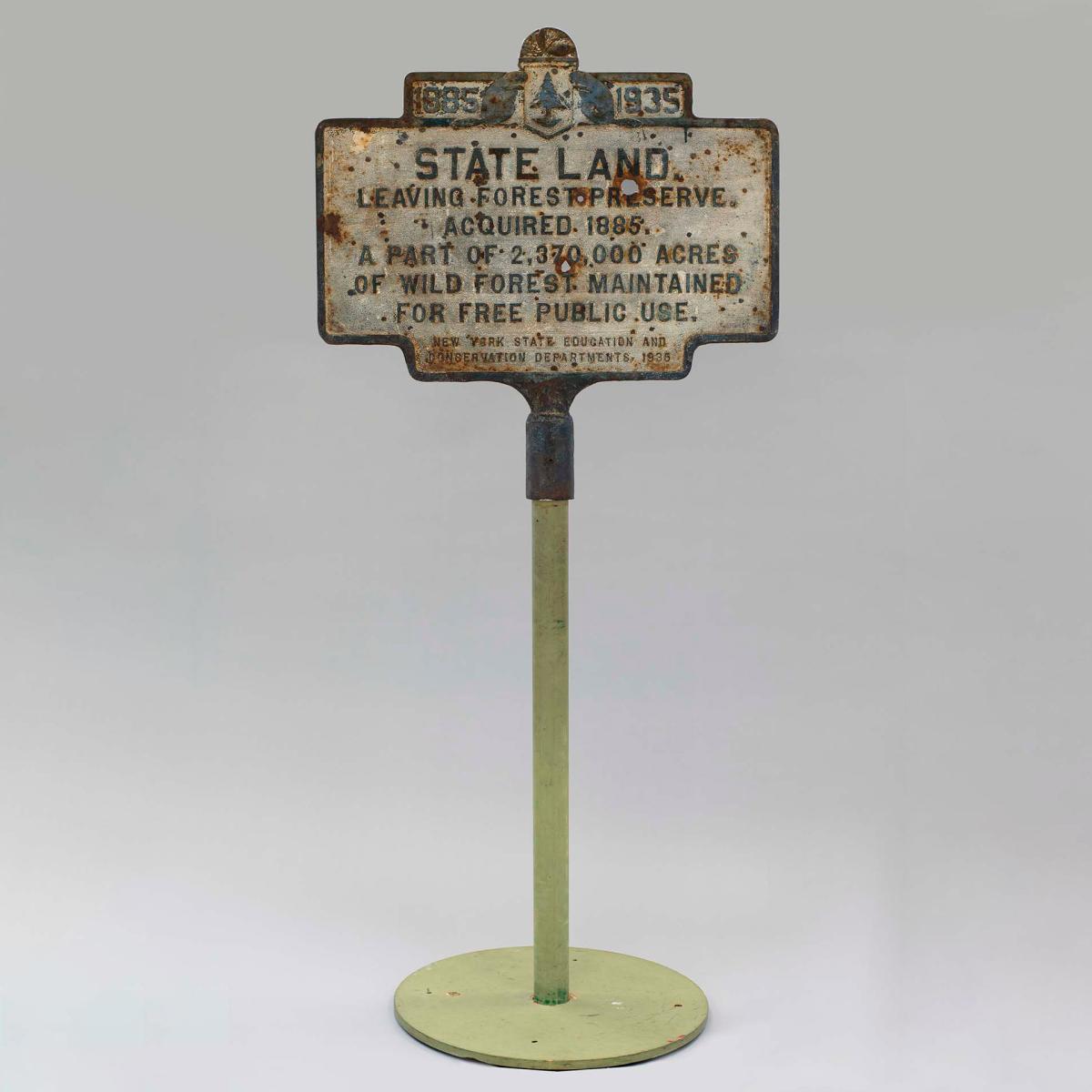
Adirondack Park was established in 1892 by the New York State Legislature. Measuring 2,800,000 acres when it was created, Adirondack Park is the largest parkland in the contiguous United States.
New York State Museum H-1988.8.1
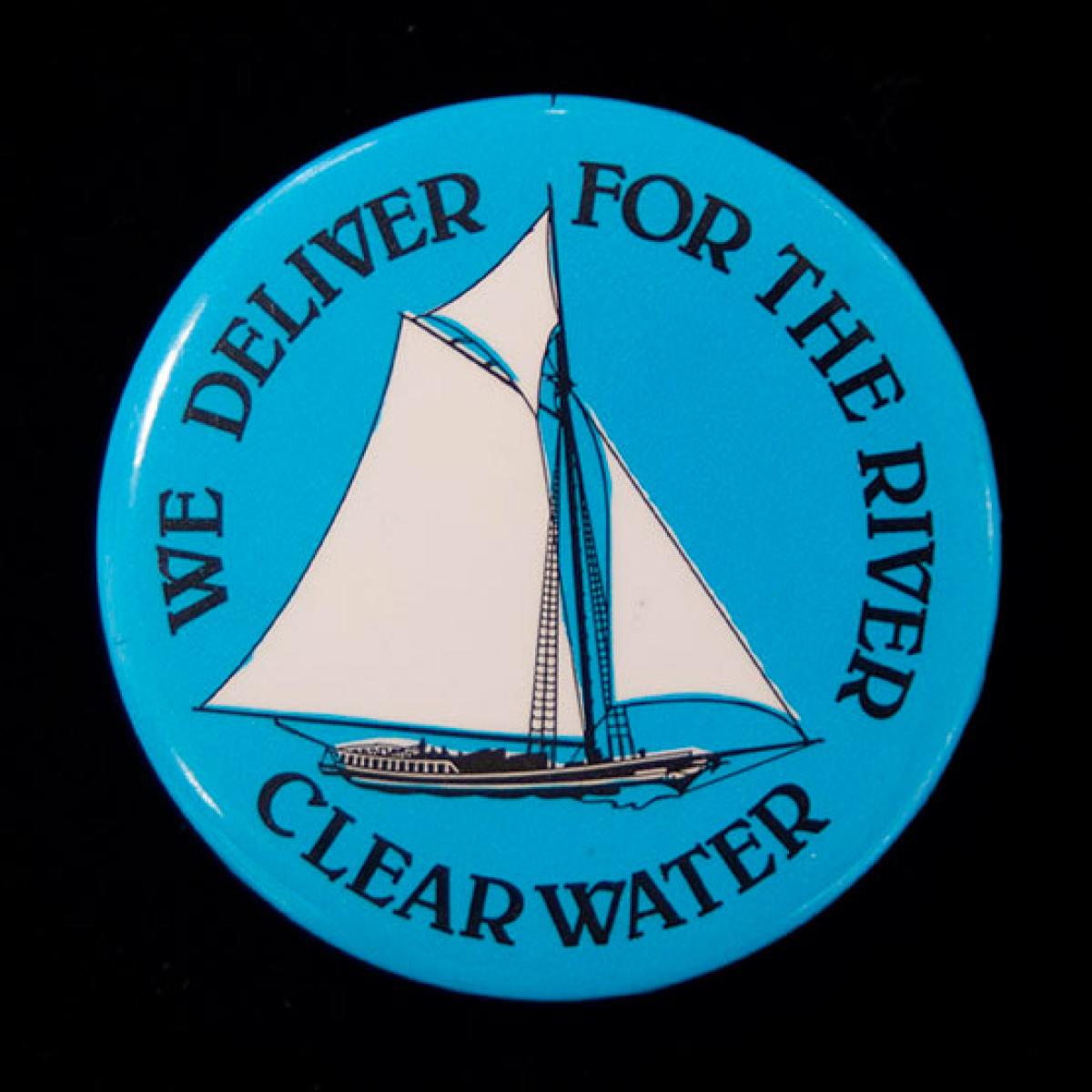
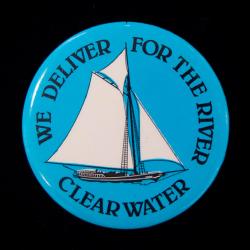
Pete Seeger sailed to Washington, D.C., on the Hudson River Sloop Clearwater in 1970 to deliver evidence on pollution to congress, dramatically increasing public support for the proposed Clean Water Act.
New York State Museum H-2025.43.2
We the People: Women's Rights
Women heard the calls of “no taxation without representation” during the American Revolution, but they were still denied the right to vote. During the abolition and temperance movements of the 19th century, women worked for social reforms while bearing injustices in their own lives. Women were not only denied a voice in government, but also the ability to pursue their education, to access most employment, and to have an active role in the church.
By the middle of the 19th century, women’s rights activists came together to work for the right to vote, with the idea that a voice in government would make other necessary reforms more achievable. When the vote was won in New York State in 1917, and federally in 1920, women immediately turned to the goal of enshrining women’s rights in the United States Constitution through the Equal Rights Amendment.
Highlights
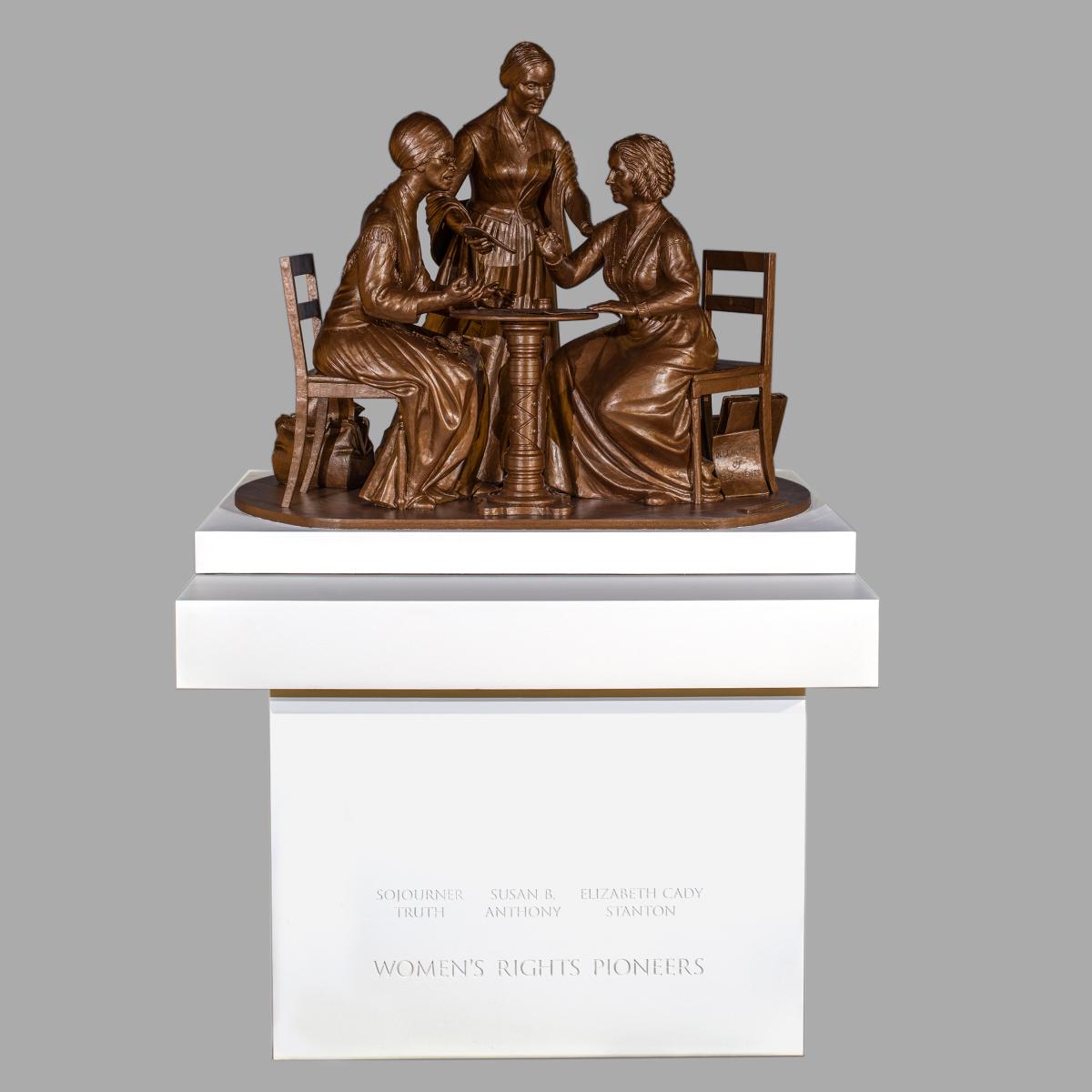
Meredith Bergmann
1/3 scale model
Women’s Rights Pioneers is the first monument to honor real women in New York City’s Central Park. It depicts three leaders of the 19th century women’s rights movement in New York and nationally: Sojourner Truth, Elizabeth Cady Stanton, and Susan B. Anthony.
New York State Museum, H-2023.3.1
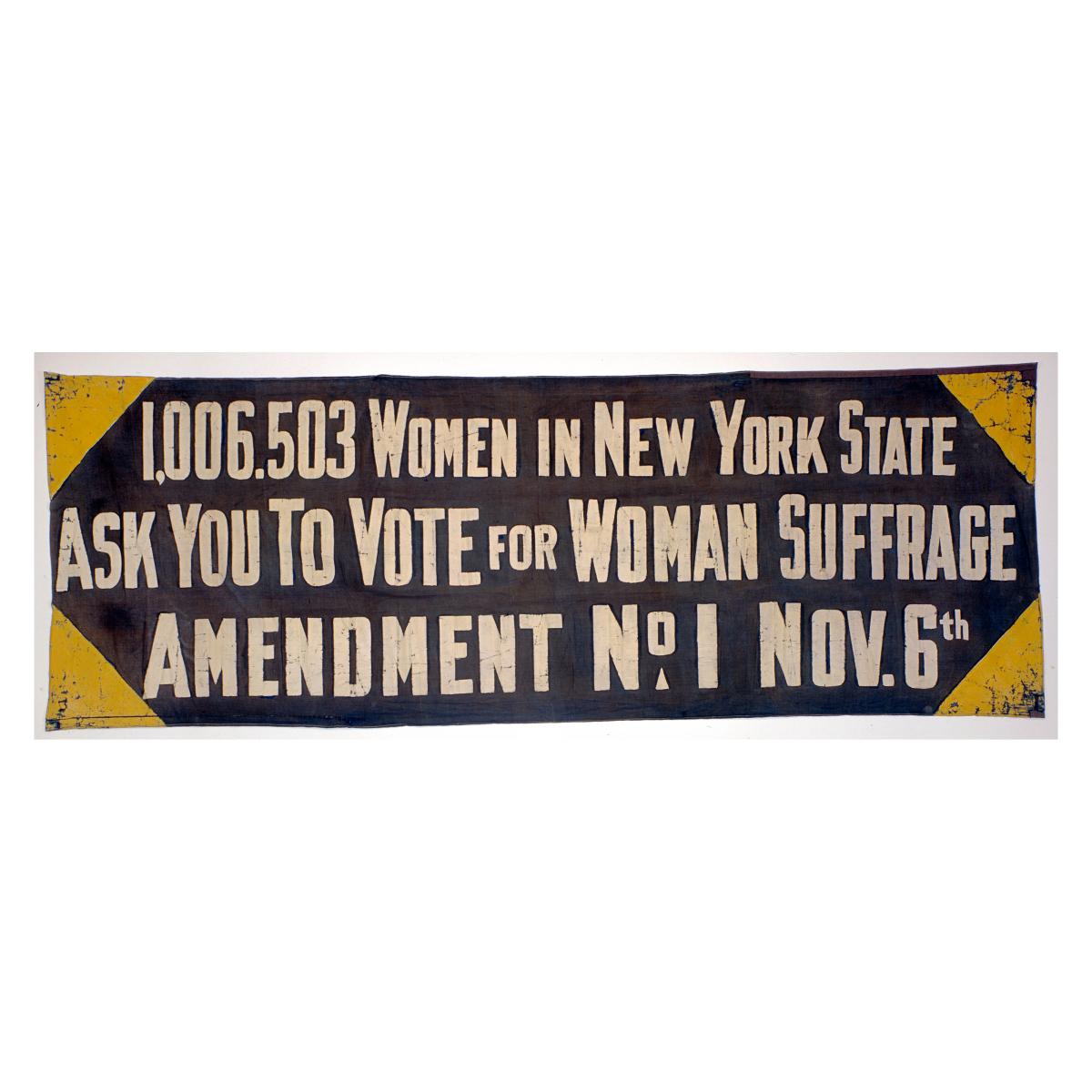
On October 27, 1917, ten days before Election Day, thousands of women marched for suffrage in New York City. This banner was carried by women from Orange County.
New York State Museum, H-1974.174.1
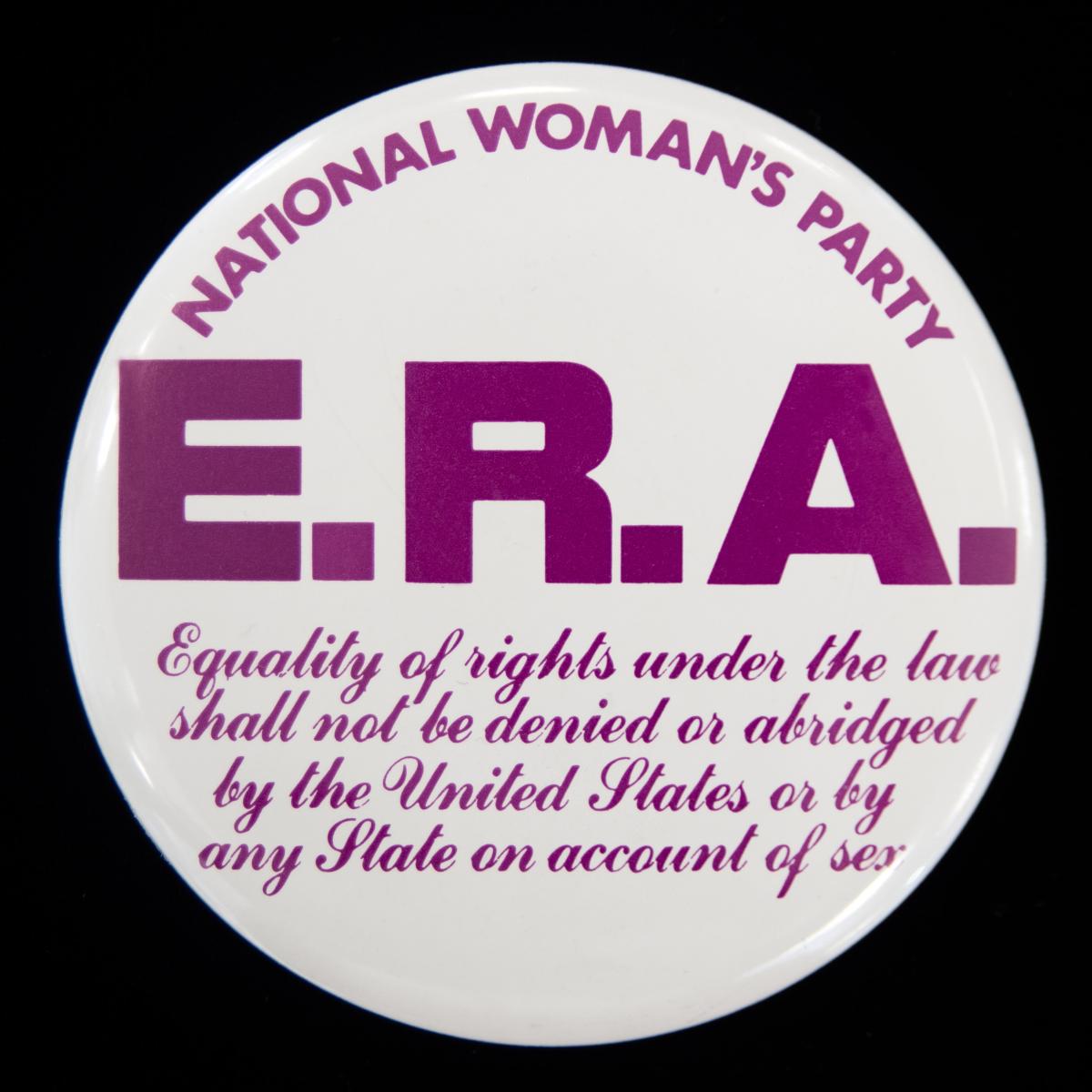
“National Woman’s Party, E.R.A., Equality of rights under the law shall not be denied or abridged by the United States or by any State on account of sex.”
New York State Museum, H-2016.32.28
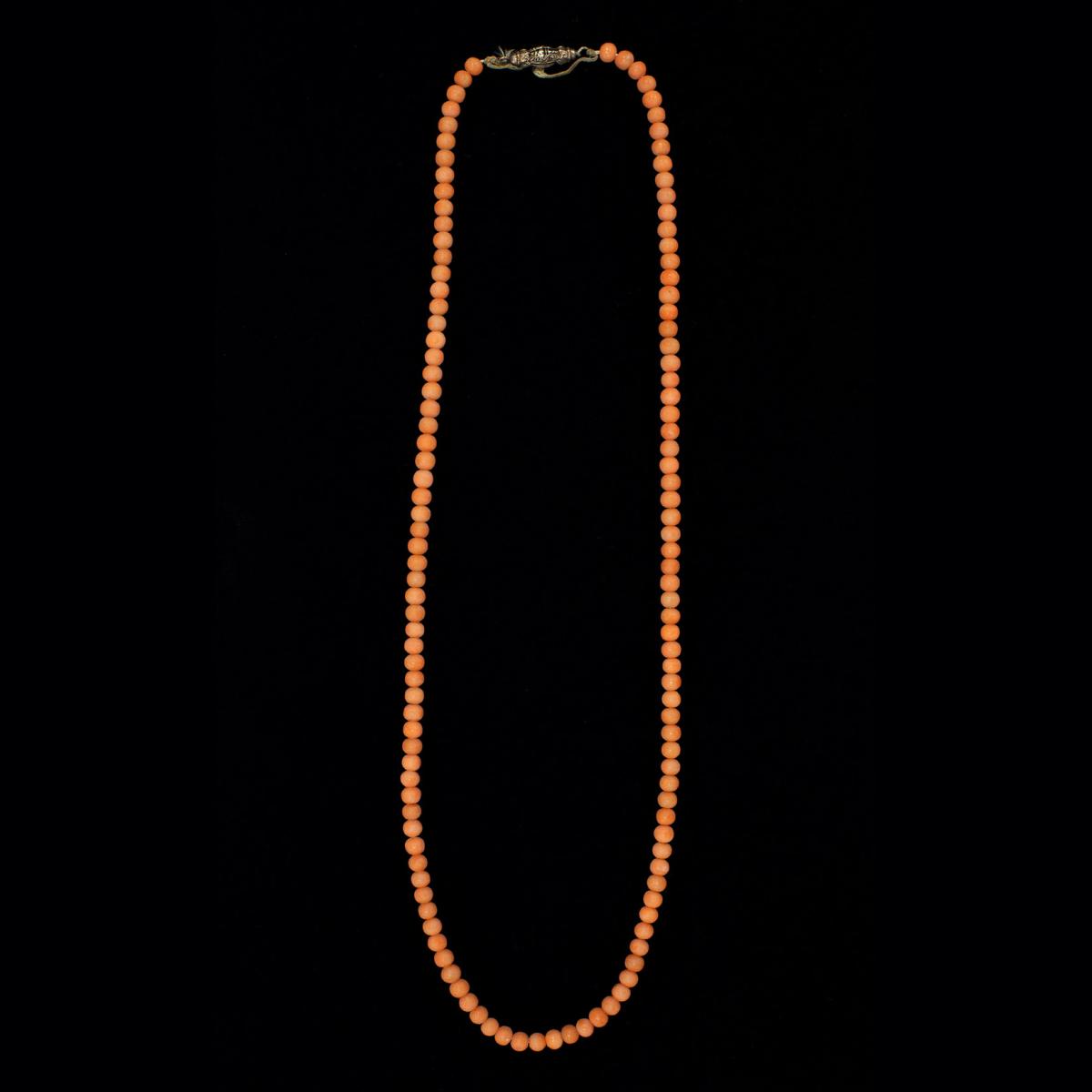
In her father’s law office, Elizabeth Cady Stanton (1815-1902) witnessed widows stripped of property they brought into marriage. Law clerks teased that her new coral necklace could be locked away or sold by her husband without her permission. Her outrage fueled her work for women’s rights.
New York State Museum, H-1972.115.150
Additional Resources
Talking Statues
Listen to an imagined conversation between Sojourner Truth, Susan B. Anthony, and Elizabeth Cady Stanton that brings their voices and their fight for women’s rights to life through this mobile-friendly audio experience, available in English and Spanish.
We the People: Freedom and Contradiction - Abolition and Civil Rights
The new nation was built on the labor of enslaved people, and slavery was protected by the US Constitution until 1865. The struggle for freedom was inseparable from the struggle for civil rights, as enslaved people and their allies fought for emancipation and equal recognition as citizens. From the beginning, there were also those who resisted this fight for justice.
Enslaved people fought for their own liberation, and early abolitionists challenged the system. While New York was once the largest slaveholding state in the North, it later became a center of antislavery activism and civil rights reform. After slavery was abolished locally in 1827, many New Yorkers helped lead the national abolition movement—culminating in the 13th Amendment of 1865.
After emancipation, activists shifted their focus to securing civil rights for African Americans. New Yorkers led efforts in their own communities and on the national stage. That work continues today, as generations strive to fulfill the founding ideals of liberty and equality for all.
Highlights
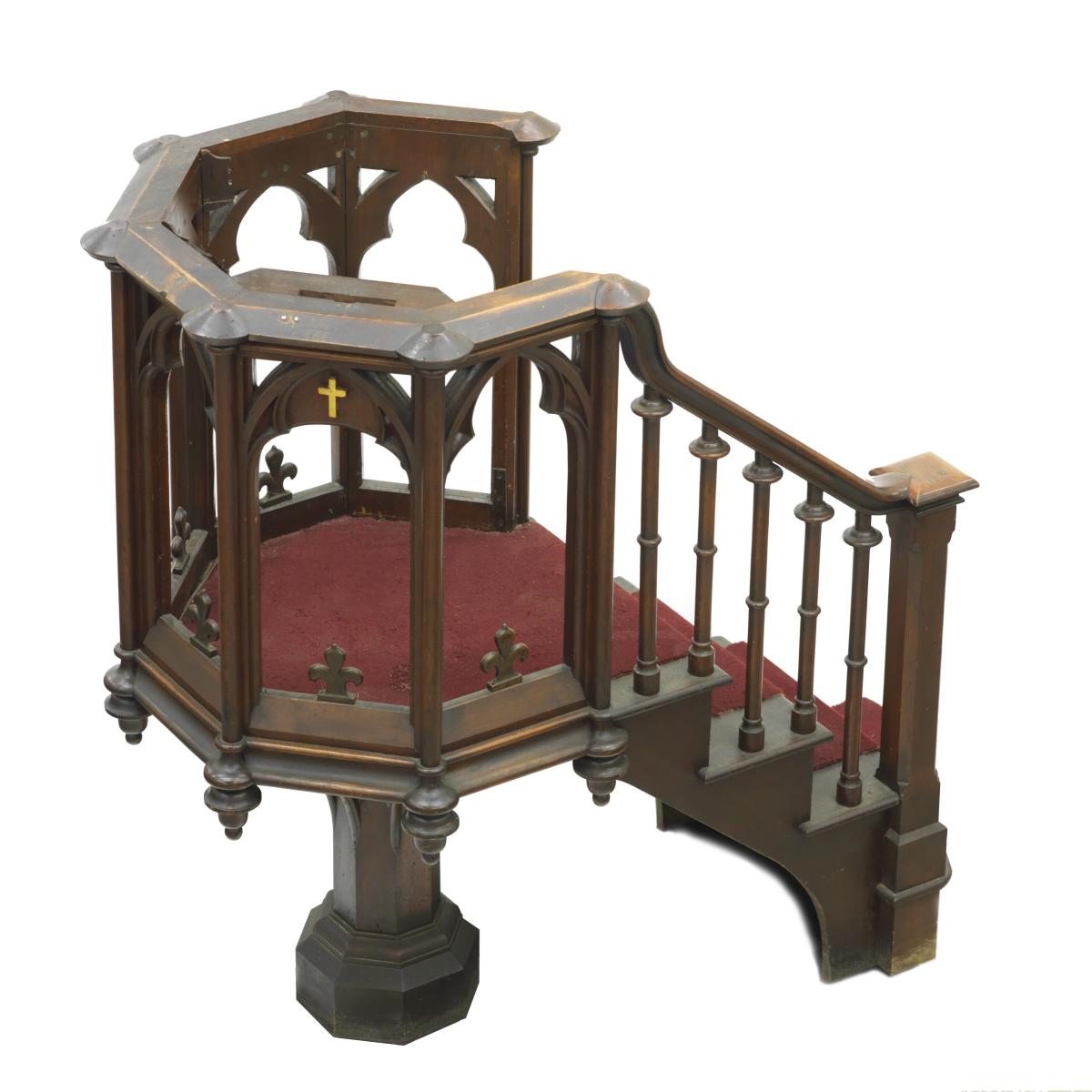
Troy, NY
Wood
This pulpit symbolizes the power and passion of the abolitionist and civil rights movements. Many African American communities organized for change through their churches.
New York State Museum H-2011.4.1
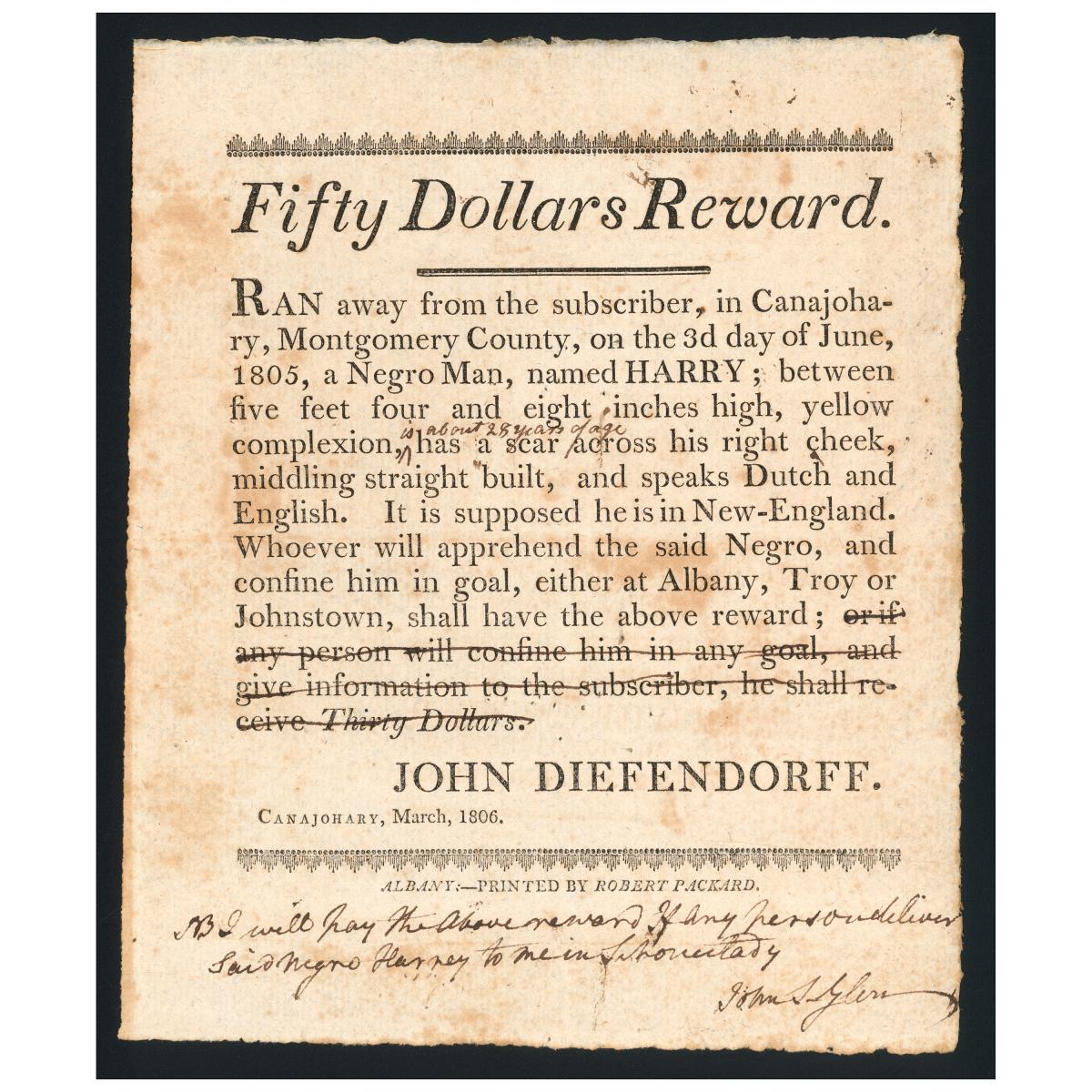
Canajoharie, NY
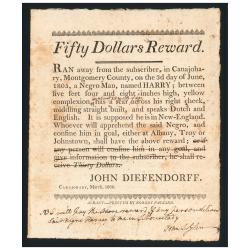
Cash rewards for the return of an enslaved person were common. Freedom seekers took huge risks when making a decision to flee.
New York State Museum H-2006.59.2
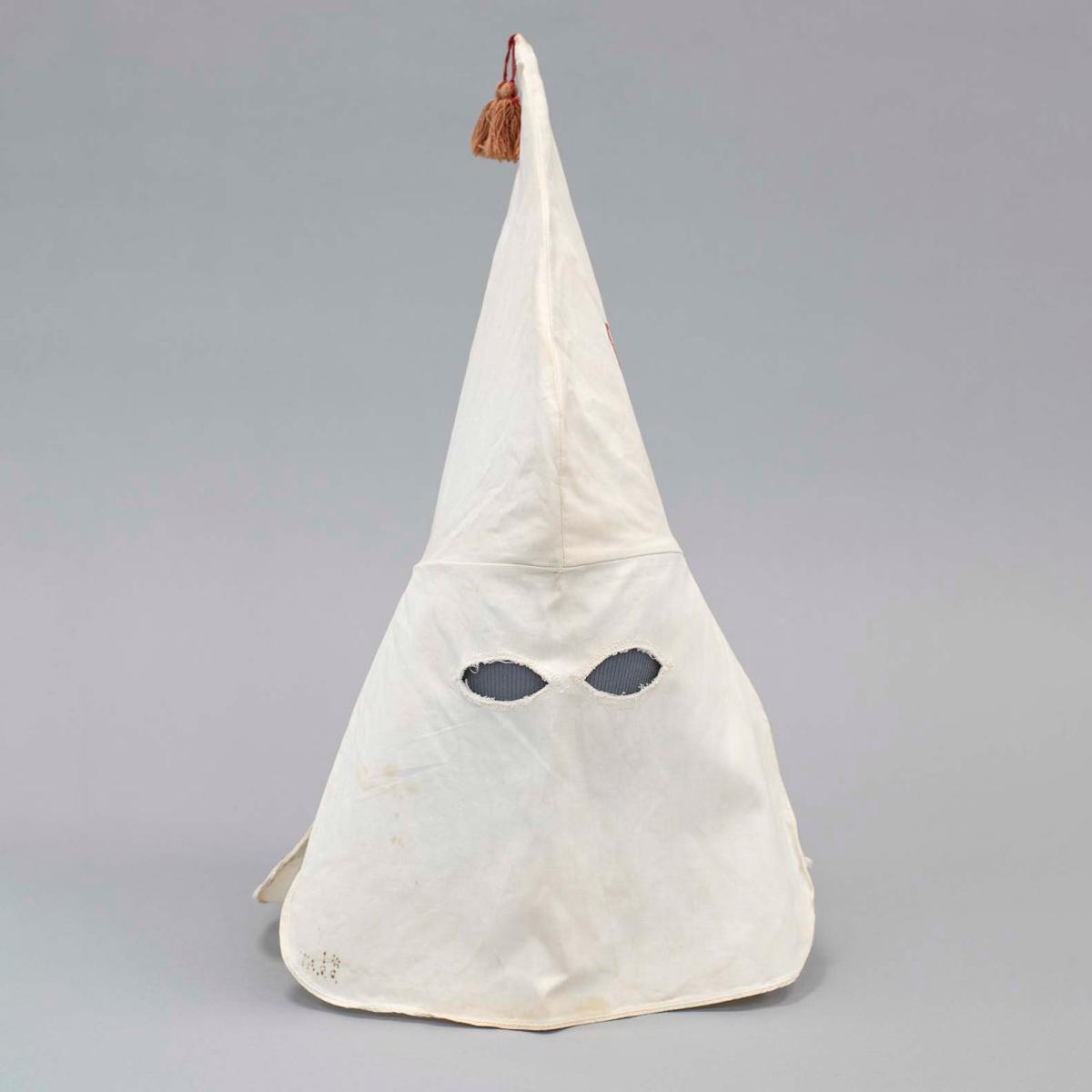
This hood is from Greene County where Klan activity was prevalent between 1920-1940s.
New York State Museum H-1983.136.18
Additional Resources
The Underground Railroad
Discover Underground Railroad sites across New York
We the People: The American Dream
Immigrants often face great danger in choosing to come to the United States. Despite this reality, the pull of a potentially better life—including economic opportunity, safety, and democracy itself—is enough for many to make this choice.
Immigrants have often led the charge for equal rights in the United States, while simultaneously facing discrimination and anti-immigrant laws. Many immigrants escaped poor conditions, poverty and tyranny in their home countries, only to experience difficult conditions in America as well. Some have labored in factories and given voice to the need for labor reform, while at the same time being dismissed as “part of the problem.” Led by the promise of the American Dream, immigrants have fought for equality in all aspects of American life.
Highlights
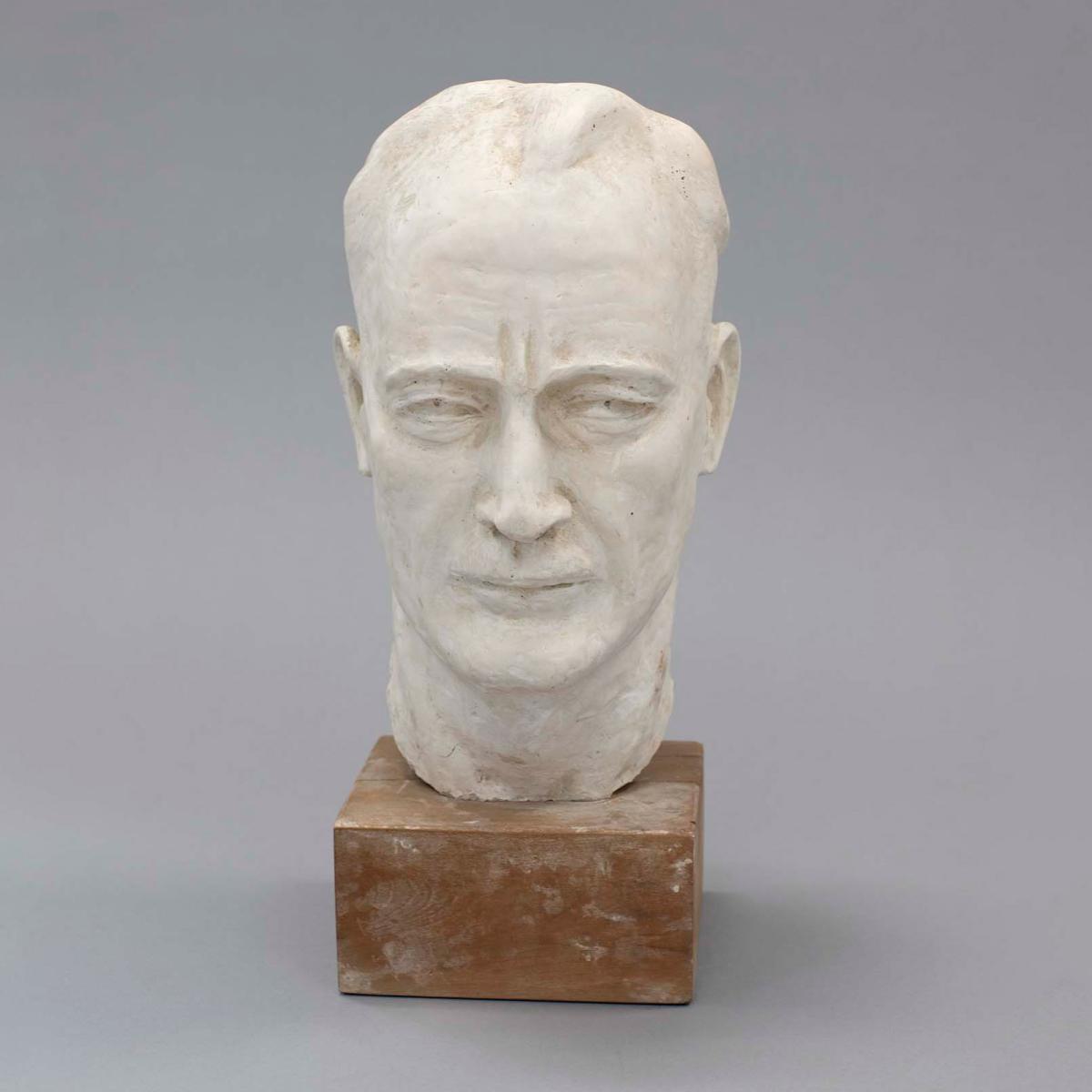
Henry DiSpirito
Plaster
DiSpirito was commissioned to create a large-scale work of the Utica College symbol, the Pioneer; himself an Italian immigrant who arrived in Utica in 1921 and built a life as a stonemason and sculptor, he chose to imagine the figure not as a man in buckskins in the American West, but as an immigrant, creating this study of a man from his own diverse East Utica neighborhood.
New York State Museum H-2016.30.1A-B
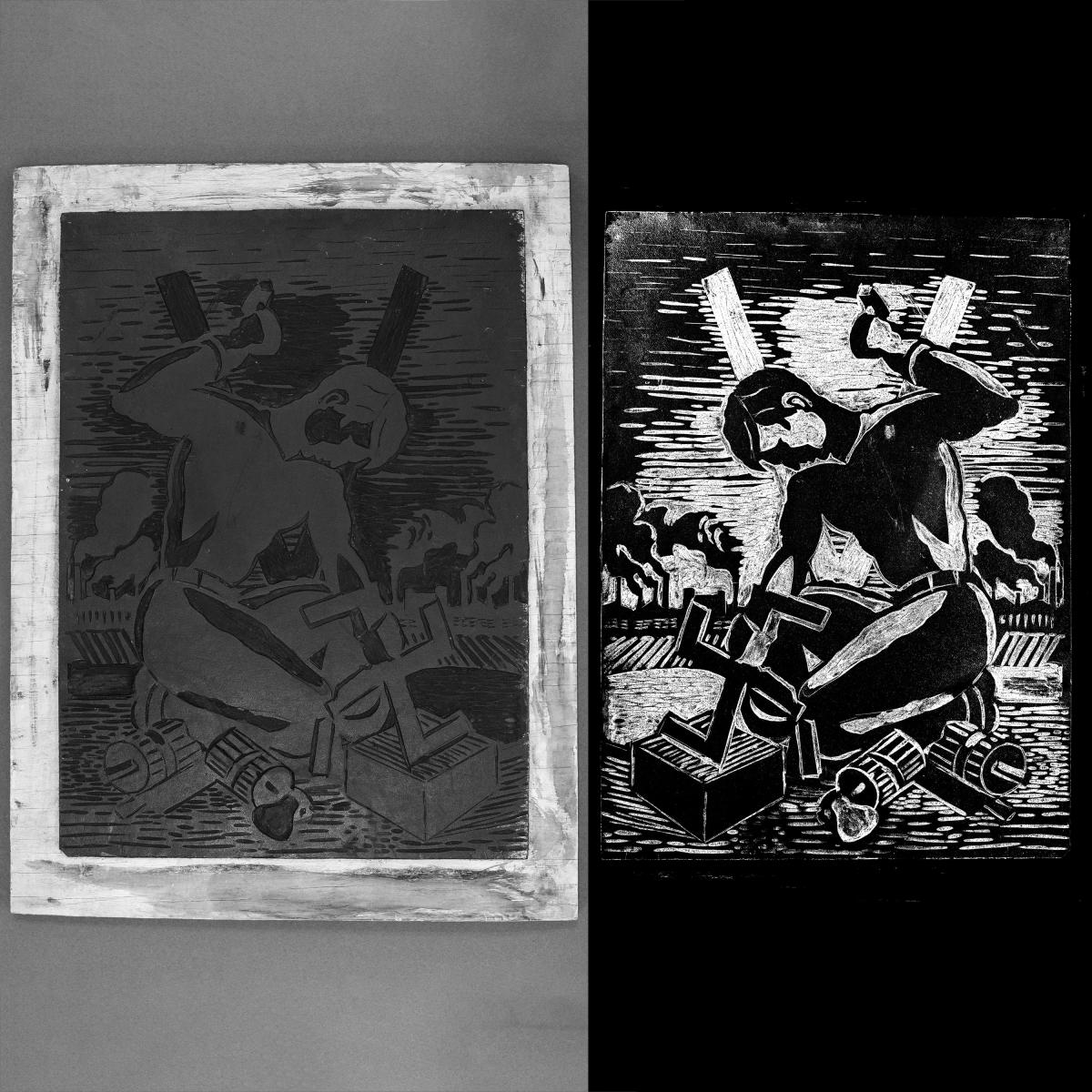
Henry DiSpirito
Digital rendering courtesy of the John D. Calandra Italian American Institute, Queens College, The City University of New York.
Before emigrating to America, Henry DiSpirito witnessed the horrors of World War I and the rise of fascism in Italy. He created this linocut at the close of World War II, expressing a desire for peace and freedom from oppression.
New York State Museum H-2022.4.1
We the People: LGBTQ+ Rights
LGBTQ+ rights have been fought for in the streets, courtrooms, and legislatures, as well as in more private settings, person to person. These rights include protection from discrimination on the basis of sexual orientation or gender expression, recognition of marriage and the rights that come with it, and access to gender-affirming care.
Each June, Pride serves as a commemoration of the anniversary of the Stonewall uprising. What began in New York City is now recognized all over the state and the world. It is both a protest and a celebration.
Highlights

In 2007, Erin Davies discovered that her Volkswagen Beetle, parked just down the street from the New York State Museum and sporting a small rainbow sticker, had been spray painted with the words “fag” and “urgay.” Rather than immediately removing the graffiti, Davies took the car on a 58-day trip through the United States and Canada, documenting other hate crimes, as well as her experience driving the vehicle and interacting with people. A year later, the car was given a rainbow wrap. Davies and the Fagbug ultimately toured all 50 states, produced two documentaries, and made numerous stops at colleges, universities, and community Pride events.
Gift of Erin Davies, New York State Museum H-2018.17.1
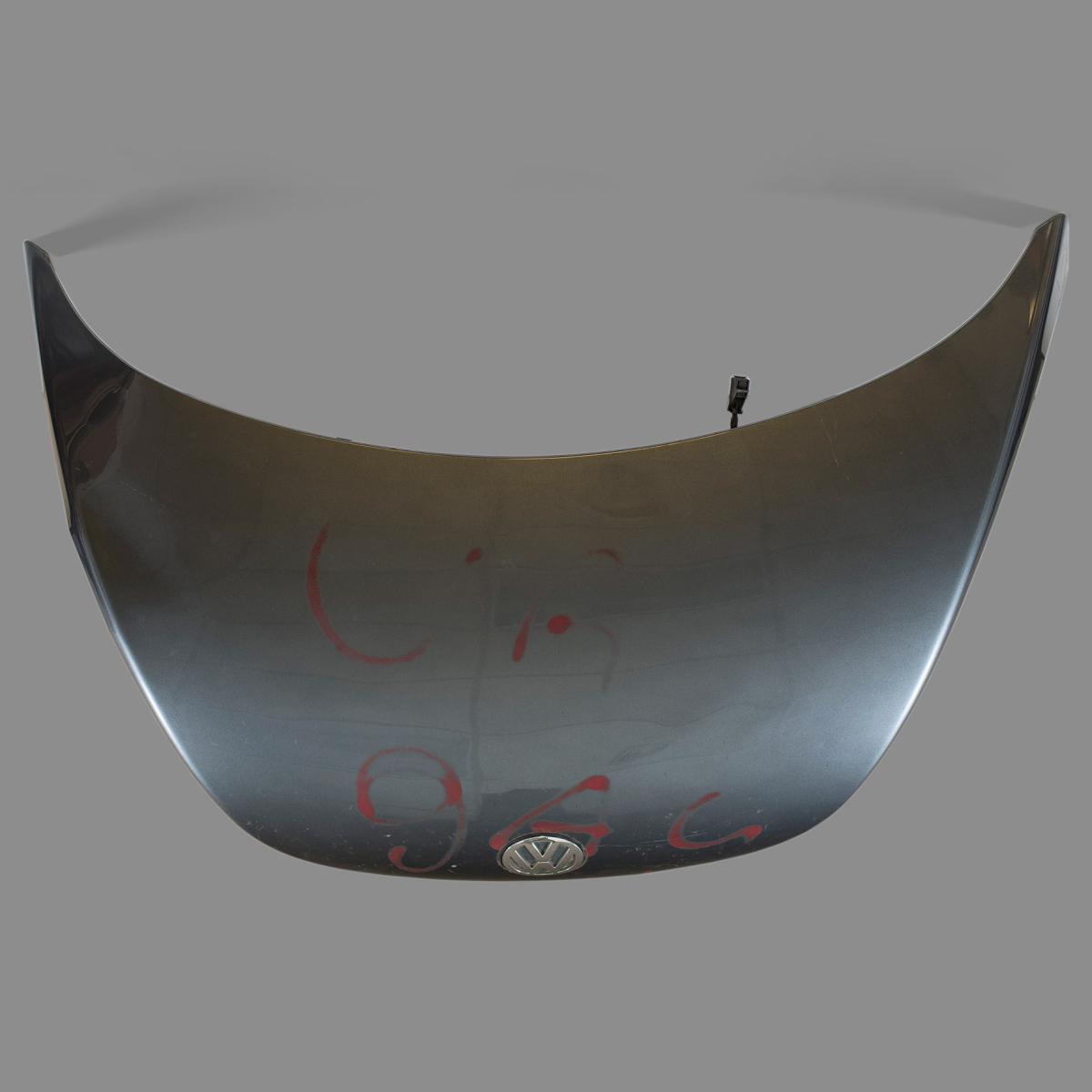
Gift of Erin Davies, New York State Museum H-2018.17.2
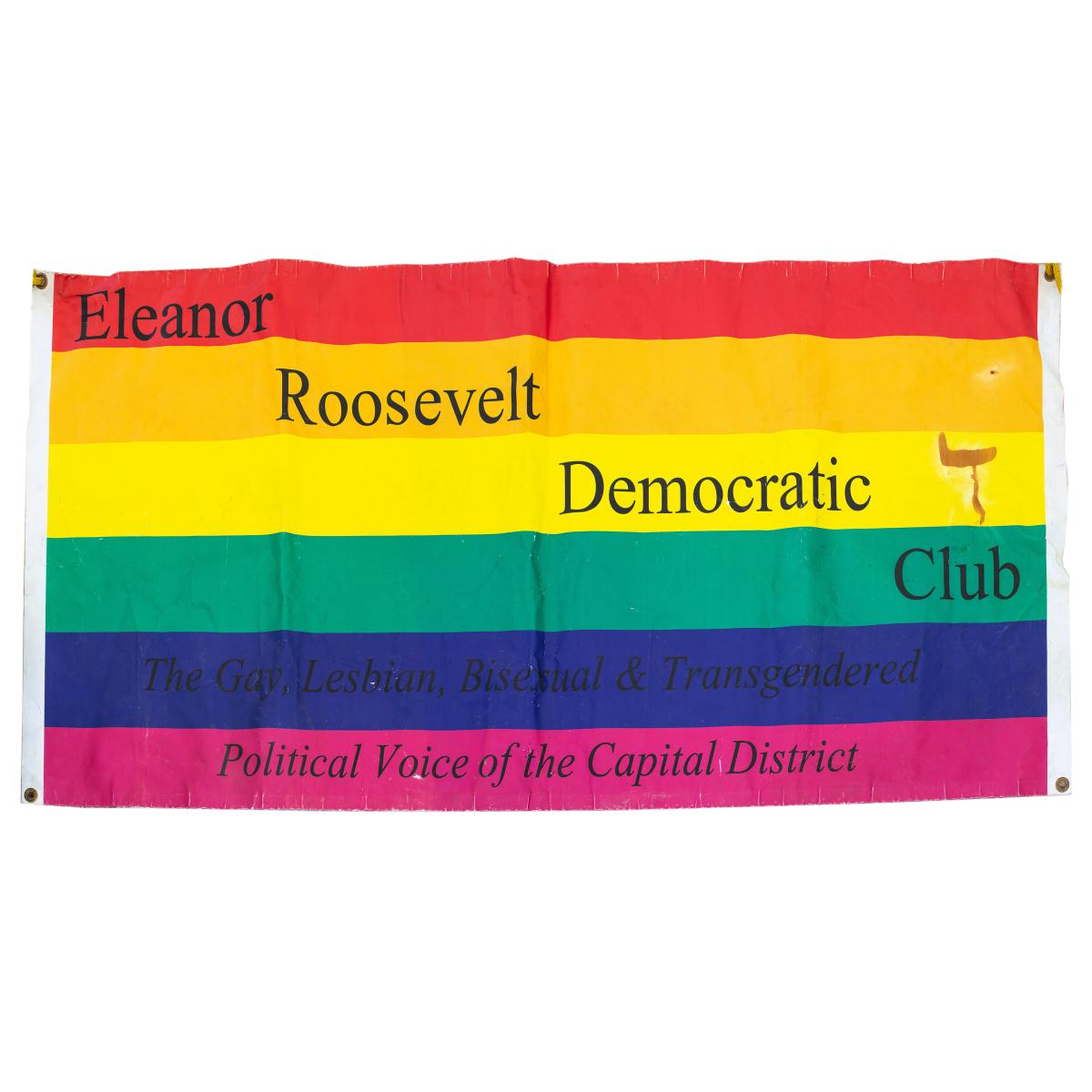
Organizations like the Eleanor Roosevelt Democratic Club in Albany, NY, worked to build representation in government that would support LGBTQ+ rights.
New York State Museum Collection
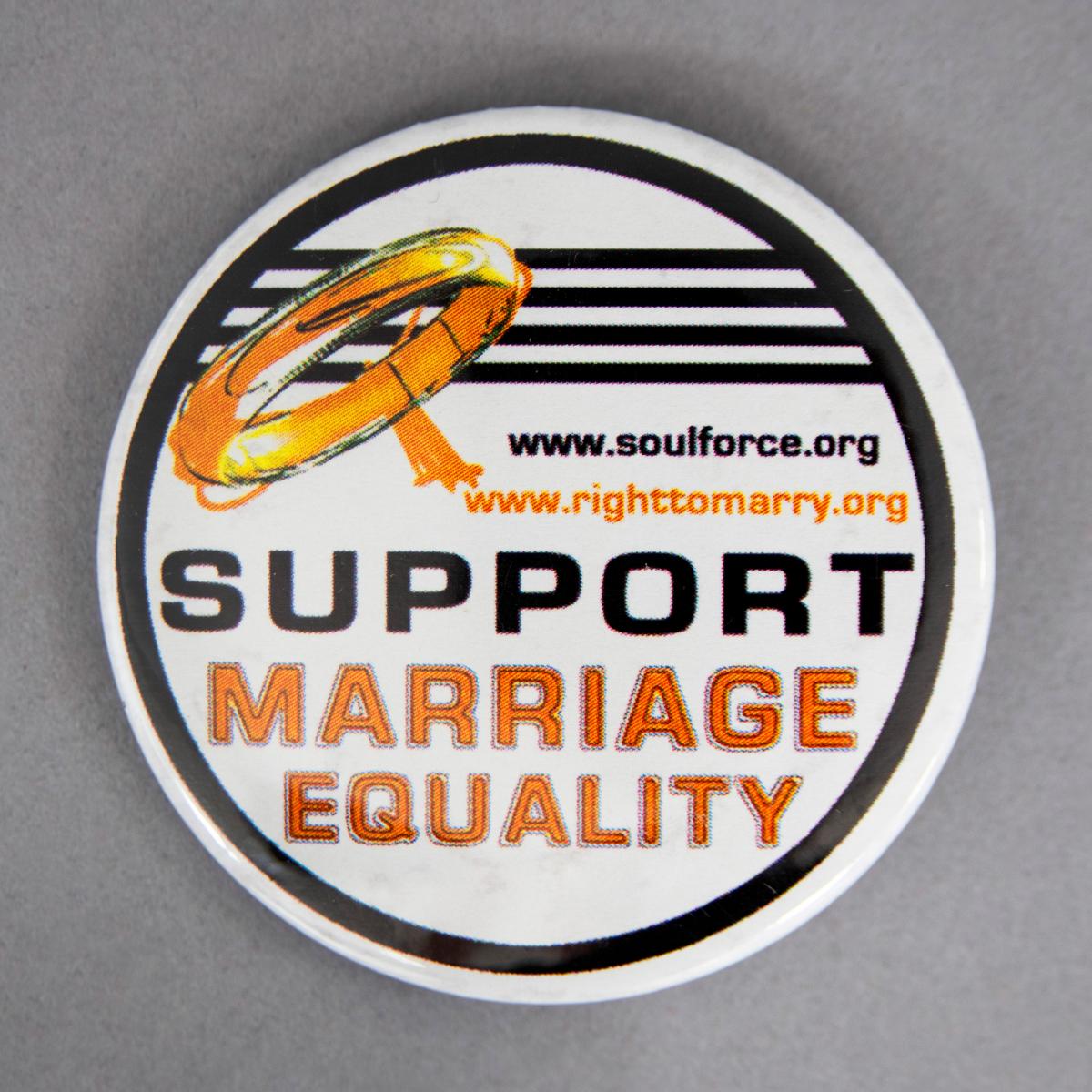
Passage of marriage equality in New York was considered key to the success of the measure on the federal level. Many national organizations supported efforts in New York.
New York State Museum H-2018.25.2
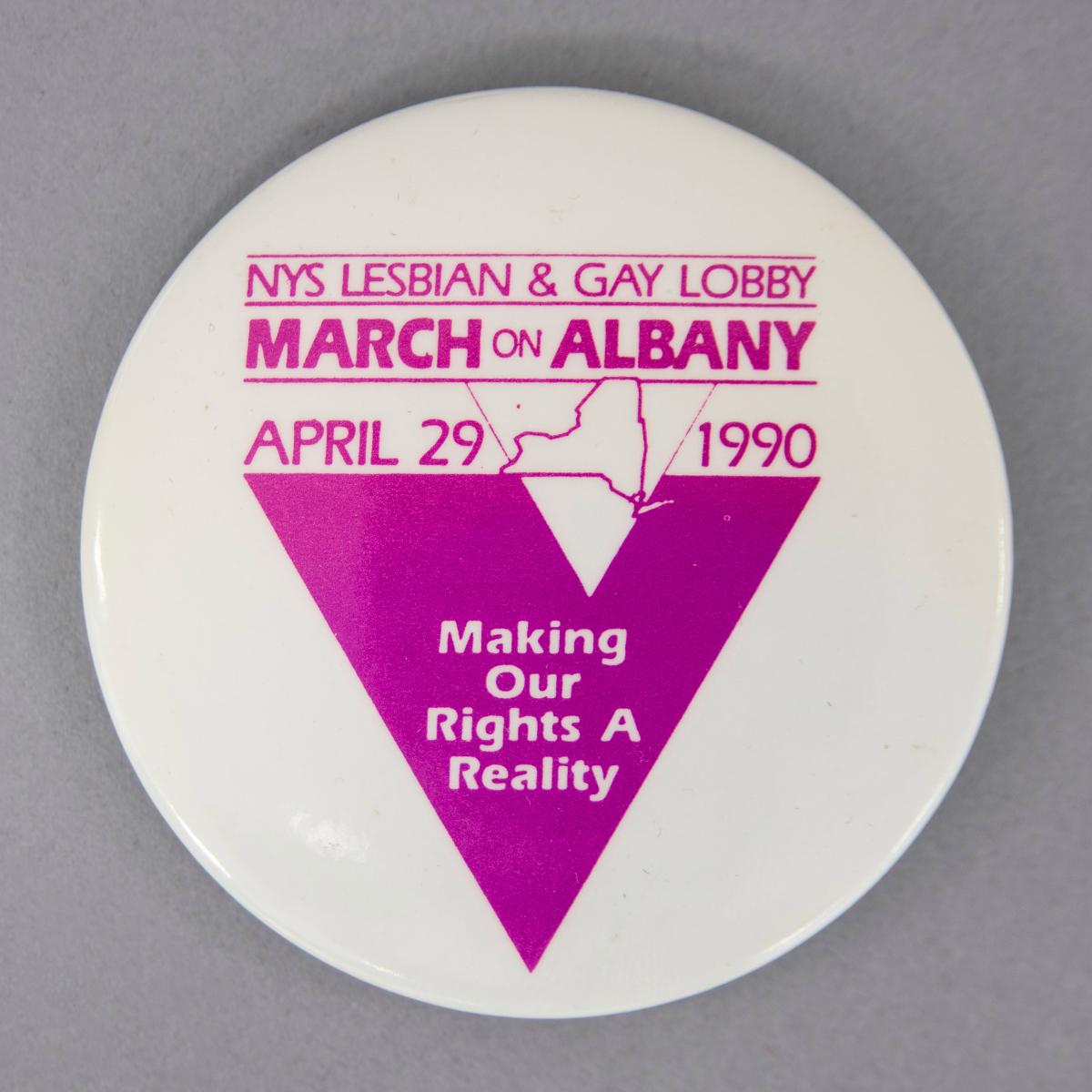
March on Albany, April 29, 1990
The New York State Lesbian and Gay Lobby was a lead advocacy organization working for passage of LGBTQ+ supportive legislation in New York State.
New York State Museum H-2024.4.18
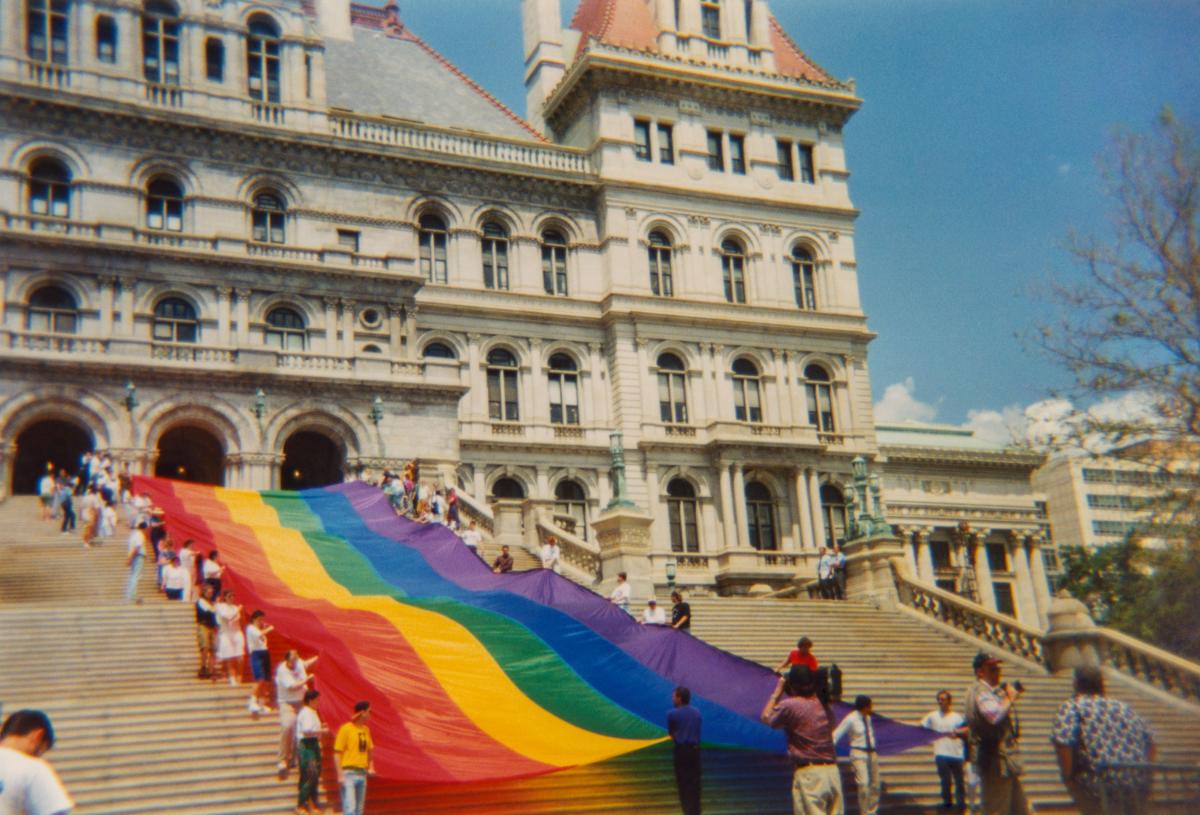
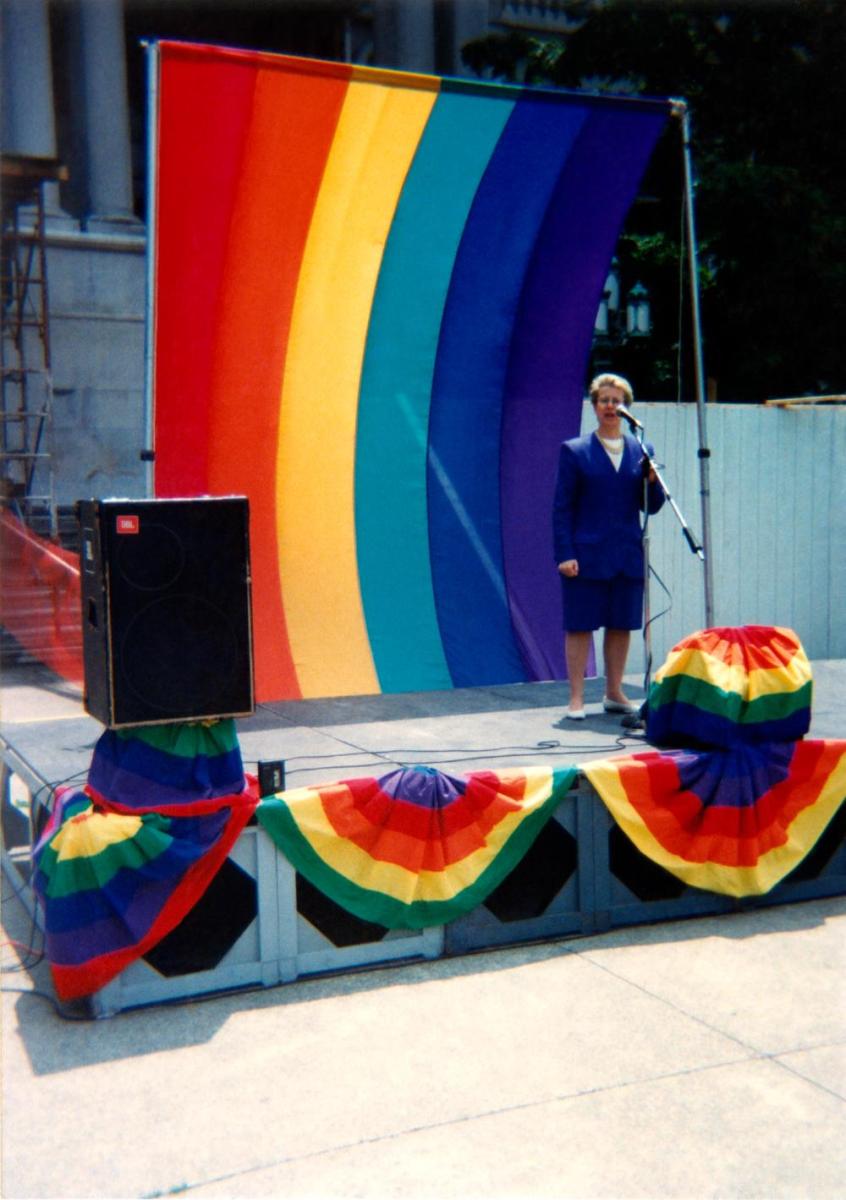
In 1994, the 25th anniversary of Stonewall, a portion of Gilbert Baker's mile-long rainbow flag was unfurled in front of the New York State Capital.
New York State Museum H-2024.45.76
Additional Resources
Oral Histories from the Pride Center of the Capital Region
To commemorate the Pride Center’s 50th anniversary in 2020, the New York State Museum partnered with the Center to collect oral histories from members of the community, ultimately resulting in the creation of a panel exhibition and recorded interviews.
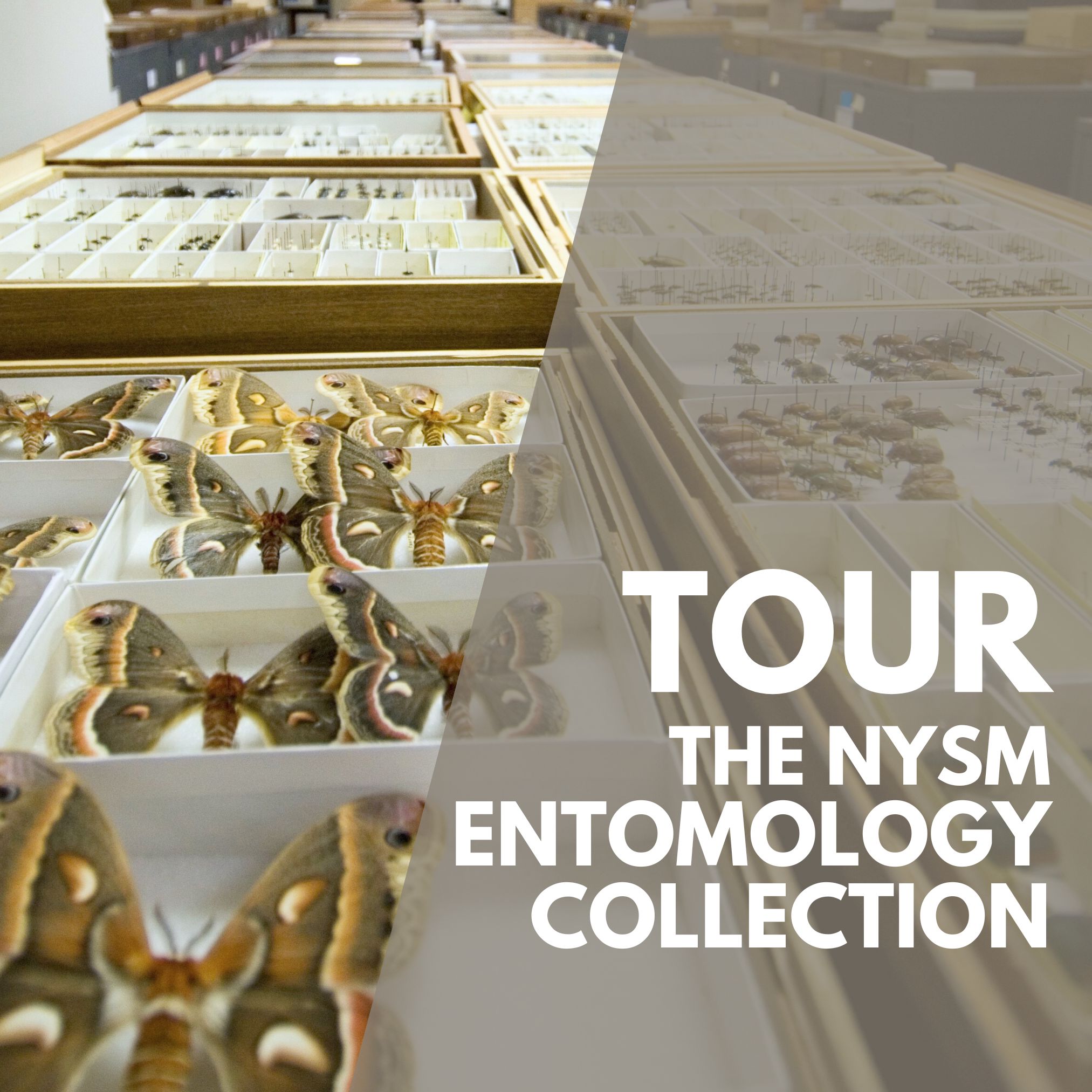
Have you ever seen a nearly two-foot-long walking stick? Or a beetle as large as the palm of your hand? Did you know that an adult insect's life span can be as short as twenty minutes or as long as 50 years? Join New York State Entomologist, Dr. Timothy McCabe, as he reveals more incredible insects and fun facts on a tour of the New York State Museum’s Entomology collection.
Visitors who have received registration confirmation should meet in the Museum Lobby prior to the start of the tour.
New York Pride: Resources
Explore the visual highlights and core content from the New York Pride: The Fight for Marriage Equality exhibition. To help preserve the textiles, this exhibition is currently dark. It will reopen with full lighting in June for Pride Month. Please check back for announcements about upcoming related programming.
Title Panel
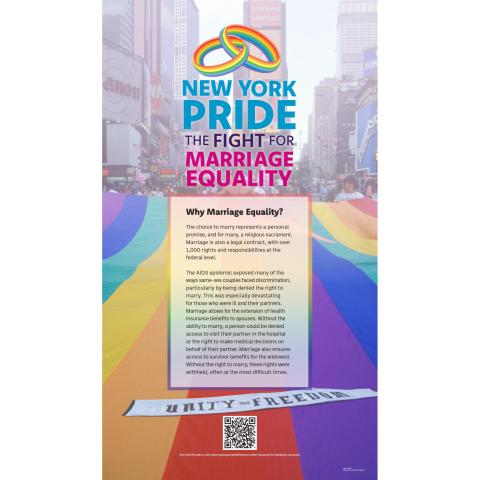
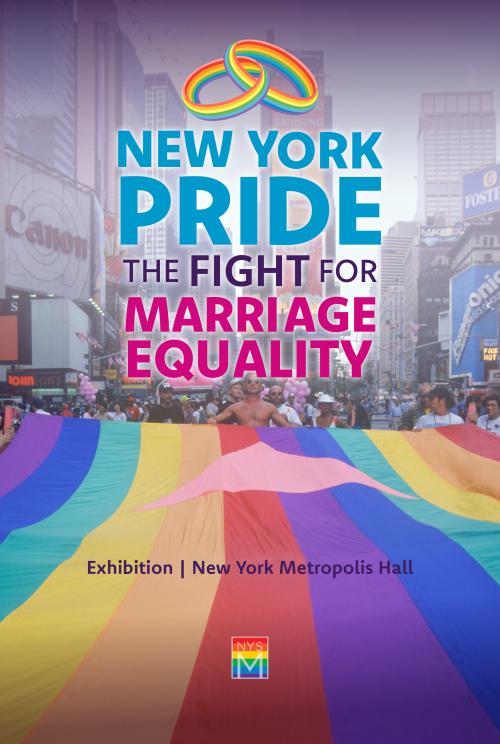
The exhibit begins with a large introductory panel that features the title, New York Pride: The Fight for Marriage Equality. Above the title is a graphic illustration of two intertwined wedding rings filled with colors from the Pride flag—red, orange, yellow, green, blue, and purple. The design of this panel sets the tone for the rest of the exhibit, incorporating a vibrant rainbow ribbon that flows from panel to panel.
Exhibit Case
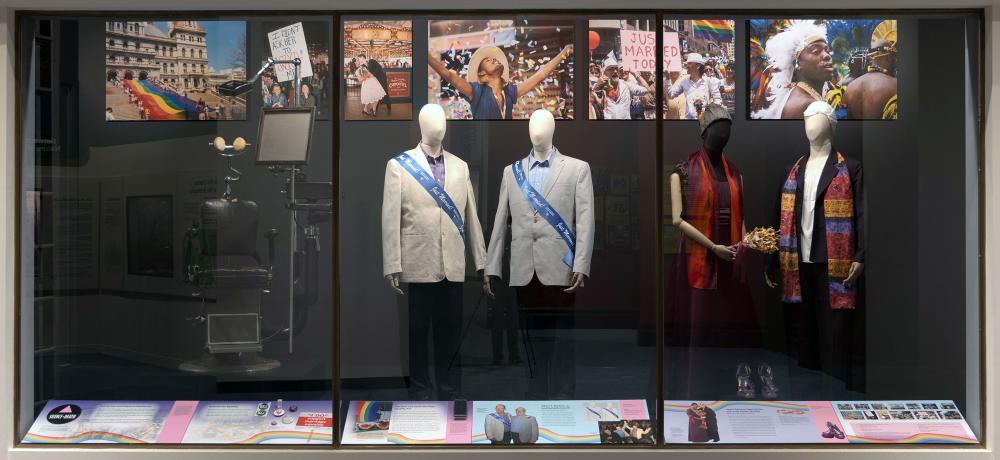
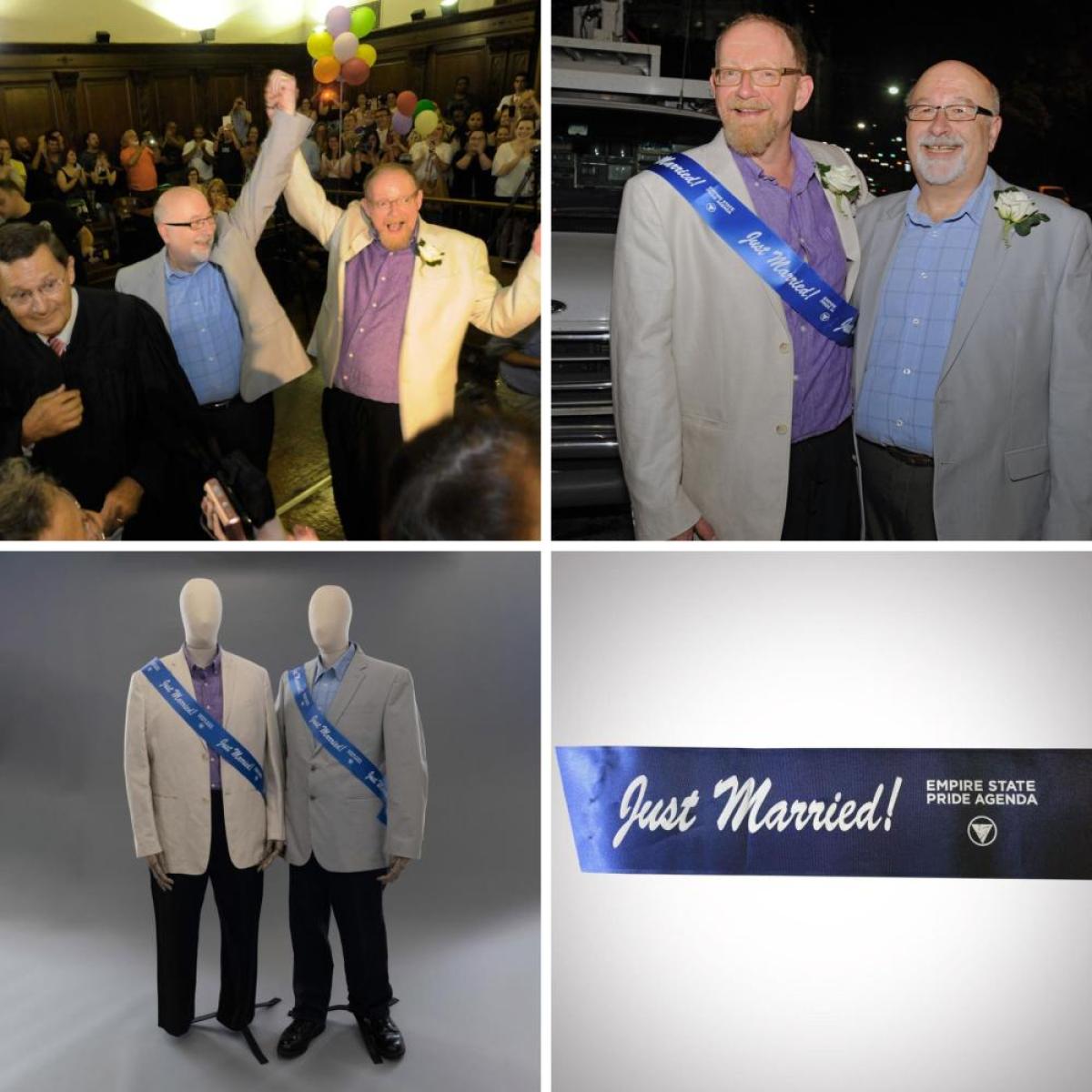
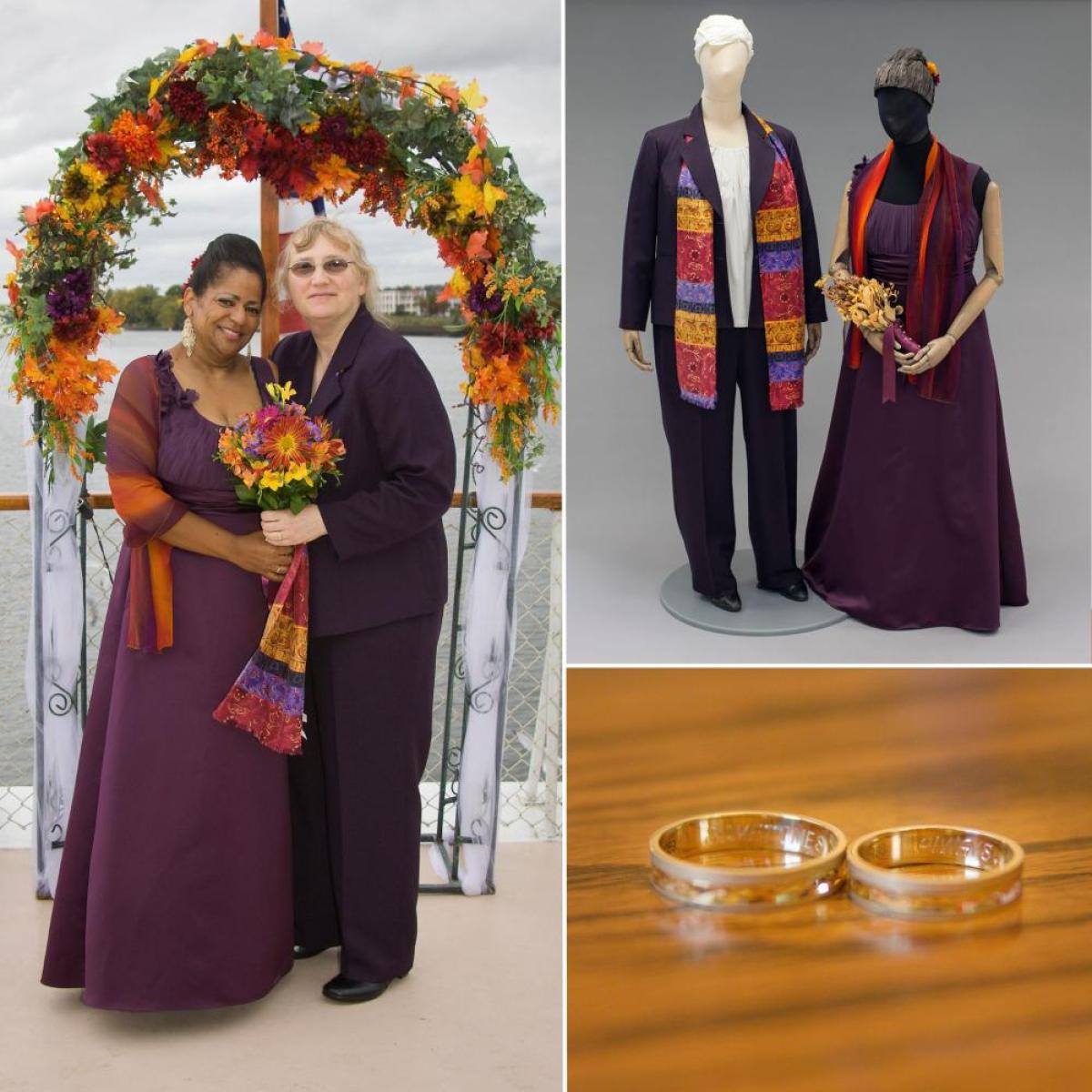
To the right of the introductory panel, is a large exhibition case that’s inset into the wall and has three continuous windows. In the first window an ophthalmic chair from the Whitney Young Health center is displayed. The middle window showcases the wedding ensembles of couple Albert T. Martino, Jr. and Harold Lohner III. A tan jacket with purple dress shirt and a gray jacket with a light blue dress shirt—both outfits have black slacks. In the third window wedding ensembles of couple Joyce Darlene (Jaye) Holly and Judy Elaine Yeckley are displayed. A sleeveless, long dark purple dress and a dark purple suit with a white blouse underneath. Both of these ensembles are accessorized with colorful scarves in shades of red, purple, and gold.
Photo Backdrop
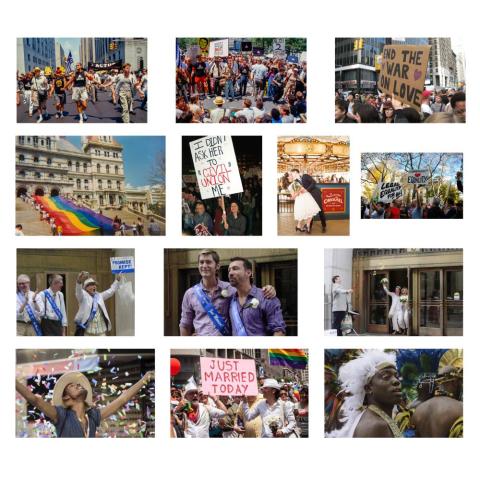
As a backdrop to the displayed artifacts, are 13 large photo blow-ups that are hung above the artifacts that are exhibited. These images highlight LGBTQ+ activism in New York—from ACT UP’s AIDS healthcare protests in the 1980s, to marriage equality rallies in the 2000s, and celebrations of its legalization in 2011, including early same-sex marriages and pride parades that followed. Among the images featured are photos by Margaret McCarthy (the last 6 thumbnails shown). These are recent acquisitions to our growing LGBTQ+ History collection and are a gift of the Margaret McCarthy Trust. NYSM H-2025.11.
Interpretive Text
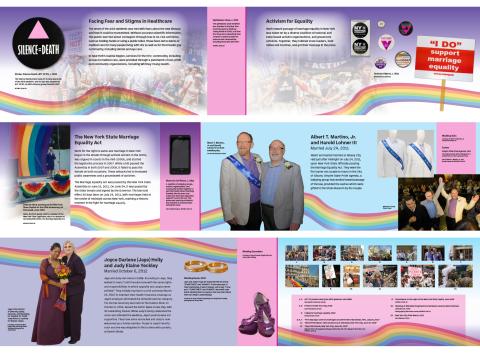
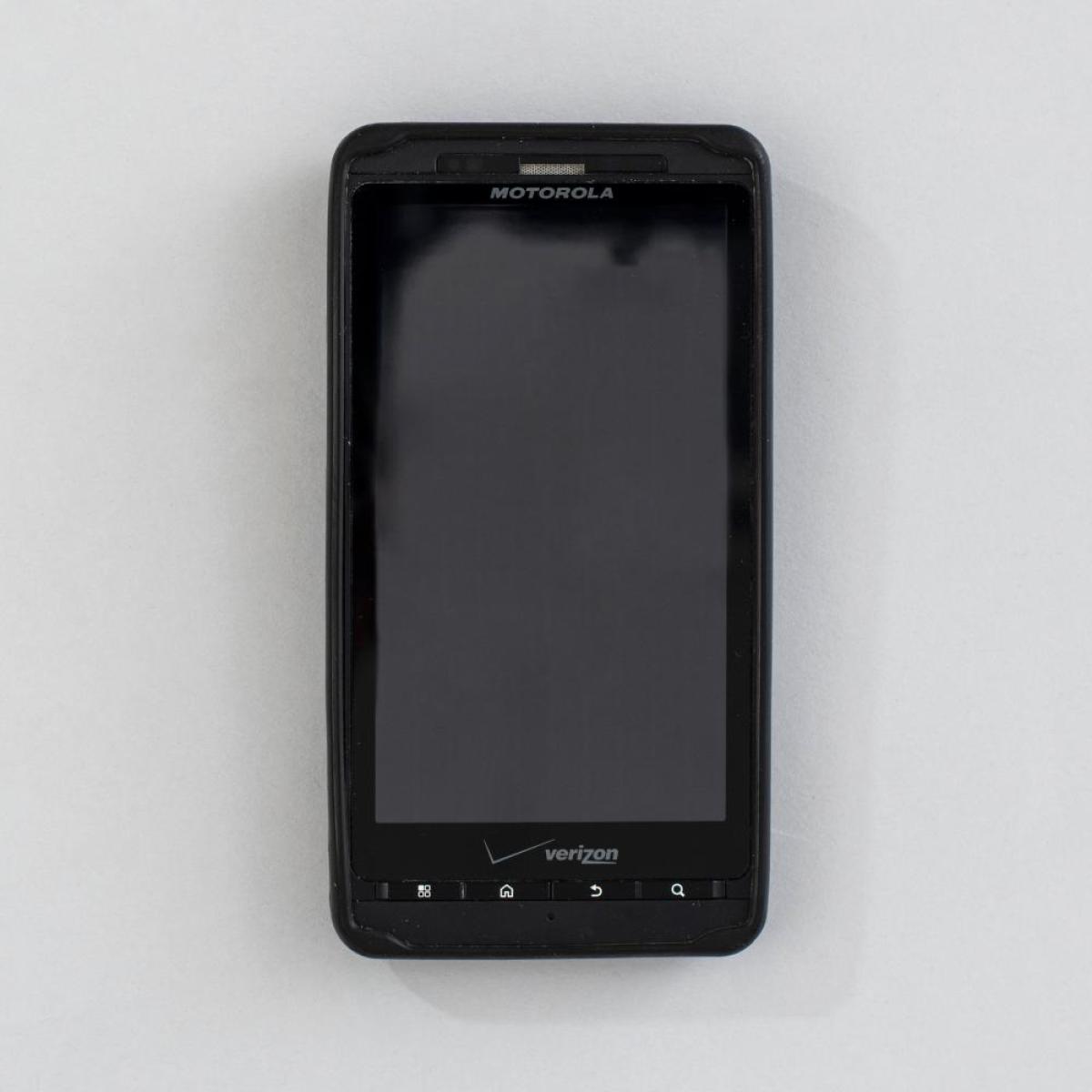
Inside the exhibit case, slanted interpretive text panels run along the bottom edge of the windows, approximately one and a half feet above the floor. These panels provide descriptions of the artifacts displayed, and context on early healthcare disparities, activism and advocacy, and finally the 2011 passage of the Marriage Equality Act in New York. A few small artifacts related to activism such as pins are mounted right on the text panel and a cellphone used by lobbyists are directly attached to the panels.
Conclusion Panel
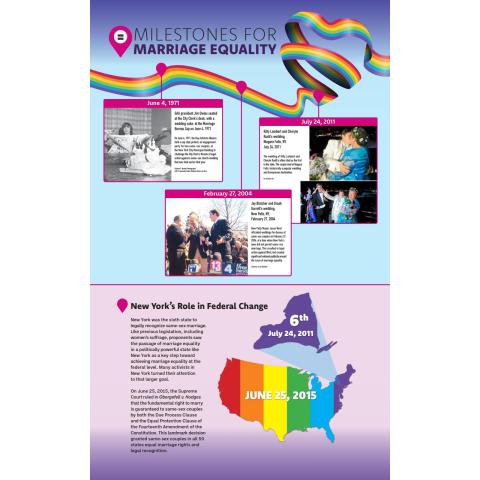
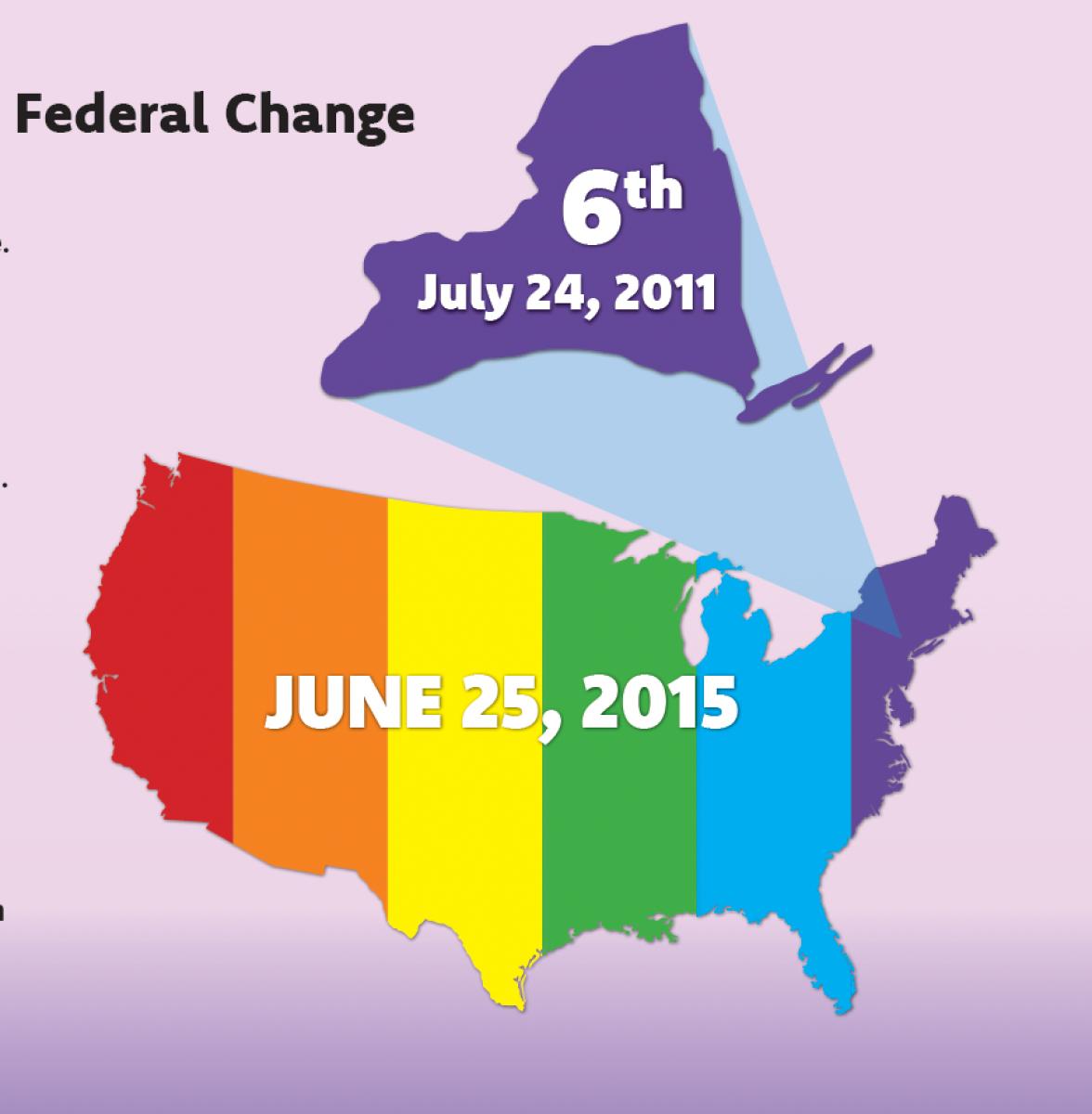
To the far right of the display, a final panel concludes the exhibit. It highlights a few key milestones in Marriage Equality and closes the exhibit with New York’s role in achieving federal marriage equality for LGBTQ+ people across the United States. A graphic highlights New York State by extracting it from a larger map of the United States, showing it as the sixth state to legalize same-sex marriage. It notes the date marriage equality took effect in New York—July 24, 2011—as well as the nationwide legalization on June 25, 2015.
Why Marriage Equality?
The choice to marry represents a personal promise, and for many, a religious sacrament. Marriage is also a legal contract, with over 1,000 rights and responsibilities at the federal level.
The AIDS epidemic exposed many of the ways same-sex couples faced discrimination, particularly by being denied the right to marry. This was especially devastating for those who were ill and their partners. Marriage allows for the extension of health insurance benefits to spouses. Without the ability to marry, a person could be denied access to visit their partner in the hospital or the right to make medical decisions on behalf of their partner. Marriage also ensures access to survivor benefits for the widowed. Without the right to marry, these rights were withheld, often at the most difficult times.
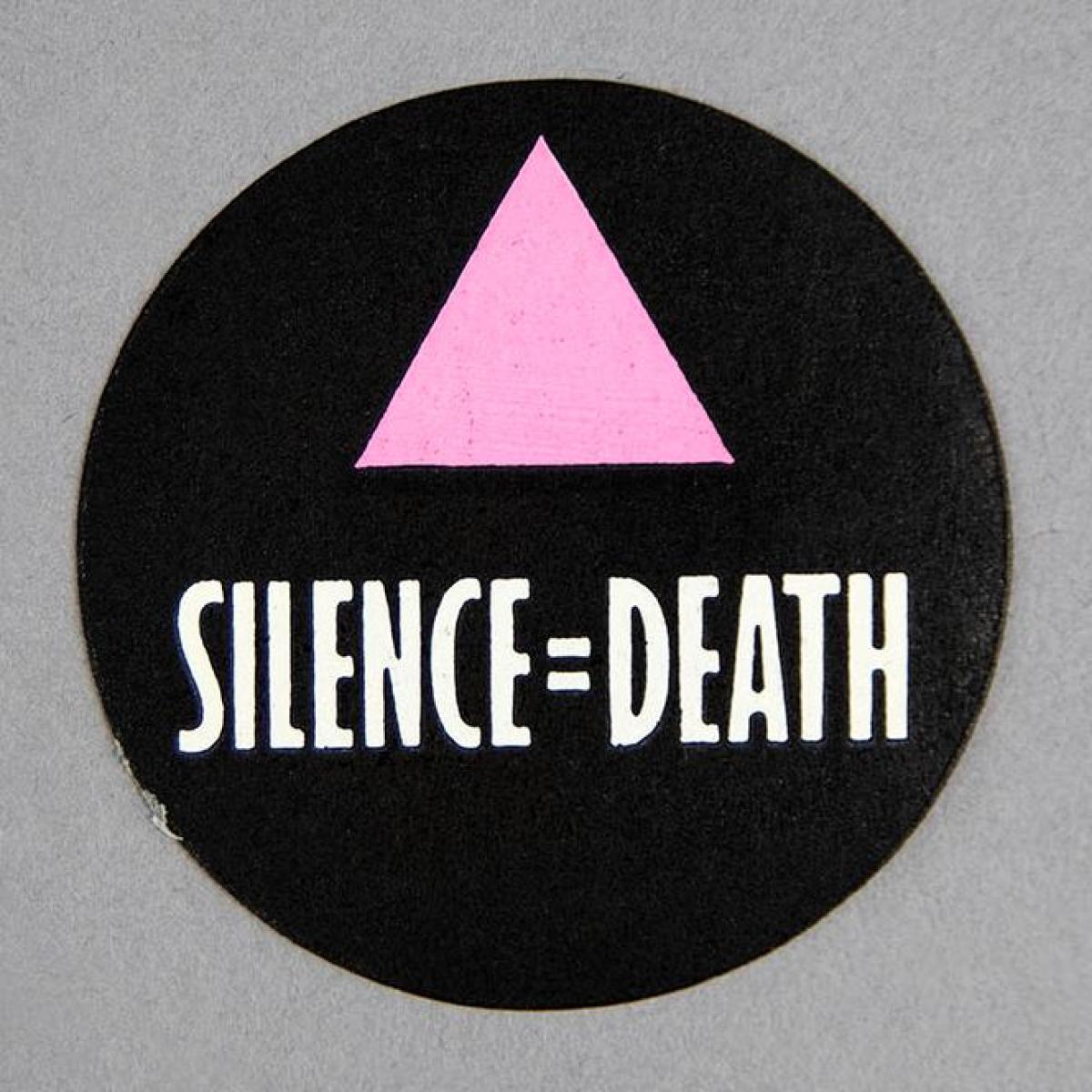
Sticker, Silence = Death, Act Up NY, c. 1990, NYSM H-2018.31.2
The Silence=Death project used art to raise awareness of the AIDS epidemic, and its logo was adopted by Act Up NY, an AIDS advocacy group formed in 1987.
Facing Fear and Stigma in Healthcare
The onset of the AIDS epidemic was met with fears about the new disease, and how it could be transmitted. Without accurate scientific information, the public worried about contagion through low to no-risk activities, such as holding hands or using a public toilet. These fears led to denial of medical care for many people living with HIV as well as for the broader gay community, including dental and eye care.
In New York’s Capital Region, services for the HIV+ community, including access to medical care, were provided through a patchwork of non-profit and community organizations, including Whitney Young Health.
Ophthalmic chair, c. 1970, NYSM H-1989.18
This ophthalmic chair was donated to the New York State Museum by Whitney Young Health in 1989, at a time that they were expanding their services to better provide for underserved communities, including those who were HIV+.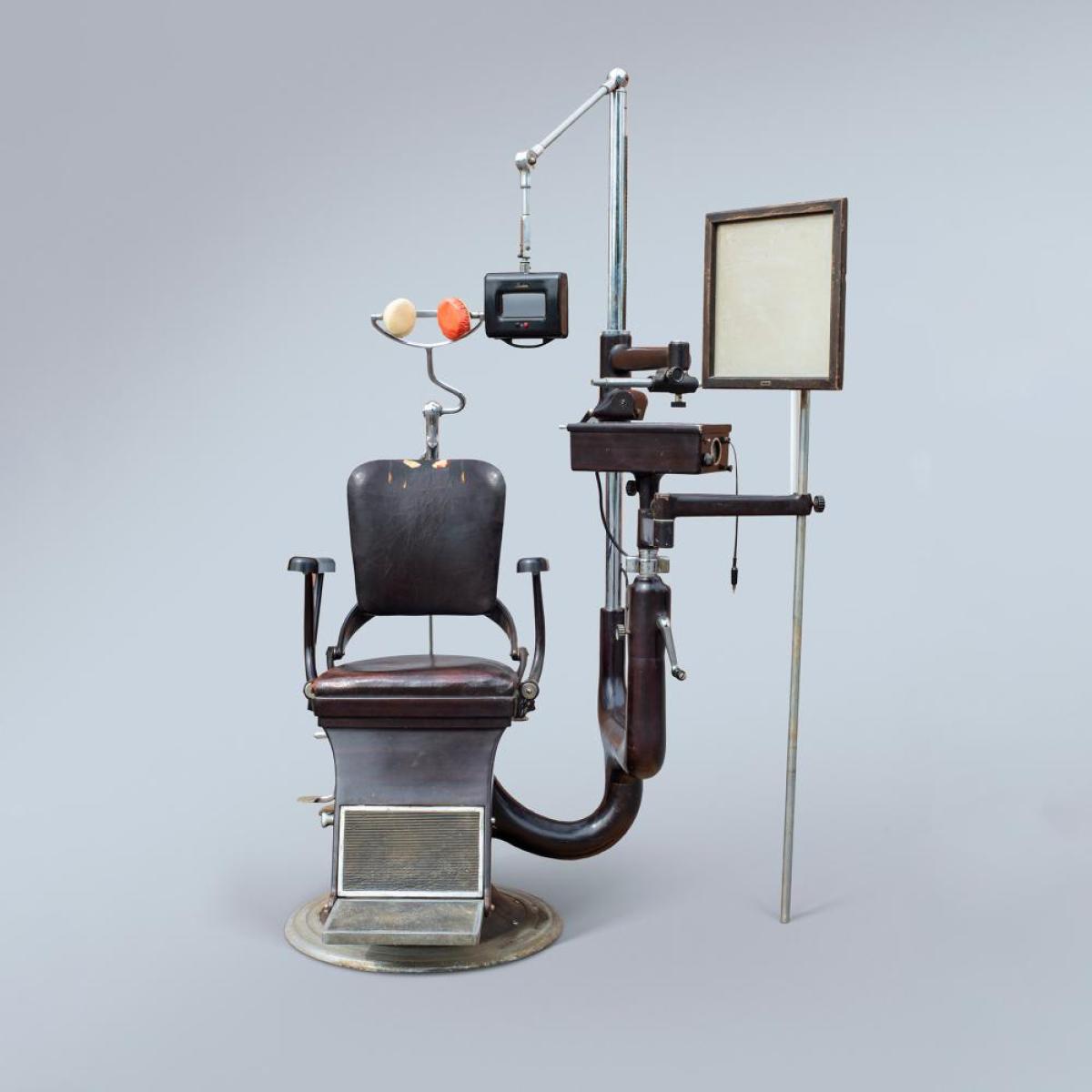
Activism for Equality
Work toward passage of marriage equality in New York was taken on by a diverse coalition of both national and state based activist organizations, and grassroots activists. Together, they lobbied state leaders, held rallies and marches, and got their message in the press.
Activism Artifacts from the NYSM History Collection
Buttons, stickers, a ring, and a sign supporting Marriage Equality.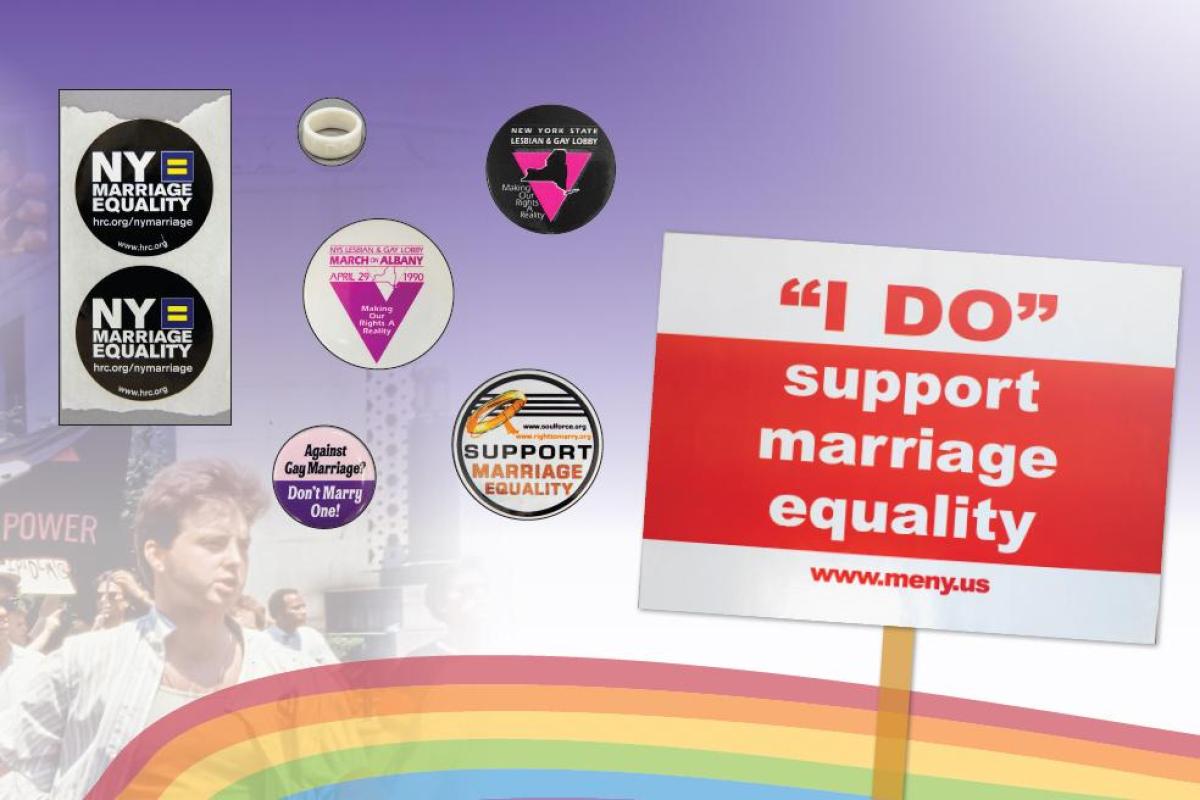
The New York State Marriage Equality Act
Work for the right to same-sex marriage in New York began in the streets through activist actions in the 1970s, was argued in courts in the mid-2000s, and started the legislative process in 2007. While a bill passed the Assembly in both 2007 and 2009, it failed to pass the Senate on both occasions. These setbacks led to increased public awareness and a groundswell of activism.
The Marriage Equality Act was passed by the New York State Assembly on June 15, 2011. On June 24, it was passed by the State Senate and signed by the Governor. The law took effect 30 days later, on July 24, 2011, with marriages held at the stroke of midnight across New York, marking a historic moment in the fight for marriage equality.
Motorola cell phone, c. 2011, gift of Robb Penders, NYSM H-2012.3
Deborah Glick speaking at the New York State Capitol for the 25th Anniversary of Stonewall, June 1994. NYSM H-2024.45
Glick, the first openly LGBTQ+ member of the New York State Legislature, was a co-sponsor of Assembly Bill A8354, the Marriage Equality Act.
Albert T. Martino, Jr. and Harold Lohner III, married July 24, 2011
Albert and Harold married at Albany City Hall just after midnight on July 24, 2011, upon New York State officially passing the Marriage Equality Act. They were the first same-sex couple to marry in the City of Albany. Empire State Pride Agenda, a lobbying group that worked toward passage of the law, provided the sashes which were gifted to the State Museum by the couple.
Photographs from the 2011 Martino-Lohner Wedding (Courtesy of Michael P. Farrell, Lori Van Buren, Times Union) and items donated to the NYSM History Collection, including their suits and a "Just Married" sash.
Joyce Darlene (Jaye) Holly and Judy Elaine Yeckley, married October 6, 2012
Jaye and Judy met online in 1998. According to Jaye, they waited to marry “until it would come with the same rights and responsibilities to which opposite sex couples were entitled.” They initially married in a civil ceremony March 24, 2012 to maintain their health insurance coverage as Jaye’s employer eliminated the domestic partner category. The formal ceremony was held on the Hudson River on October 6, 2012, aboard the Dutch Apple cruise ship, with 40 celebrating friends. While Judy’s family celebrated the union and attended the wedding, Jaye’s parents were not supportive. They have since reconciled and Judy is now welcomed as a family member. Purple is Jaye’s favorite color and she was delighted to find a dress with pockets, at David’s Bridal.
Jaye and Judy’s rings are engraved with the words “SOMETIMES” and “ALWAYS.” In the early days of their relationship, it wasn’t always safe to say, “I love you.” “SOMETIMES” and “ALWAYS” were their code words allowing them to express their love that others were not ready to acknowledge.
(Left) Wedding portrait, photograph by Jenny Yates; (Top Right) Wedding Ensembles donated to the NYSM History Collection; (Bottom right) Wedding bands, photograph by Jenny Yates.
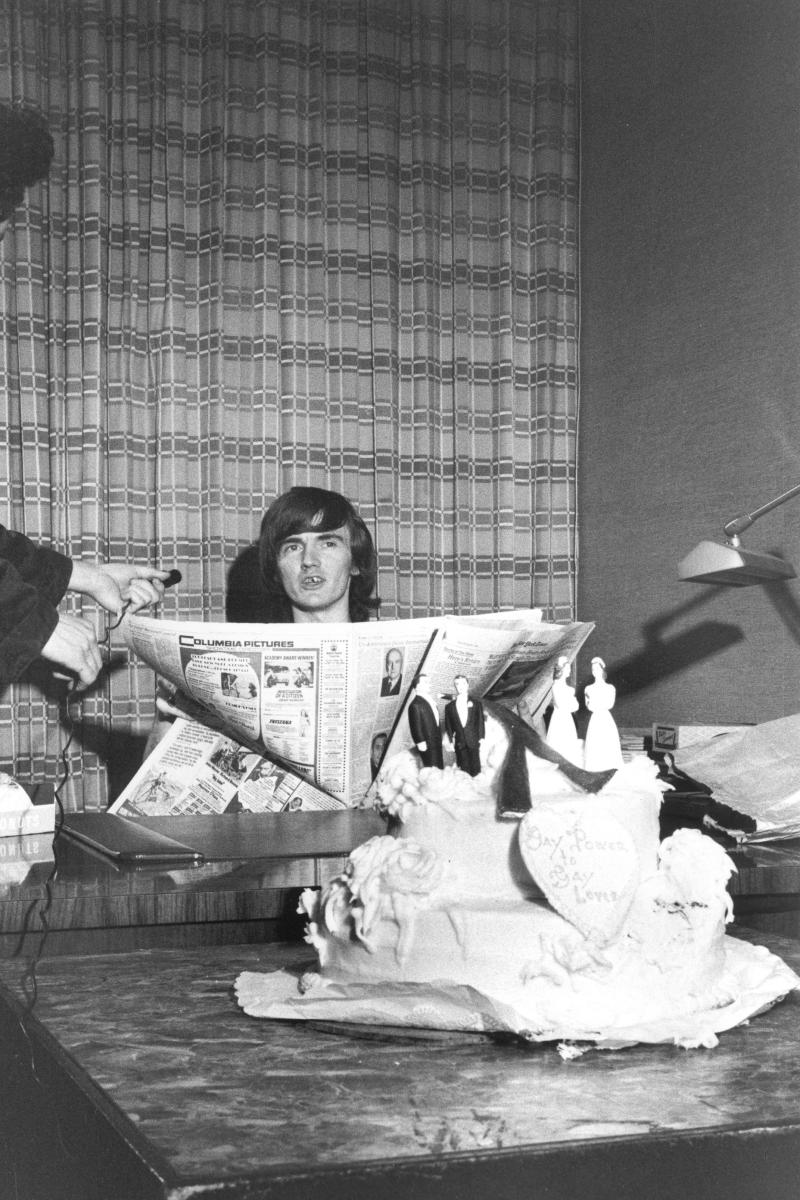
Milestones for Marriage Equality
GAA president Jim Owles seated at the City Clerk’s desk, with a wedding cake, at the Marriage Bureau Zap on June 4, 1971
On June 4, 1971, the Gay Activists Alliance held a zap style protest, an engagement party for two same-sex couples, at the New York City Municipal Building to challenge the City Clerk’s threats of legal action against a same-sex church wedding that was held earlier that year.
Credit: Richard C. Wandel Photographs/LGBT Community Center National History Archive
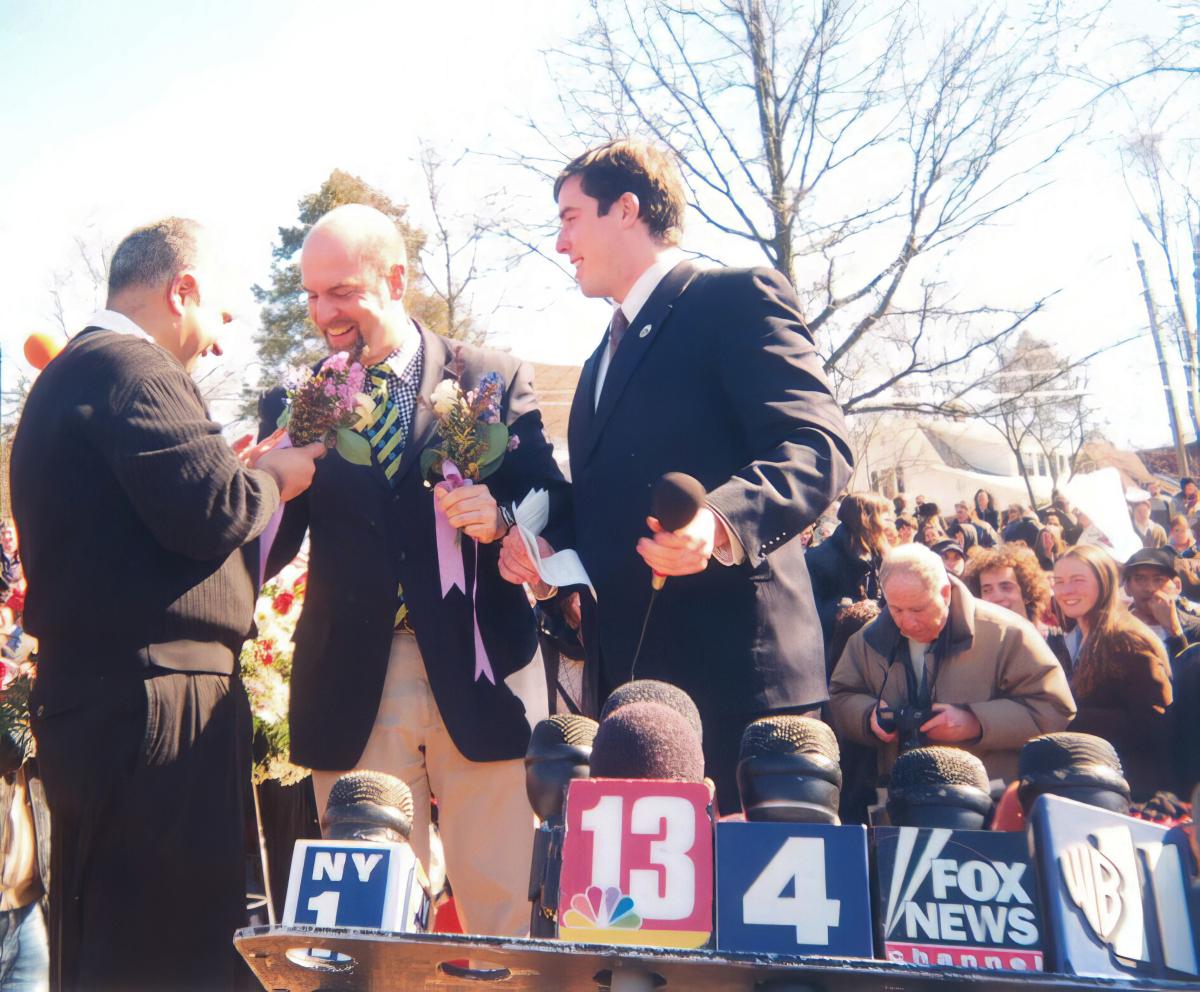
Jay Blotcher and Brook Garrett’s wedding, New Paltz, NY, February 27, 2004
New Paltz Mayor Jason West officiated weddings for dozens of same-sex couples on February 27, 2004, at a time when New York’s laws did not permit same-sex marriage. This resulted in legal action against West, but created significant national publicity around the issue of marriage equality.
Credit: Courtesy of Jay Blotcher
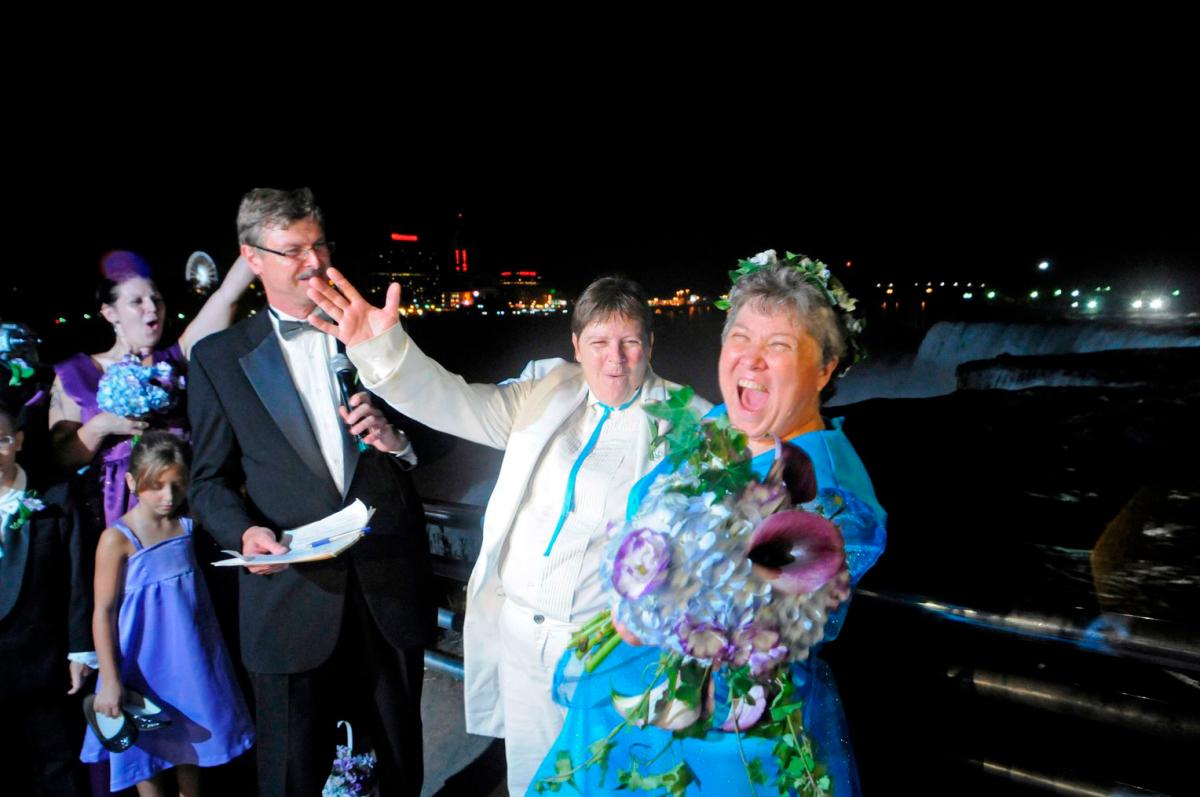
Kitty Lambert and Cheryle Rudd’s wedding, Niagara Falls, NY, July 24, 2011
The wedding of Kitty Lambert and Cheryle Rudd is often cited as the first in the state. The couple wed at Niagara Falls, historically a popular wedding and honeymoon destination.
Credit: Dr. Michael Yeh
New York’s Role in Federal Change
New York was the sixth state to legally recognize same-sex marriage. Like previous legislation, including women’s suffrage, proponents saw the passage of marriage equality in a populous state like New York as an important step toward achieving marriage equality at the federal level. Many activists in New York turned their attention to that larger goal.
On June 25, 2015, the Supreme Court ruled in Obergefell v. Hodges that the fundamental right to marry is guaranteed to same-sex couples by both the Due Process Clause and the Equal Protection Clause of the Fourteenth Amendment of the Constitution. This landmark decision granted same-sex couples in all 50 states equal marriage rights and legal recognition.
Federal Change
Choosing Sides
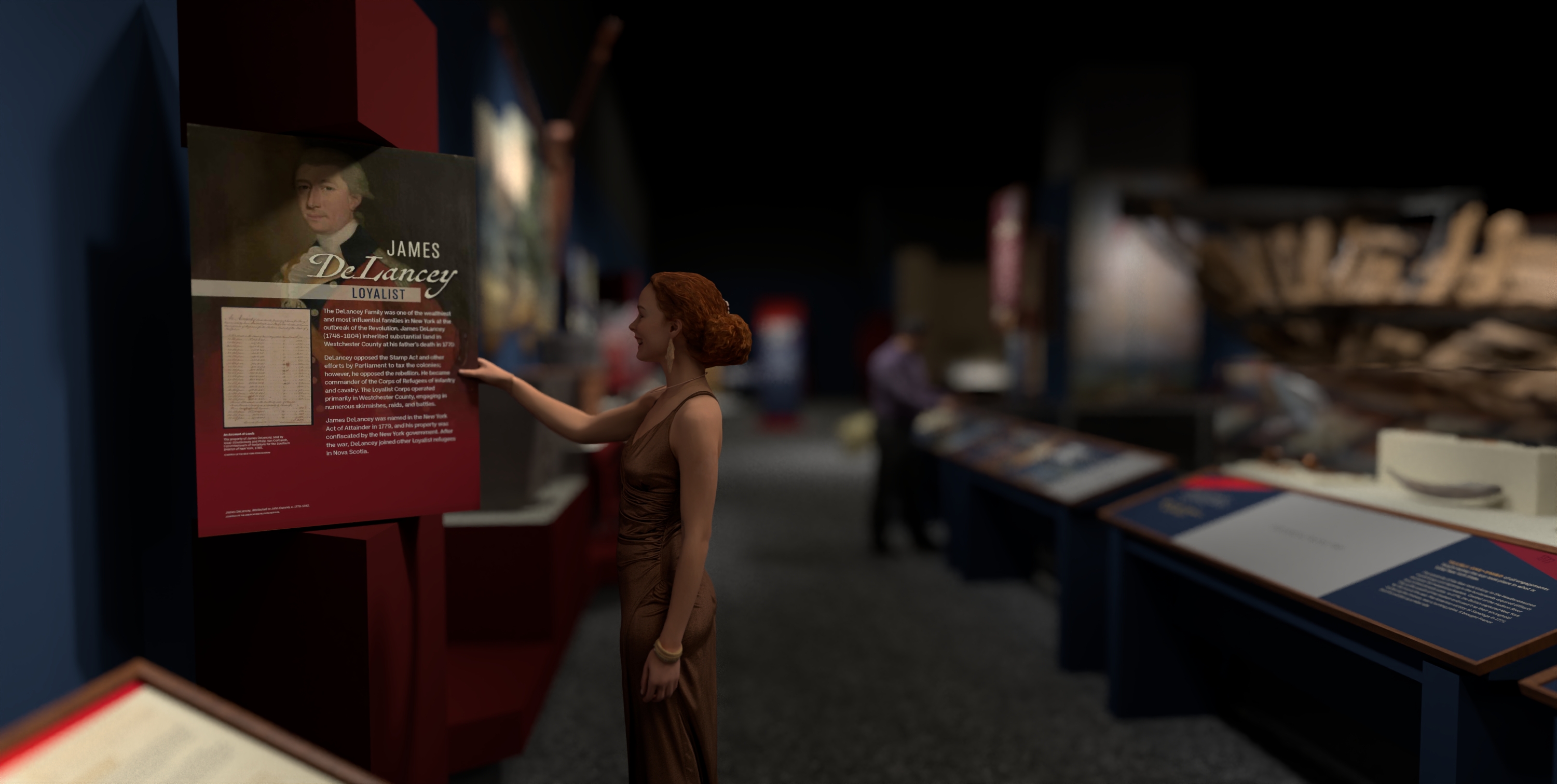
This next section of the exhibit runs along the gallery’s far left wall that runs parallel to the gunboat. It begins with another tall introductory panel. It is titled, “Choosing Sides,” then asks: “Liberty for whom?” Tall graphic text panels are mounted vertically along the wall in a straight row, with angled panels at table height in front.
The content explores how different groups and individuals—including Indigenous nations, Loyalists and Rebels, African Americans, women, farmers—navigated the Revolution’s challenges. Large newspaper graphics highlight the Loyalists vs. Rebels debate. A cannon from the USS Liberty is displayed vertically and is nearly seven feet tall. A large image of a wheat field is located above a blanket chest, a Palatine cradle, and a reproduction flour barrel are displayed. Interactive elements include two spinner panel towers: one features biographies; another discusses spying. Each spinner consists of a movable triangular component that displays a different text panel on each side. Visitors can rotate through these panels.
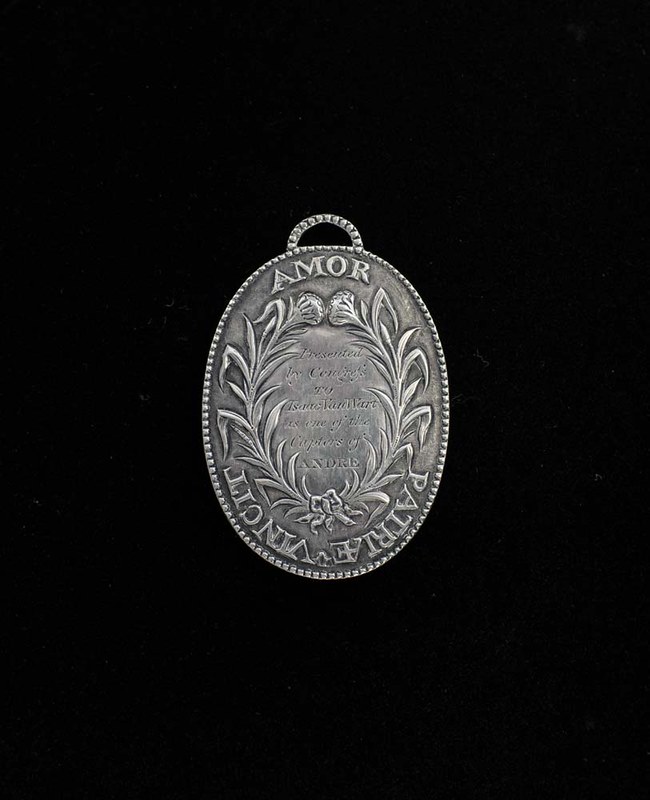
The section concludes with West Point, featuring a large map of fortifications, the Hudson River chain, facsimiles of the André Papers found on British Major John André upon his capture, and the Van Wart Fidelity Medallion. Together, these panels, objects, and images trace the complexity of choices faced by diverse people during the American Revolution.
On the eve of the revolution in 1775, diversity was the hallmark of the colony’s 165,000 people. Most were rural farmers, but Manhattan residents inhabited North America’s third-largest city. English, Dutch, French, German, Jewish, and other European colonists mingled with Indigenous people and freed Blacks, even as whites held some 20,000 Black people in bondage—the highest percentage of enslaved people in the North. Diverse religious and ethnic traditions shaped the choices people made in the coming war.
The American Revolution is considered by some to be the country’s first civil war. Choosing sides was often a complex series of decisions based on circumstances, geographic location, and many other factors. Men, women, soldiers, civilians, enslaved Africans, free African Americans, Indigenous peoples, and others were all affected by the Revolution and had to balance the social, economic, and political changes wrought by the war.
Highlights
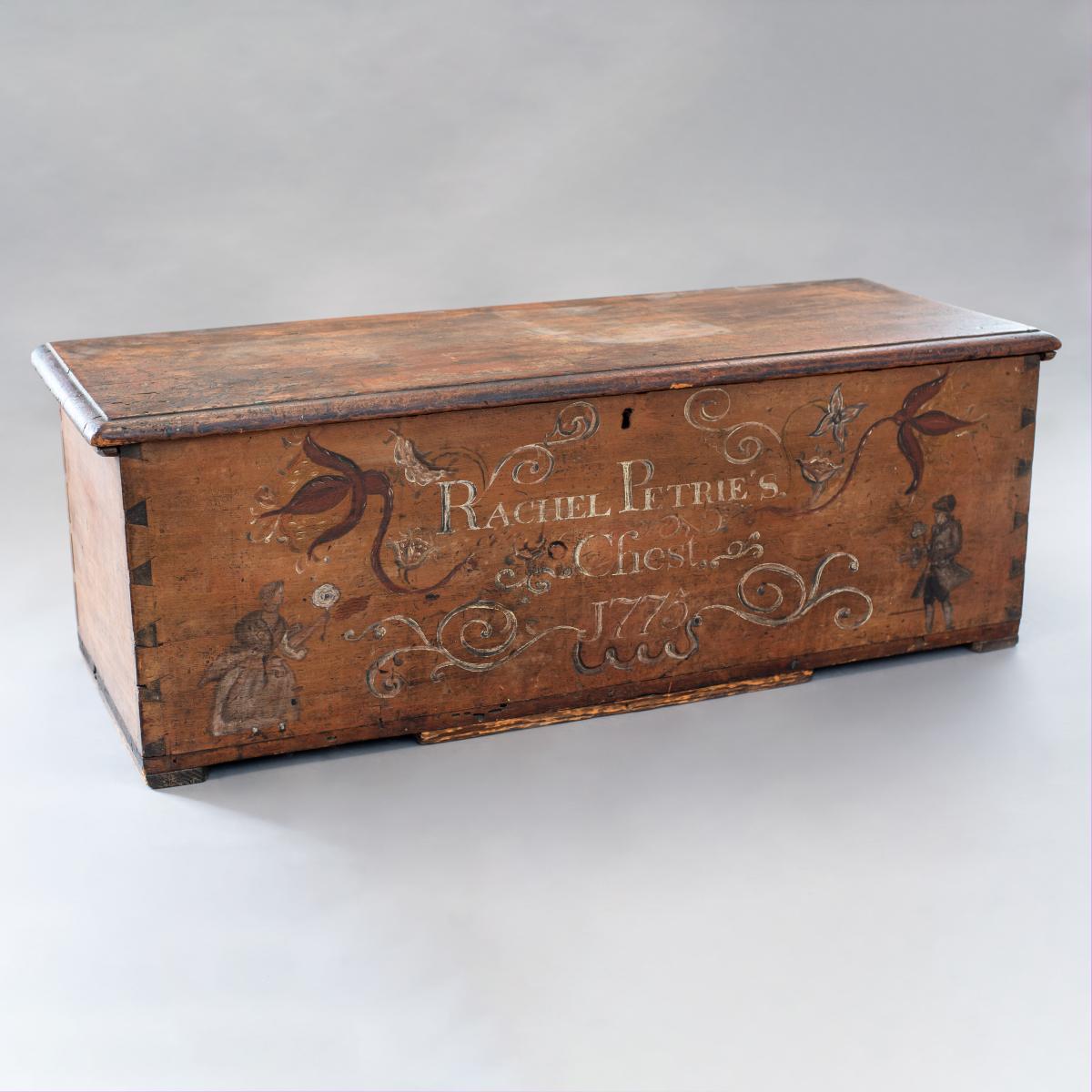
This blanket chest belonged to Rachel Petrie of Linlithgo, Columbia County. Family tradition states that this chest was made by Petrie’s fiancé before he joined New York’s militia at the outset of hostilities.
New York State Museum Collection H-1972.56.1
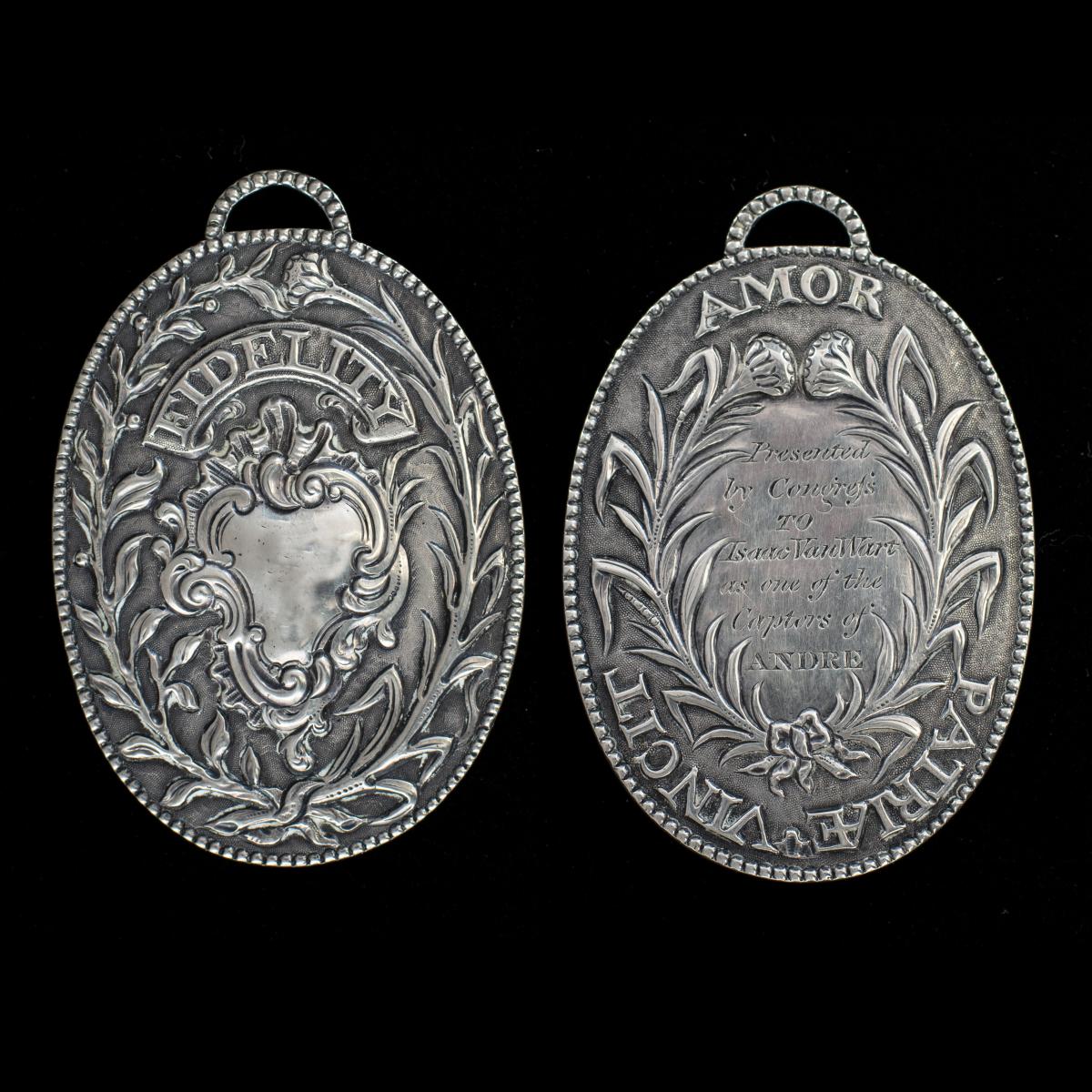
The Fidelity Medallion is the first military medal authorized and presented by the Continental Congress. The medal was created for the three enlisted militiamen who captured John André. The medal featured here was awarded to Isaac Van Wart. Van Wart was born in New York in 1750 and died in Westchester County on May 23, 1828.
Gift of the Estate of Rae Faith Van Wart Robinson, New York State Museum H-2023.4.1
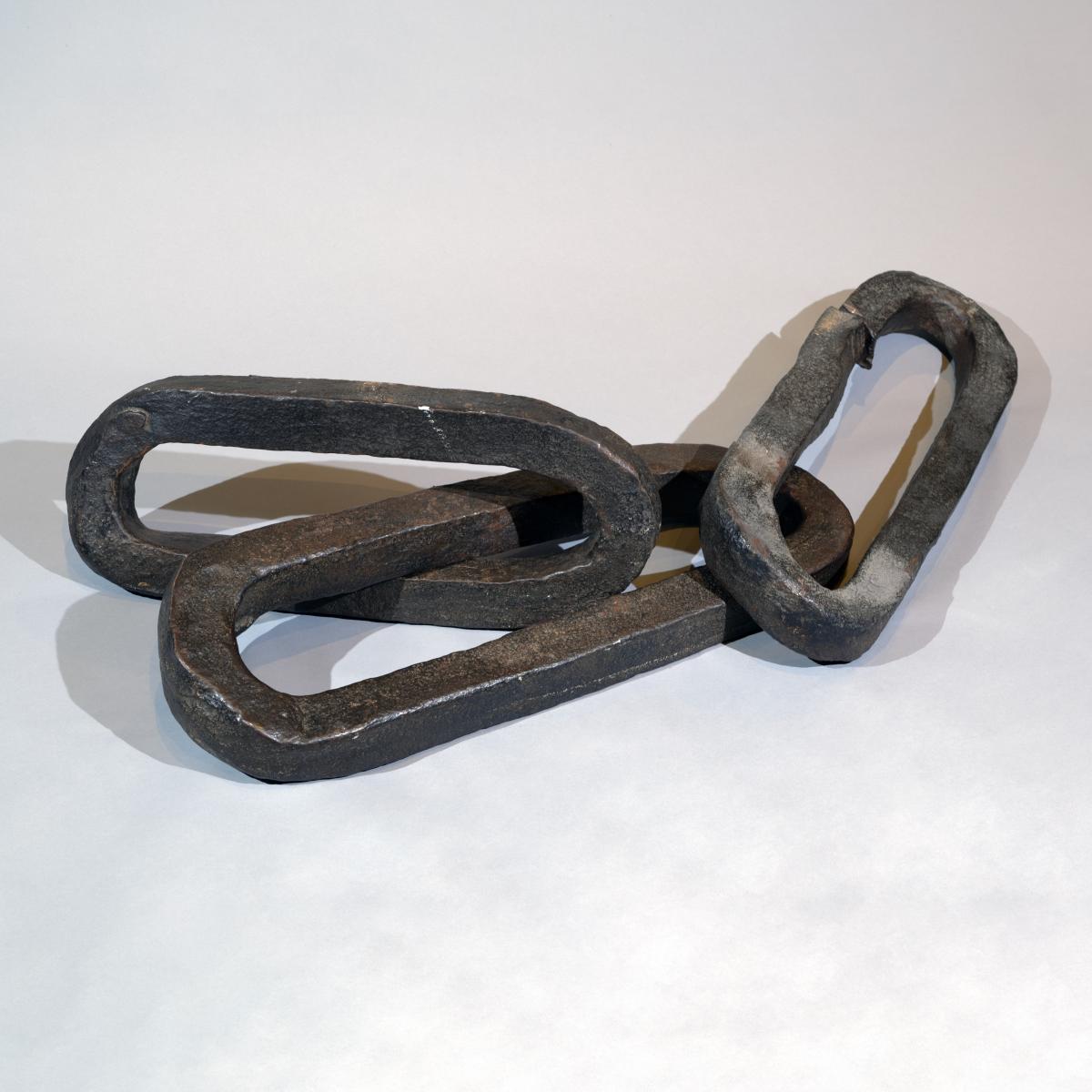
These iron chain links were once part of a chain boom constructed across the Hudson River at West Point to prevent British ships from sailing north from New York City. The chain was forged in 1778 at Sterling Iron Works in Warwick, Orange County, and remained in use until the end of the war in 1783. Each link measures approximately two feet in length and weighs between 140 and 180 pounds.
New York State Museum H-2019.39.3
The New York State Museum belongs to all New Yorkers, and we want to hear from you! As the Museum is planning for its renewal, community input will play an important role in shaping what comes next.
Join us for an opportunity to share your ideas, experiences, and aspirations for the Museum. What stories should we tell? What topics and communities should be highlighted? How can we create more engaging exhibitions, programs, public spaces, and visitor experiences for people across New York State? Your feedback will help inform future exhibitions, educational programs, accessibility improvements, visitor amenities, and other aspects of the Museum's next chapter. Whether you're a longtime visitor, a first-time guest, or someone who has never visited before, your perspective matters.
As a thank-you for participating, contributors will have an opportunity to spin our prize wheel for a chance to win Museum-themed giveaways. Come share your voice and help shape the future of the New York State Museum.
Unable to attend? Your voice still matters. Complete our online survey by July 10 and share your ideas for the future of the New York State Museum: https://www.surveymonkey.com/r/NYSMSurvey. Opportunities to provide feedback in person at Museum events will continue beyond the survey deadline.
Revolutionary New York


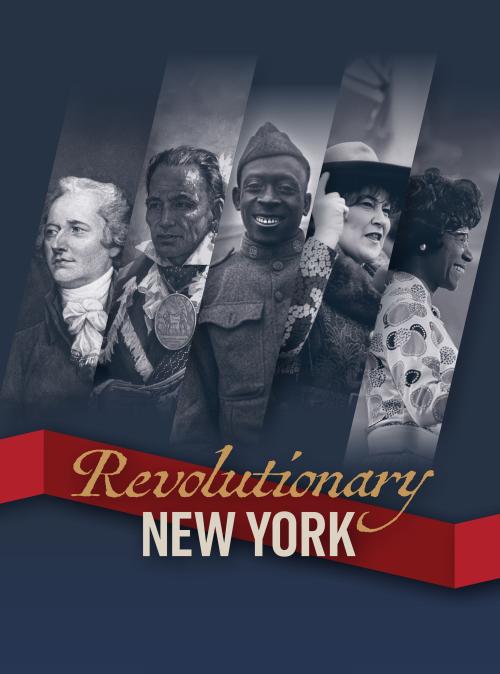
Marking the 250th anniversary of the United States, this exhibition places New York at the center of our nation’s founding story and its continued evolution. The American War for Independence raged from 1775 to 1783, but the ideas of the American Revolution did not end there. From the Battles of Saratoga to the birth of the Women’s Suffrage Movement at Seneca Falls to the Stonewall Uprising in 1969, New York has remained at the heart of this continuing Revolution.
Through compelling artifacts, images, hands-on and multimedia components, and different perspectives, the exhibition explores New York’s pivotal role in the Revolution and the difficult choices many New Yorkers faced.
This exhibition honors the New Yorkers who launched the great American experiment in 1776—and the bold leaders who, through social revolutions, have fought to make its promises real.
Online Exhibition Resources
Continue your exploration of Revolutionary New York beyond the gallery walls. This companion website features exhibition highlights and key content, along with visual descriptions for enhanced accessibility and additional resources that provide deeper context and opportunities for further discovery.
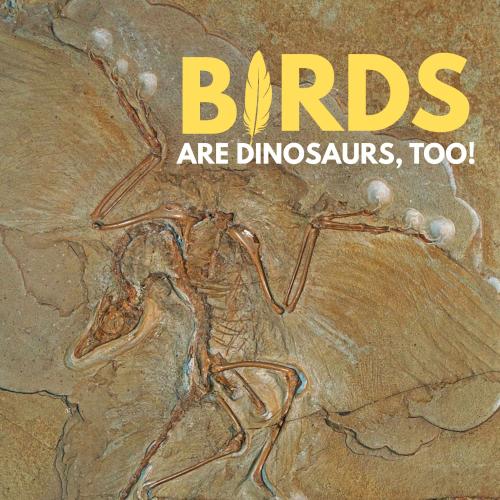
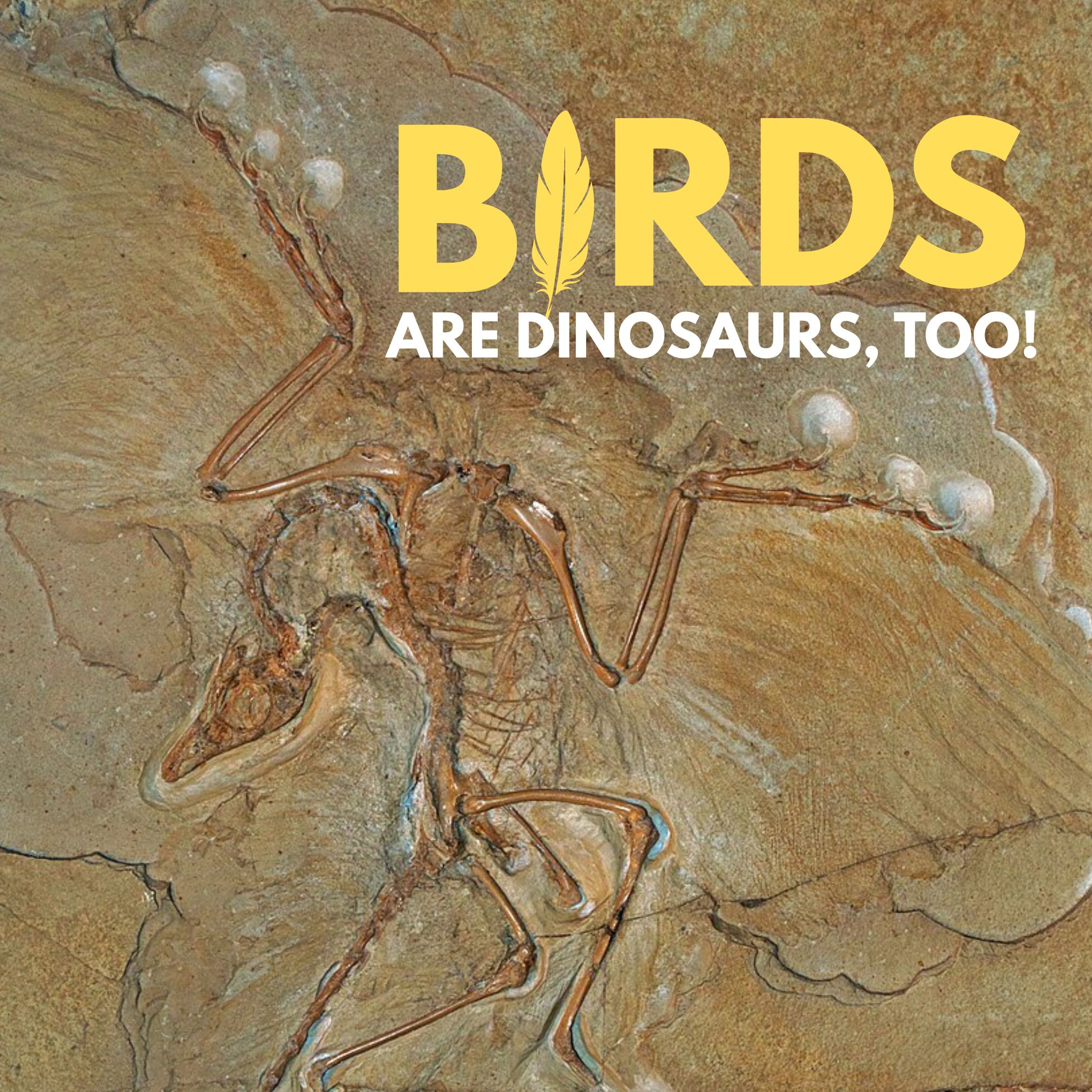
Join Dr. Jeremy J. Kirchman, Curator of Birds and Mammals at the New York State Museum, for a gallery talk exploring the remarkable evolutionary connection between birds and dinosaurs. Drawing on fossil discoveries, anatomical evidence, and modern scientific research, Dr. Kirchman will reveal how today's birds are the living descendants of theropod dinosaurs. Learn how feathers, flight, and other characteristics evolved over millions of years and discover why every sparrow, hawk, and robin offers a glimpse into the age of dinosaurs.
Continue your journey through prehistoric life by visiting Expedition Dinosaur: Rise of the Mammals on the Museum's 4th Floor Terrace.
From the Lab to the Trails: New York State Museum Scientists Invite You to Explore the Albany Pine Bush
Interactive Pine Bush Programs Give Families the Chance to Learn from Museum Experts
The New York State Museum and Albany Pine Bush Preserve are teaming up for a summer of exploration, discovery, and hands-on learning through a new educational program series, In the Field. Museum scientists will lead three monthly programs at the Pine Bush, giving families and nature enthusiasts the opportunity to experience exciting field science firsthand and learn directly from experts at both institutions. Each program highlights a different aspect of the preserve’s unique ecosystem, from moths and migratory birds to fungi, showcasing the diversity of plants and animals found throughout the 3,400-acre preserve.
New York State Museum Executive Director Jennifer Saunders said, “Summer is the perfect time to get outdoors and explore the nature in our own backyard. The Albany Pine Bush Preserve is a local treasure, and the Museum is thrilled to partner with them to offer more opportunities for families to learn and explore together. Whether it’s spending a night documenting moths or waking up early to identify and monitor birds, there’s always something new to discover.”
“This partnership with the New York State Museum creates a unique opportunity for people to experience science in the field and connect more deeply with the Albany Pine Bush Preserve,” said Christopher Hawver, Executive Director of the Albany Pine Bush Preserve Commission. “By bringing Museum scientists directly into the preserve, these programs invite participants to explore the remarkable biodiversity of this globally rare inland pine barrens ecosystem through hands-on discovery and learning.”
Free family-friendly programs are scheduled from June through August, with reservations required.
Make a reservation by calling 518-456-0655 or visiting the Albany Pine Bush’s website.
In the Field: Moth Mania with Dr. Timothy McCabe * Registration Full
Date: Friday, June 26, 2026
Time: 8:30 pm to 10:00 pm
Location: Albany Pine Bush Preserve, Karner Barrens Blue Trail, and DC Butterfly Pavilion
Suitable For: All Ages
Spend the evening with New York State Museum Entomologist Dr. Timothy McCabe observing and documenting moths in the Albany Pine Bush Preserve. The preserve is home to one of the most diverse and fascinating moth communities in the Northeast, including species that have adapted specifically to the pine barrens. Participants should be prepared for light hiking.
In the Field: M.A.P.S. Bird Banding Demo with Dr. Jeremy Kirchman
Date: Thursday, July 30, 2026
Time: 5:00 am to 12:00 pm
Location: Albany Pine Bush Preserve, Traux Trail Barrens
Suitable For: All Ages
See wild birds up close and personal with NYS Museum Ornithologist and Curator of Birds and Mammals, Dr. Jeremy Kirchman, and Albany Pine Bush Preserve Commission Conservation Director, Neil Gifford, as they capture and fit them with uniquely coded leg-bands. Part of the Monitoring Avian Productivity and Survivorship (MAPS) program, the bands allow scientists to identify individuals to study how long birds live, where they breed, and when and where they migrate.
In the Field: Mushroom Walk with Dr. Patricia Ononiwu Kaishian
Date: Tuesday, August 11, 2026
Time: 1:00 pm to 3:00 pm
Location: Albany Pine Bush Preserve, Hunger Kill Barrens Trailhead
Suitable For: Ages 8+
Join Dr. Patricia Ononiwu Kaishian, Curator of Mycology at the NYS Museum, for a beginner-friendly exploration of fungi through the Hunger Kill Barrens—a forested habitat within the unique and ecologically rare Pine Bush. Discover the key role fungi play in this ecosystem and enjoy an engaging stroll through one of the Capital Region’s natural treasures.
About the New York State Museum
Established in 1836, the New York State Museum is the oldest and largest public museum in the United States. Home to leading scientists, historians, archeologists, and anthropologists, its collections represent the State’s rich cultural and natural heritage from the past and present, including a staggering 20+ million artifacts spanning 1.1 billion years ago to today. Located at 222 Madison Avenue in Albany, the Museum is open Tuesday through Sunday from 9:30 a.m. to 5 p.m. It is closed on the Fourth of July, Thanksgiving, Christmas, and New Year's Day. Admission is free. For additional information, visit the New York State Museum website and subscribe to our newsletter.
About the Albany Pine Bush Preserve
The 3,400+ - acre Albany Pine Bush Preserve (APBP), located in New York’s Capital District, protects one of the best remaining inland pitch pine-scrub oak barrens in the world. This extraordinary fire-dependent ecosystem provides habitat for many rare plants and animals, including more than 20 percent of New York State’s wildlife Species of Greatest Conservation Need, such as the endangered Karner blue butterfly. The APBP is a National Natural Landmark, Maurice D. Hinchey Hudson River Valley National Heritage Area, National Recreation Trail Site, a New York State Unique Area, Birding Trail Site, Bird Conservation Area, and a National Audubon Society Important Bird Area. Characterized by rolling sand dunes and over 20 miles of trails, the APBP offers visitors many recreational opportunities, including hiking, bird watching, cross-country skiing, horseback riding, mountain biking, hunting, fishing, and canoeing. The Albany Pine Bush Preserve Commission is a public-private partnership created by the NYS Legislature in 1988 to protect and manage the APBP and provide the public with educational and recreational opportunities. The Management Plan for the APBP guides all aspects of expanding and managing the preserve. The Commission’s goal is to preserve 5,380 acres.
As the gateway to the Pine Bush, the Discovery Center at 195 New Karner Road, Albany, is a “green” certified interpretive center where visitors come to understand why the Pine Bush is rare and special. A visit to this unique destination is an exciting exploration where learning comes naturally through interactive exhibits, an outdoor Discovery Trail, and numerous programs on the ecology, natural history, cultural history, and management of the Pine Bush. Admission to the Discovery Center is free (there is a fee for some programs). The center is open daily, weekdays 9 a.m. - 4 p.m. and weekends 10 a.m. - 4 p.m. For more information, visit the Albany Pine Bush website or call 518-456-0655.
(518) 474-1201
Press@nysed.gov
www.nysed.gov
New York State Museum Opens Sweeping New Exhibition Celebrating America’s 250th and New York’s Role in Shaping a Nation
Revolutionary New York Highlights More Than 200 Artifacts, Rare Documents, and Immersive Displays to Explore 250 Years of Freedom, Equality, and Civic Change
Select Artifact Images and Behind-the-Scenes Exhibit Photos Are Available in the Digital Press Kit
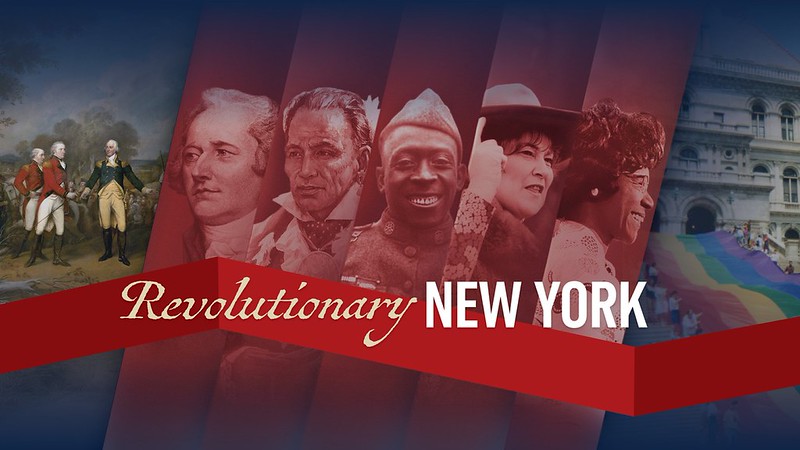
The New York State Museum today announced the opening of Revolutionary New York, a major new exhibition commemorating the 250th anniversary of the Declaration of Independence and bringing to life New York’s central role in shaping American democracy.
Opening to the public on Wednesday, July 1, 2026, and remaining on display for several years, the nearly 7,000-square-foot exhibition brings together more than 200 artifacts, rare documents, immersive displays, interactive elements, and powerful stories that connect the Revolution’s founding ideals to the continuing pursuit of freedom, equality, justice, and civic responsibility across generations.
Drawing on themes developed by the New York State 250th Commemoration Commission, Revolutionary New York invites visitors to see the state not only as a battleground of the American Revolution, but as a place where the meaning of liberty has been debated, challenged, expanded, and redefined for more than two centuries. The exhibition presents revolution as an ongoing American story, including the birth of the women’s suffrage movement in Seneca Falls, the Stonewall Uprising, emancipation and the Underground Railroad, labor rights, and environmental justice.
Board of Regents Chancellor Lester W. Young, Jr. said, “The Revolutionary New York exhibition reminds us that the promise of our nation has always been shaped by people willing to challenge injustice, expand opportunity, and demand that America live up to its founding ideals. As we commemorate the 250th anniversary of the Declaration of Independence, this enduring pursuit of a more perfect union is reflected in our commitment to equity and excellence in education, and to ensuring that every student can contribute to the future of their communities, to New York State, and to our country. Together, the Board of Regents, the State Education Department, the Office of Cultural Education, and the New York State Museum invite visitors to see history not as a closed chapter, but as an ongoing story of freedom, equality, and civic responsibility.”
Commissioner Betty A. Rosa said, "The New York State Museum is one of our state’s great educational institutions, and the addition of the Revolutionary New York exhibition underscores its enduring capacity to inspire learning, discovery, and reflection. This exhibit tells a unique story, connecting the ideals of the Revolution to generations of New Yorkers who carried that pursuit of freedom and equality forward through transformative movements, from the Underground Railroad to Seneca Falls to Stonewall and beyond. As we mark this historic anniversary, we are proud to offer students, families, educators, and visitors a meaningful opportunity to explore New York’s central role in shaping both our nation’s past and its future."
New York State Museum Executive Director Jennifer Saunders said, “Few places were more central to the birth of our nation than New York. About one-third of the battles of the American Revolution were fought in present-day New York State, and Revolutionary New York honors and builds on that history to tell a broader story about liberty, representative government, equality, civic duty, and the generations of New Yorkers who have continued to give meaning to those ideals. We hope visitors leave with a deeper understanding of New York’s role in shaping American democracy and a renewed sense of their own place in carrying that work forward.”
250 Years of New York Revolutions
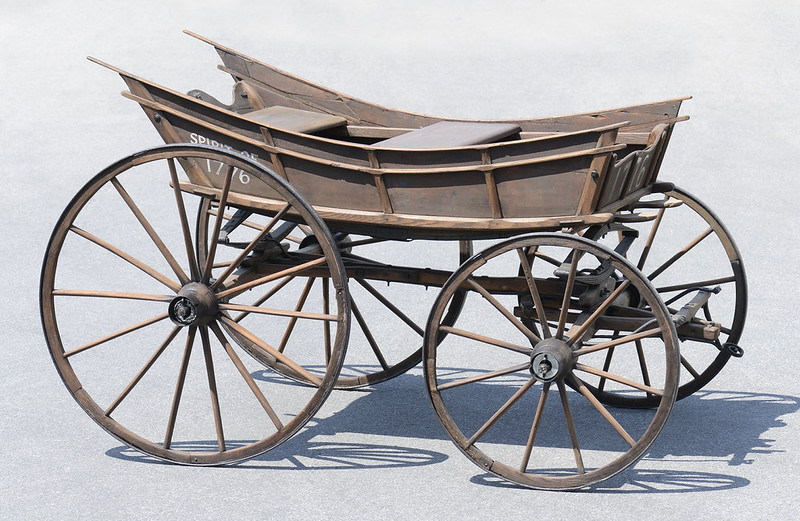
Guests entering the exhibit are welcomed by a women’s suffrage wagon used on Long Island, one of two known to exist. Once inside, visitors will encounter more than 200 artifacts exploring the state’s role in revolutions spanning three centuries. Rotating documents from the New York State Archives and Library ensures both public access and long-term preservation, while interactive elements, such as the opportunity to touch a six-pound British-made cannon, bring the Revolutionary era vividly to life.
Revolutionary New York is divided into five main sections.
Power of Place
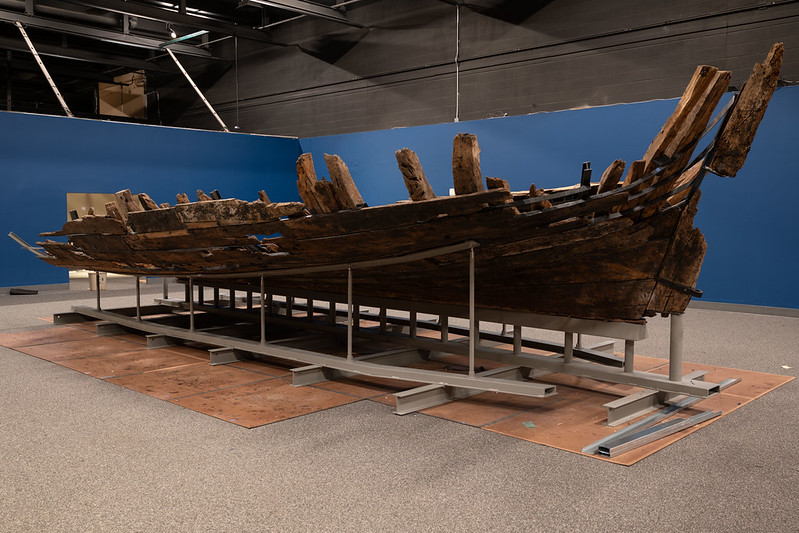
Centered around a reconstructed Revolutionary War-era gunboat discovered beneath the site of the World Trade Center, this section invites visitors to explore events from the 1763 Treaty of Paris through the War of 1812, highlighting New York State’s critical role in the fight for liberty.
Interactive elements include the opportunity to:
- Touch a six-pound, British-made cannon recovered in 1986 from the U.S. Assay site in Lower Manhattan. The cannon rests atop a replica artillery sled constructed by students at WSWHE BOCES, modeled after those used by Henry Knox to transport cannons from Fort Ticonderoga to Boston
Choosing Sides
The left side of the gallery examines how diverse groups and individuals navigated the Revolution. Men, women, soldiers, civilians, enslaved Africans, free African Americans, Indigenous peoples, and others were all affected by the Revolution and had to balance the social, economic, and political changes wrought by the war.
Artifacts include:
- Chains that spanned the Hudson River to prevent British ships from sailing north from New York City
- Fidelity Medallion presented to Issac Van Wart after he and two other militiamen captured British Major John Andre
Revolutionary Ideas Over Time
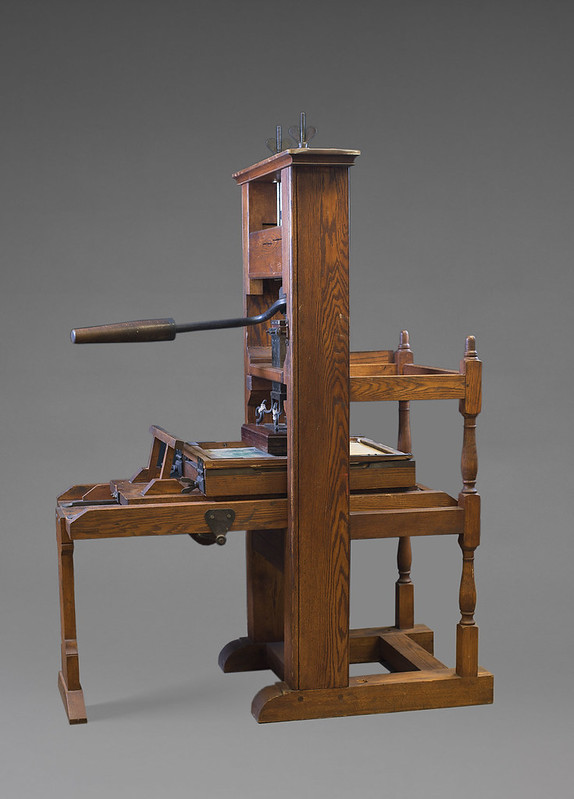
The next section focuses on the legacy of Revolutionary ideals in ongoing movements for equality and justice, as well as the enduring role of the press.
Visitors will explore:
- Audio recordings from modern revolutionaries, including Martin Luther King Jr., Franklin Delano Roosevelt, and Shirley Chisholm
- A replica printing press from the bicentennial
- Rotating original materials from the New York State Archives and Library, including a 1912 petition in favor of women’s suffrage
Founding of the Nation
Guests will then examine how New Yorkers helped shape the founding of the United States while confronting contradictions between the nation’s ideals and realities.
Artifacts from early state and federal history include:
- A gavel reportedly used by Walter Livingston to convene the first New York State Assembly in 1777
- George Washington’s watch chain
- A mahogany side chair used in Federal Hall during Washington’s inauguration
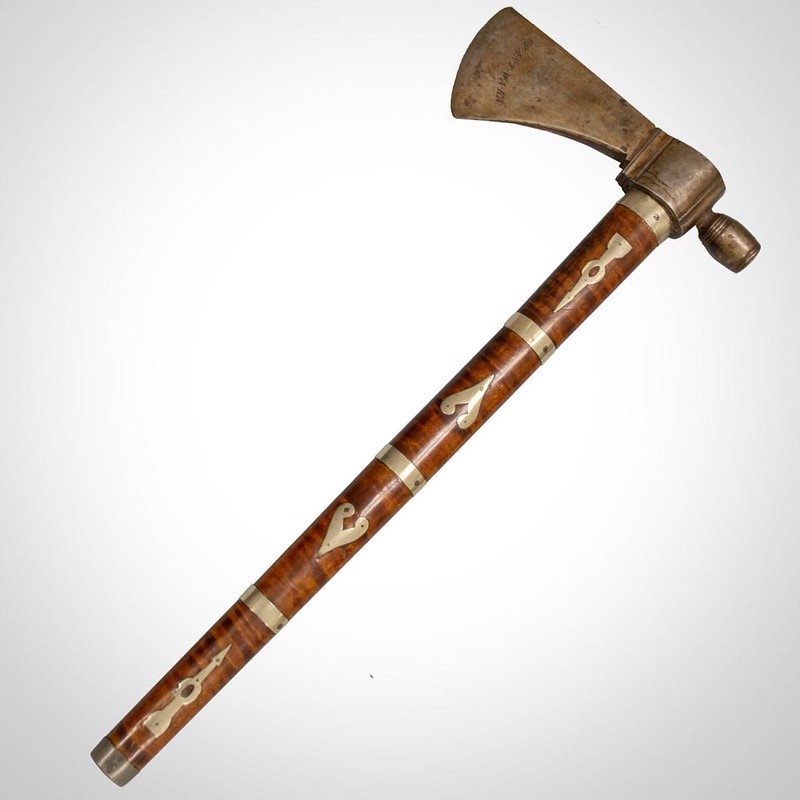
- A replica of the pipe tomahawk George Washington is believed to have presented Cornplanter; the original was returned to the Seneca Nation in 2020
We the People
The right side of the gallery is devoted to major movements for social change following the Revolution, including women’s suffrage, abolition and civil rights, immigration, labor rights, environmental justice, and LGBTQ+ equality.
Each movement is represented through dedicated displays featuring items such as:
- A pulpit from Holy Cross Church in Troy, NY, circa 1835
- A one-third-scale model of the Women’s Rights Pioneers Monument
- A full-size Volkswagen Beetle painted in bright rainbow-colored stripes
Select artifact images and behind-the-scenes exhibit photos are available to download in the Digital Press Kit.
Educational Resources
Patrons with low vision, individuals unable to travel, and guests hoping to learn more are encouraged to visit the Revolutionary New York exhibit webpage. There, you’ll discover additional resources, including visual descriptions of each gallery space and information on featured objects and artifacts.
Educational resources and accompanying learning activities from the Museum, Library, and Archives are available as part of the New York at 250 Resources for Educators on ConsidertheSourceNY.org.
Public Programming
In addition to Revolutionary New York, the New York State Education Department’s Office of Cultural Education will continue to host 250th-related public programs, including:
Spying in the American Revolution
Date: Friday, July 3
Time: 12:00 p.m.
Location: South Lobby, New York State Museum
During the American Revolution, both sides used spies to gather information on troop movements and military plans. Join Senior Historian Aaron Noble to learn about one of the war's most infamous spies and try your hand at Revolutionary War spy craft using secret codes, invisible inks, and other tools of the trade.
Roots & Rhythms: An Afternoon with The Little Zippers
Date: Sunday, July 5
Time: 2:00 p.m.
Location: South Lobby, New York State Museum
Enjoy an afternoon of blues, jazz, and Americana with The Little Zippers. Known for their rich harmonies and engaging performances, the duo brings together classic favorites and original songs inspired by America’s diverse musical traditions.
This performance is made possible through the generous support of the Musicians Performance Trust Fund.
The Crucible of the Revolution: New York Harbor at 250th with Tyler Warman
Date: Saturday, July 11
Time: 1:00 p.m.
Location: New York Metropolis Hall, New York State Museum
As we approach the 250th anniversary of the United States, this tour offers an immersive exploration of the Port of New York, known as the “strategic center" during the American Revolution. From the arrival of the massive British armada in 1776 to the final departure of the Redcoats on Evacuation Day in 1783, New York’s waters were the most contested and vital theater of the war.
NY250: Tapestry of New York
Date: Tuesday, July 14, 2026
Location: Webinar
Join the NYS Library and special guests from WNET, New York’s flagship public media station. Learn about the Tapestry of New York—a new online platform showcasing the creative work of New York students in honor of America’s 250th anniversary. This webinar will provide a full project overview, explore examples of student work, and outline strategies to implement this exciting program within library settings.
About the New York State Museum
Established in 1836, the New York State Museum is the oldest and largest public museum in the United States. Home to leading scientists, historians, archeologists, and anthropologists, its collections represent the State’s rich cultural and natural heritage from the past and present, including a staggering 20+ million artifacts spanning 1.1 billion years ago to today. Located at 222 Madison Avenue in Albany, the Museum is open Tuesday through Sunday from 9:30 a.m. to 5 p.m. It is closed on all state-observed holidays, including the Fourth of July, Thanksgiving, Christmas, and New Year's Day. Admission is free. For additional information, visit the New York State Museum website and subscribe to our newsletter.
(518) 474-1201
Press@nysed.gov
www.nysed.gov
Founding the Nation
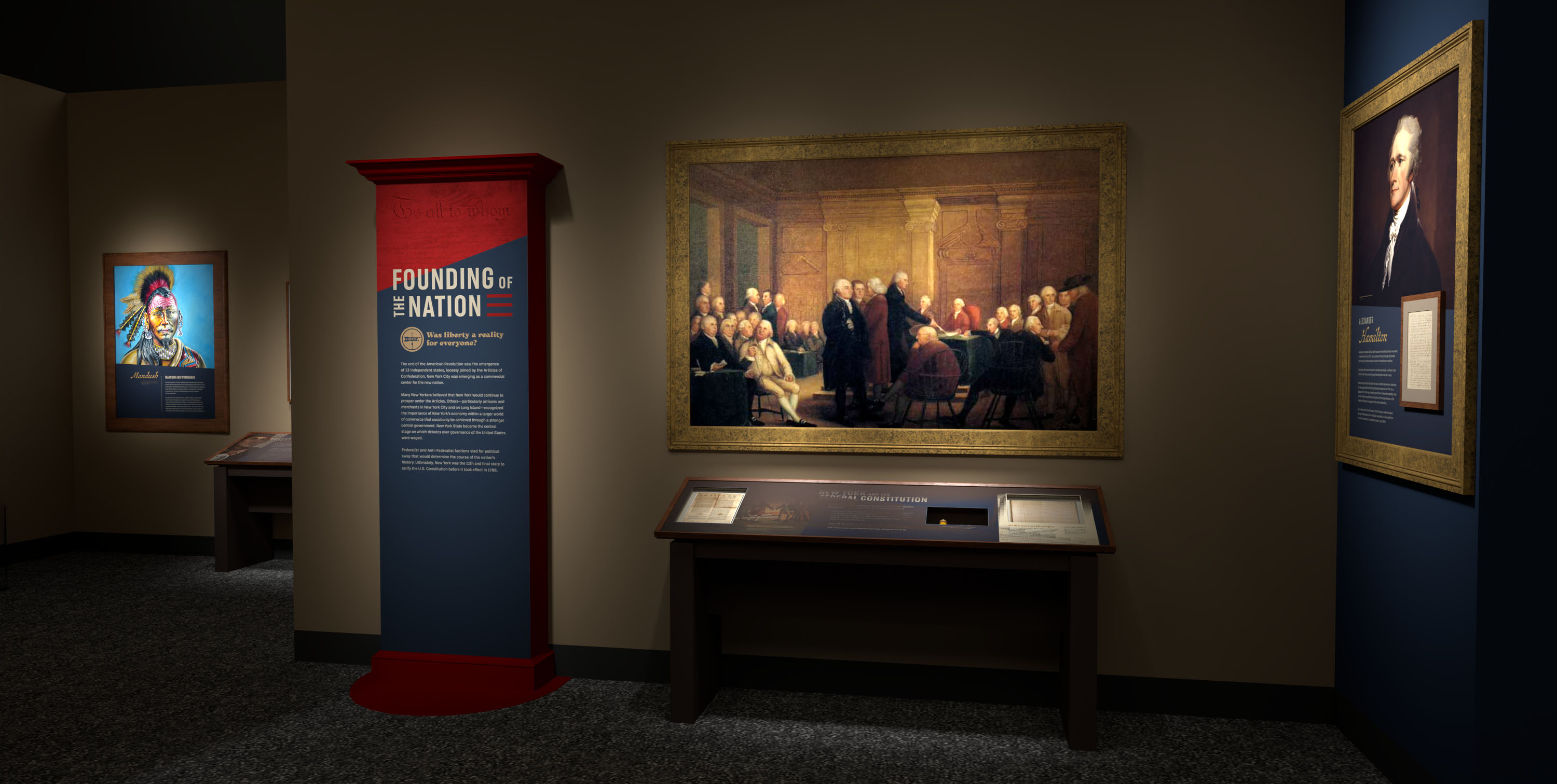
As you move to your right, you encounter another tall introductory panel titled “Founding the Nation,” which asks, “Was liberty a reality for everyone?” This section examines how New Yorkers helped shape the early United States while confronting the contradictions between the nation’s ideals and its realities.
To the right of the introductory panel hangs a large graphic panel of The Congress Voting Independence, showing a meeting room where members of the Continental Congress sit at long tables while several men stand at the center holding documents. The gallery follows an S-shaped path created by tall walls that wind through the space. Along this route is another table-height case titled “Documenting New York,” containing original documents from the New York State Archives and the New York State Library. Large wall panels feature portraits of key figures such as Alexander Hamilton and Gayëtwahgeh (John Abeel, known as Cornplanter), with a replica pipe tomahawk displayed in a case beside Cornplanter’s panel. There are also table-height slant panels that contain interpretive text.
As you continue, you encounter objects, documents, and images tied to early state and federal history, including reproductions of the Treaty of Canandaigua, the New York and Federal constitutions, and the New York Bill of Rights. Notable artifacts include a gavel reportedly used by Walter Livingston, side chairs said to have been used in Federal Hall during George Washington’s inauguration, and Washington’s watch chain and seals. Materials related to treaty making appear throughout, including a roll of muslin treaty cloth gifted to the New York State Museum by the Seneca Nation. Nearby, Indigenous veterans are highlighted through a large contemporary image honoring continued military service, paired with a 1783 quote from Mohegan Chiefs reflecting shared sacrifice. A dedicated display area honors these veterans, featuring a rotating object that will change over the course of the exhibition. A separate treaty-related quote from the US Constitution highlights federal authority over relations with Indigenous nations.
Approaching the end of this section, there is content on illegal state treaties and Indigenous displacement. Large prints of artwork appear nearby, including Honoring the Harvest by Dawn Dark Mountain (Oneida Wisconsin), part of a series commemorating the Treaty of Canandaigua, and The Great Canandaigua Treaty—1794 by Robert Griffing, depicting treaty negotiations held under an oak tree. The gallery path leads to an open space where there are four vertically oriented video screens, with a horizontal screen below displaying a written transcription of the video feature, which also includes sound. Bench seating is available in this space for viewing.
This media feature is introduced on a panel titled “Unfinished Revolutions.” It explores how, over the past 250 years, New York has been a battleground for struggles over freedom, equality, and citizenship—debates that continue today. It brings together five historians, each offering a different perspective on what the Revolution meant for specific groups and how its legacy continues to shape our world.
After the American Revolution, 13 independent states were loosely united under the Articles of Confederation in 1777. This “League of Friendship” gave Congress limited power and one vote per state. As New York City emerged as a commercial center, debates sparked over the need for a stronger federal government. While some supported the existing system, others—particularly merchants and artisans in New York City and Long Island—pushed for a stronger central government to support commerce. Federalists and Anti-Federalists clashed over the nation’s future as economic crisis grew. After intense debate, New York became the 11th state to ratify the US Constitution in 1788.
While New Yorkers helped shape the nation’s foundation, there was a contradiction between the nation’s ideals and its reality. Despite the 1776 Declaration of Independence that stated that “All men are created equal” and entitled to “Life, Liberty, and the Pursuit of Happiness,” in 1790, nearly 700,000 African Americans were enslaved, including over 21,000 in New York. The state passed a bill for the gradual abolition law in 1799, ending slavery by 1827. Nationally, slavery persisted until the Civil War and was finally abolished in 1865 by the 13th Amendment.
Highlights
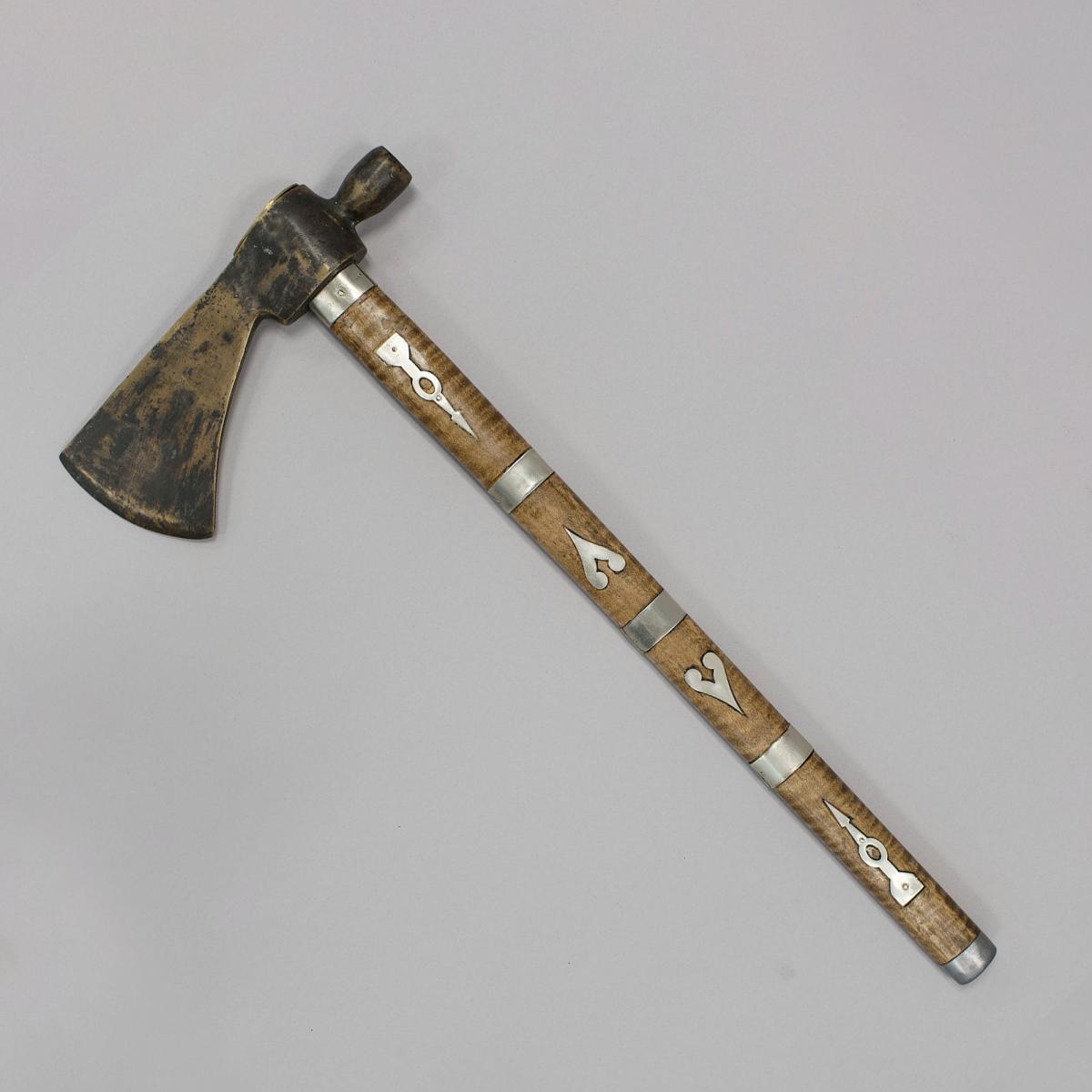
Glenn Zweygardt and Mike Crouse (Seneca Nation)
At all colonial meetings with Indigenous people, gift giving played a prominent part of diplomatic protocol. In 1792 it is believed George Washington presented Cornplanter with a pipe tomahawk. The silver inlay on this replica of Cornplanter’s pipe tomahawk was made by a descendant of Peter Crouse, a Dutch German immigrant taken captive by Seneca as a young boy, around 1778. He lived on Seneca territory for the rest of his life.
New York State Museum E-2025.
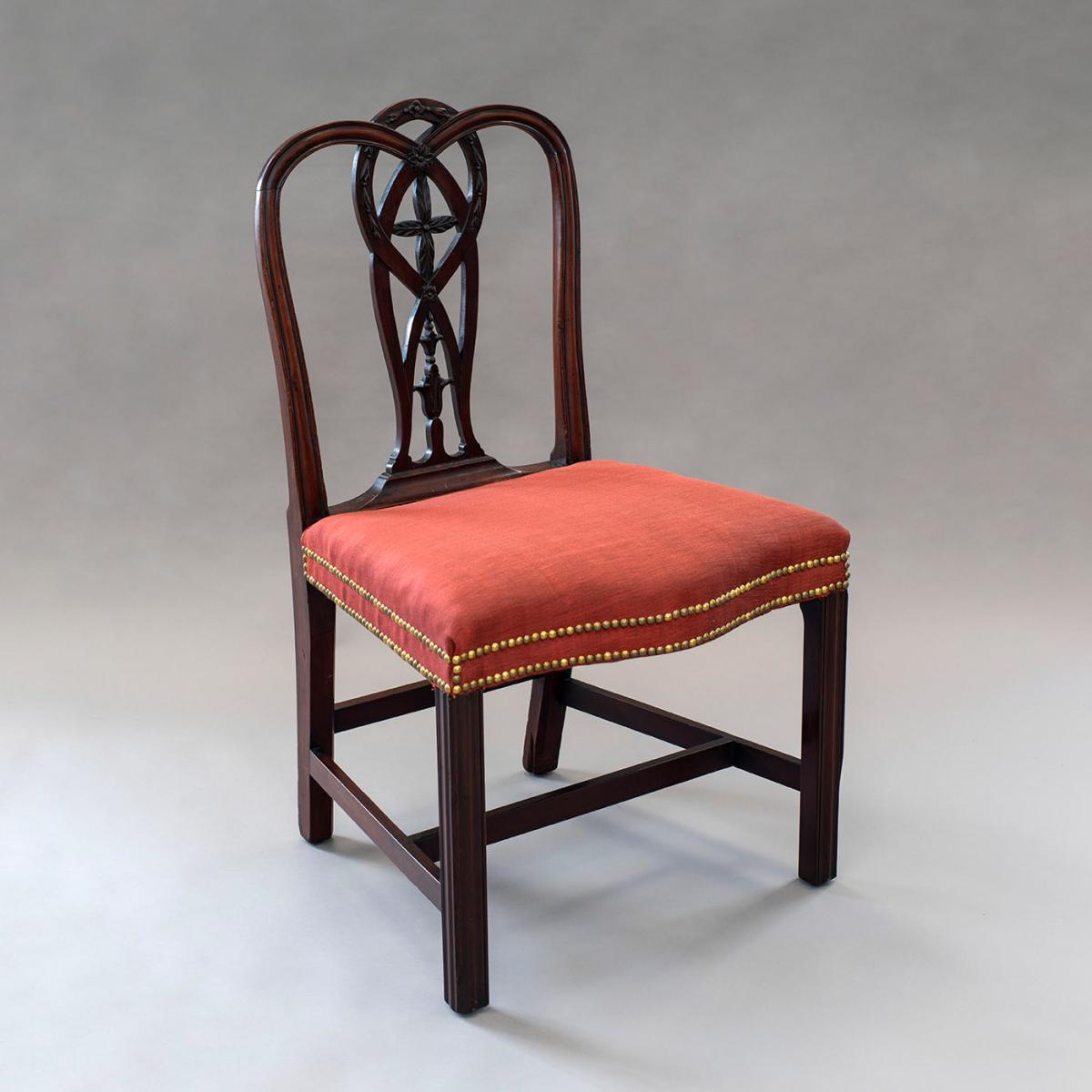
One of a pair of Federal Hepplewhite mahogany side chairs said to have been used in Federal Hall during George Washington’s inauguration.
New York State Museum H-1970.136.3 A
Additional Resources
Tattoos with Dr. Hemlock
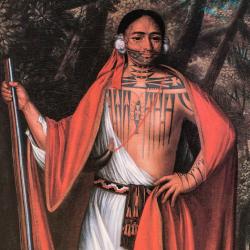
Sha’kaien’kwarahton is one of the figures depicted in Four Indian Kings of the New World painted by John Verelst in 1710. Discover how recent research by Dr. Kanen'tó:kon Hemlock reveals the cultural meaning and symbolism behind the tattoos within Haudenosaunee traditions.
During the American Revolution, both sides used spies to gather information on troop movements and military plans. Join Senior Historian Aaron Noble to learn about one of the war's most infamous spies and try your hand at Revolutionary War spy craft using secret codes, invisible inks, and other tools of the trade.
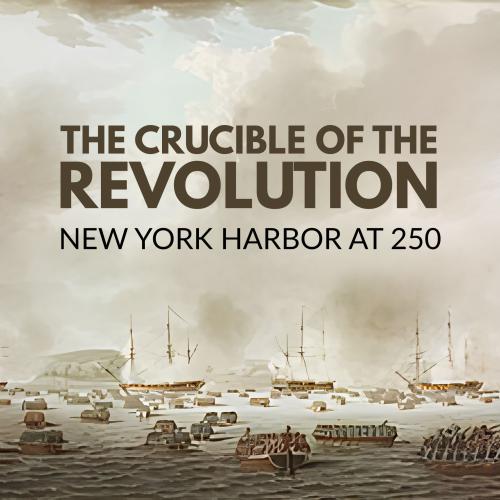
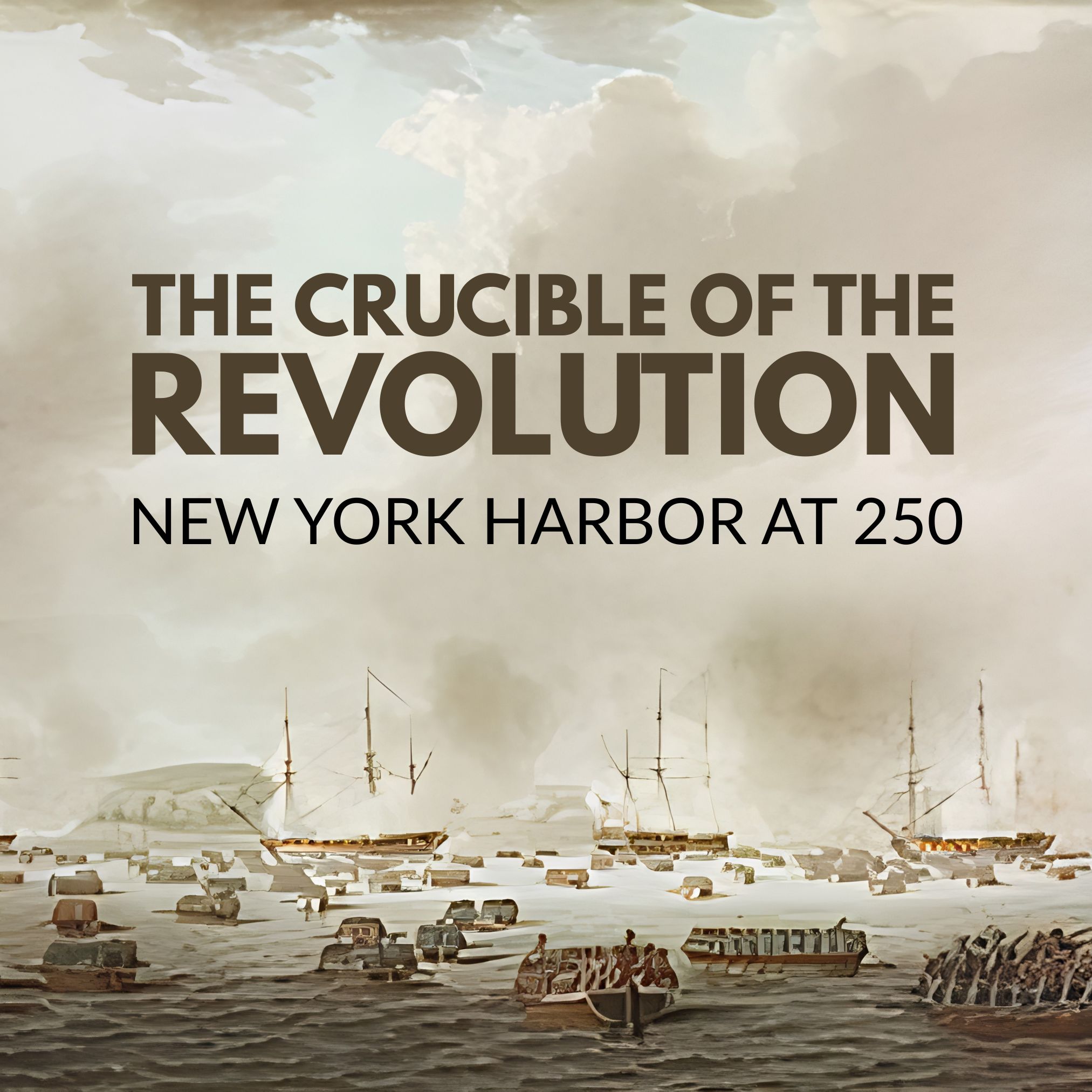
As we approach the 250th anniversary of the United States, join museum educator Tyler Warman for an immersive exploration of the Port of New York and its pivotal role in the American Revolution. From the arrival of the massive British armada in 1776 to the final departure of the Redcoats on Evacuation Day in 1783, New York’s waters served as one of the war’s most contested and strategically important theaters, shaping the course of the conflict and the nation’s future.
Curious about New York's past? Come uncover the stories behind the state's history— one document at a time! Join us every Thursday at 11:00 a.m. for "Ask an Archivist" at the New York State Museum. Each session offers a peek into New York State’s rich and surprising history through carefully chosen original documents, photographs, and videos. An expert archivist will be on hand to share stories, answer your questions, and reveal how we uncover and preserve the past. You never know what fascinating piece of history you’ll discover!
Freedom Train
Discover a selection of documents from the Revolutionary War and beyond promoting New York's heritage of freedom.
New York Pride: The Fight for Marriage Equality
**To help preserve the textiles, this exhibition is currently dark. It will reopen with full lighting for programs at the end of May and in June for Pride Month.**
Marriage equality in New York was an important chapter in the broader fight for federal recognition of same-sex marriage. It began with early activism in the 1970s, progressed through court battles in the 2000s, and culminated in the passage of the Marriage Equality Act in 2011. For many, the right to marry meant not only a personal commitment but also access to over 1,000 legal rights and protections—such as health insurance, hospital visitation rights, and survivor benefits.
The AIDS crisis intensified the need for these protections, exposing the discrimination faced by couples unable to marry and care for one another during times of illness and loss.
New York’s success in passing the Marriage Equality Act became a catalyst for national change, culminating in the 2015 Supreme Court ruling Obergefell v. Hodges, which legalized same-sex marriage in all 50 states. This exhibition highlights these milestones, showcasing artifacts, photographs, and personal stories that illustrate the power of activism in creating change.
Accessibility for Visitors Who Are Blind or Visually Impaired
We are proud to offer resources to ensure that visitors with low vision or who are blind can experience this exhibit. Our goal is to create an inclusive and welcoming environment where everyone can engage with the exhibition meaningfully.
Access the New York Pride Resource Page for transcripts of the main panels, photos, and descriptions of the exhibition. Additionally, a QR code located at the bottom of the exhibit's Introduction panel, at left, will take you to the resource page.
Pride Month and LGBTQ+ Resources
Welcome to the New York State Museum
We are excited to welcome you to the Museum! Please review the information provided here to ensure an enjoyable and safe visit to the Museum for everyone.
Notice of Temporary Changes to Museum Hours
Saturday, July 4, 2026
The New York State Museum will be closed on Saturday, July 4, 2026, in observance of the Independence Day federal holiday.
Saturday July 25 - Sunday 26, 2026
The Museum will be closed for plaza-wide systems testing on Saturday, July 25 and Sunday, July 26. As the Museum is closed to the public on Mondays, we will return to normal hours of operation on Tuesday, July 28. Thank you for your patience.
Museum Hours
Open Tuesday through Sunday, 9:30 am – 5:00 pm
Closed all state-observed holidays*
Thursday, January 1 - New Year's Day
Monday, January 19 - Dr. Martin Luther King, Jr. Day
Monday, February 16 - Washington's Birthday (Observed)
Monday, May 25 - Memorial Day
Friday, June 19 - Juneteenth
Saturday, July 4 - Independence Day
Monday, September 7 - Labor Day
Monday, October 12 - Columbus Day
Wednesday, November 11 – Veterans’ Day
Thursday, November 26 – Thanksgiving Day
Friday, December 25 - Christmas Day
Main Lobby Desk:
(518) 474-5877
Admission
Admission to the New York State Museum is free. However, your support plays a vital role in the success of the Museum’s mission. Suggested donation: $5 per individual or $10 per family.

The Museum Shop
The Museum Shop offers a wide variety of thoughtfully curated items inspired by our mission and current exhibitions, while proudly showcasing products from New York–based vendors.
Hours:
Tuesday through Friday: 11 am -3 pm
Saturday and Sunday: 10 am-4 pm

Carousel Café
2nd floor Mezzanine
Enjoy a selection of popular beverages alongside kid-friendly options. Items for sale include coffee, teas, hot chocolate, fresh pastries, bagels, made-to-order sandwiches, salads, and chicken nuggets — all served in the signature Stacks style: approachable, high-quality, and proudly local.
Hours:
Wednesday–Friday: 8:00 a.m. – 2:30 p.m.
Saturday & Sunday: 9:30 a.m. – 2:30 p.m.
Parking
Parking is available in the Madison Avenue Lot, located on the west side of the Museum and accessible from Madison Avenue. The weekday parking fee is $10, Monday through Friday. Parking is free after 2:00 p.m. on weekdays and all day on weekends.
Additional visitor parking is available in the Visitor Lot/P-3 beneath the Empire State Plaza Concourse and limited metered street parking may be available nearby.
On evenings (after 4:00 p.m.) and weekends, free parking is generally available in the Madison Avenue Lot, Madison East (Cathedral) Lot, East Parking Garage, the Visitor Lot/P-3, Grand Street Surface Lot, and Elk Street Surface Lot. Please see OGS’s Visitor Parking Information for additional details and current parking updates.
Parking availability is subject to change due to event usage, construction, or operational needs.
Amenities
- Public restrooms are available on the first floor of the Museum.
- Wheelchairs, strollers, and walkers are available for public use at no cost. Please check in with staff at the Main Lobby desk for more information.
- In addition to the Carousel Café, further food and amenities can be obtained on the Concourse Level of the Empire State Plaza. Please note, food and/or drinks are not allowed in the Museum galleries.
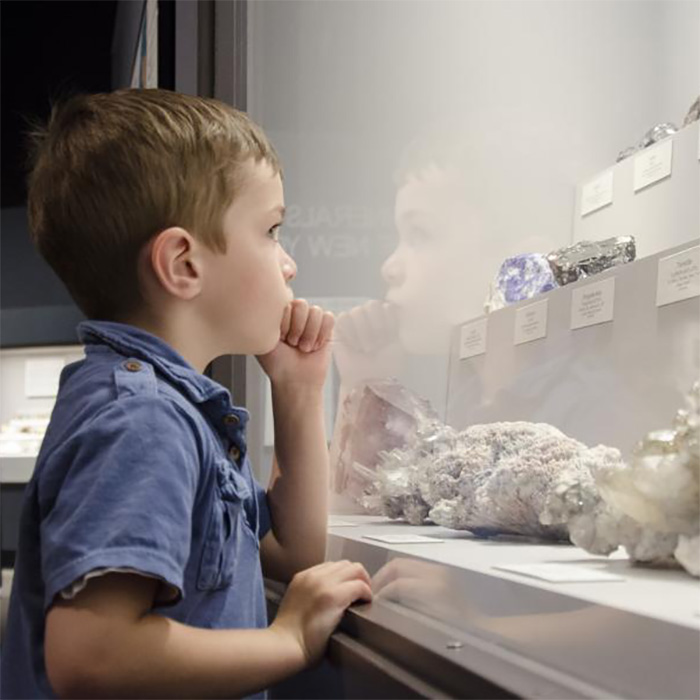
Museum Galleries and Facilities
Galleries Open for Visitors
- New York Metropolis Hall—The World Trade Center, Henry DiSpirito: Stonemason to Sculptor, Ice Ages, Black Capital: Harlem in the 1920s, Art for the People: Decorated Stoneware from the Weitsman Collection, and more!
- Adirondack Hall—Adirondack Wilderness, Beneath the City: An Archaeological Perspective of Albany, “a small fort, which our people call Fort Orange,” Artifacts for Activism, Minerals of New York, and more!
- Bird Hall
- Cohoes Mastodon
- Fire Engine Hall
- Ice Ages
- First Peoples Hall
- Fourth Terrace: NYSM Carousel
For Your Health & Safety
Please be reminded that simple steps can help stop the spread of the COVID-19 virus, including to:
- Stay home when you are sick.
- Wash hands often with soap and water for at least 20 seconds. If soap and water are not available, use an alcohol-based hand sanitizer containing at least 60% alcohol.
- Avoid touching your eyes, nose, and mouth with unwashed hands.
- Cover your cough or sneeze with a tissue, then throw the tissue in the trash.
- Avoid close contact with people who are sick.
Location
New York State Museum
Cultural Education Center
222 Madison Avenue
Albany, NY 12230
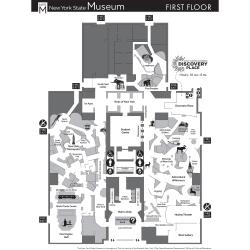
Wayfinder Map (PDF)
Download this wayfinder map for an overview of the NYSM galleries and exhibits open to visitors.
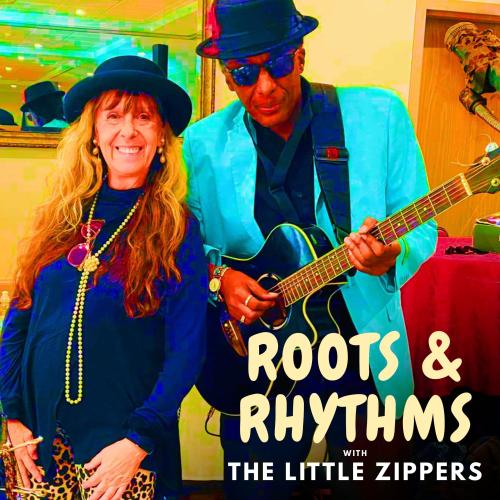
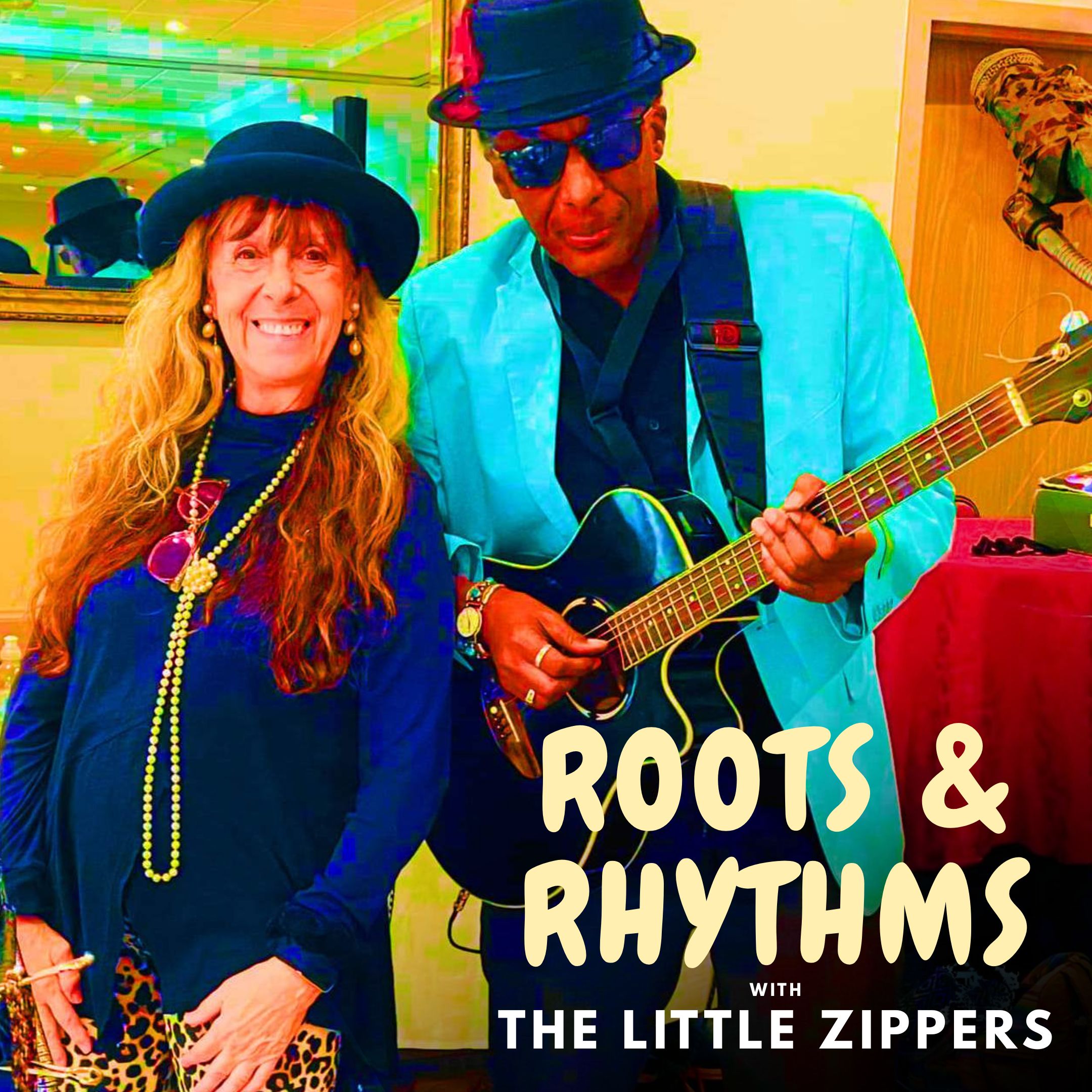
Enjoy an afternoon of blues, jazz, and Americana with The Little Zippers. Known for their rich harmonies and engaging performances, the duo brings together classic favorites and original songs inspired by America’s diverse musical traditions.
This performance is made possible through the generous support of the Musicians Performance Trust Fund.
Revolutionary New York: Resources
Explore highlights and core content from the Revolutionary New York exhibition. The page also features visual descriptions for enhanced accessibility, along with related resources and opportunities for engagement through programs and events.
A Note about Language and Content
In this exhibition, you will encounter multiple terms used to reference Native Americans in historical and contemporary contexts. For example, Six Nations, a term used during the colonial period to refer to Haudenosaunee people, today references the Six Nations of the Grand River, First Nations Reserve in what is now Canada. We use different terms in this exhibit for historical specificity and to respectfully acknowledge present-day Indigenous Nations.
This exhibition explores the American Revolution, which includes brutal and violent events. Revisiting this history can be painful. A few of the objects in the exhibit were involved in revolutionary battles. They were included in this exhibition so that we can learn from our past.
Additional Revolutionary Resources
Educational Guides, Videos, and More
Take a deeper dive into the stories featured in Revolutionary New York through a curated collection of books, videos, podcasts, educational guides, and other resources. Whether you're preparing for your visit or continuing your exploration afterward, these materials offer additional insight into New York's revolutionary past and lasting legacy.