

State Museum Hosts "Brain Food for the Curious" Program Series
New York State Museum scientists will share their knowledge and research in a series of lunchtime talks this fall and winter. “Brain Food for the Curious” will be held select Tuesdays, November through March, from 12:10 to 12:30pm in the Huxley Theater. Each program includes a 20-minute talk with a State Museum scientist followed by an optional question and answer period. Attendees are encouraged to bring their lunch.
Talk topics and dates are:
Reconstructing Ancient Marine Environments
Tuesday, November 10 | 12:10–12:30 pm
How can paleontologists reconstruct an environment that existed 450 million years ago? Join State Paleontologist Dr. Lisa Amati as she describes how scientists use clues that are preserved in rocks and fossils to interpret ancient environments.
Recent Range Shifts of New York Birds: Response to Climate Change?
Tuesday, November 24 | 12:10–12:30 pm
Join Curator of Birds Dr. Jeremy Kirchman as he describes his current research and the implications for bird conservation. Since several bird species have expanded their ranges northward in the last 25 years, Dr. Kirchman has resurveyed birds on Whiteface Mountain to examine whether they are also shifting their ranges uphill.
The New York Paleoindian Database Project: Paleoindian Occupations in Central New York
Tuesday, December 8 | 12:10–12:30 pm
Join Curator of Archaeology Dr. Jonathan Lothrop as he describes how recently collected data offers new insights on the human colonization of central New York during the Ice Age.
Household Archaeology in Eastern New York
Tuesday, December 22 | 12:10–12:30 pm
Archaeologists often use household objects to analyze and interpret the past. Join State Archaeologist Dr. Christina Rieth as she discusses the role of the household at two Late Prehistoric (c. A.D. 700-1400) sites in the Schoharie and Mohawk areas of eastern New York.
Slavery in the Hudson River Valley
Tuesday, January 19 | 12:10–12:30 pm
New York was the largest slave holding colony north of Maryland between 1680 - 1770 and Albany was the largest slave owning area north of New York City. Join Curator of Historical Archaeology Dr. Michael Lucas as he discusses preliminary results of fieldwork and research from the Albany area.
Got Time For A Cold One? – The Ice Age of New York State
Tuesday, February 2 | 12:10–12:30 pm
Join Museum scientist Dr. Andrew Kozlowski as he discusses new techniques being used to decipher the chronologic puzzle of the Ice Age in New York State.
Development and Ecology in Saber-toothed Cats
Tuesday, February 16 | 12:10–12:30 pm
Join Dr. Robert Feranec, Curator of Pleistocene Vertebrate Paleontology, as he discusses tooth development in the saber-toothed cat and why we do not expect to find evidence of saber-toothed cats in New York State.
The Evolution of the Earth’s Materials
Tuesday, March 8 | 12:10–12:30 pm
Three eras of mineral and rock evolution—planetary accretion, crust and mantle reworking, and biologically mediated mineralogy—recorded dramatic changes in the diversity and distribution of the Earth’s minerals and rocks. Join Curator of Geology Dr. Marian Lupulescu for a talk on the driving mechanisms and timing of the Earth’s mineral and rock diversification.
The State Museum is a program of the New York State Education Department’s Office of Cultural Education. Located on Madison Avenue in Albany, the Museum is open Tuesday through Sunday from 9:30 a.m. to 5 p.m. It is closed on Thanksgiving, Christmas and New Year's Day. Admission is free. Further information about programs and events can be obtained by calling (518) 474-5877 or visiting the Museum website.
Phone: (518) 474-1201
State Museum Displays Philip Johnson's "Habitable Sculpture" Model
The New York State Museum today announced a new ongoing display featuring one of the last works created by renowned architect and artist Philip Johnson titled the "Habitable Sculpture". Art investor and developer Antonio 'Nino' Vendome and Family recently donated the 8-foot "Habitable Sculpture", one of ten created and signed by Johnson, to the New York State Museum. In addition to the sculpture, banners of Johnson's early brainstorming sketches and a full-color street view rendering of the "Habitable Sculpture" are also on view.
In 2000, Philip Johnson was asked to submit a proposal for a New York City residential building by Antonio (Nino) Vendome, art investor and developer and owner of Nino's Restaurant, which provided thousands of free meals to workers at Ground Zero after September 11, 2001. Johnson designed an innovative building he called the "Habitable Sculpture". Although the project has yet to be realized, in 2001 Johnson said, "It is the best building I ever designed. It is my last opportunity in New York to do something good for the city and something good for art." Johnson died in 2005.
"The display of this important Philip Johnson collection gives State Museum visitors a unique opportunity to learn about American art, architecture, and innovation," said State Education Commissioner MaryEllen Elia. "The Board of Regents and the State Museum are grateful to donor Antonio 'Nino' Vendome and Family for allowing us to display the "Habitable Sculpture".
"Philip Johnson's "Habitable Sculpture" is an extraordinarily important work by one of America's greatest architects and artists," said State Museum Director Mark Schaming. "On view for the first time at the State Museum, the "Habitable Sculpture" gives testimony to Philip Johnson's life work as an innovator, a visionary American master architect and an artist. We thank Antonio 'Nino' Vendome and Family for their generosity in donating the "Habitable Sculpture" to the Museum."
One of the great architects of the last century, Philip Johnson first championed the International Style, later promoted Post Modernism, and continued to experiment in his designs throughout his career with groundbreaking approaches. He is best known for the Glass House (1949, his own home in Connecticut), the Seagram Building in New York City (1956, working with Ludwig Mies van der Rohe), the AT&T Building, also in New York (1984, now the Sony Tower), and what became his last project, the Urban Glass House (opened 2005, New York City).
The New York State Museum is a program of the New York State Education Department's Office of Cultural Education. Located on Madison Avenue in Albany, the Museum is open Tuesday through Sunday from 9:30 a.m. to 5 p.m. It is closed on Thanksgiving, Christmas and New Year's Day. Admission is free. Further information about programs and events can be obtained by calling (518) 474-5877 or visiting the Museum website.
Phone: (518) 474-1201
State Museum Hosts Taste NY Holiday Market on December 6
Visitors can shop at more than 40 "made in New York" food and beverage vendors at the New York State Museum’s Taste NY Holiday Market on Sunday, December 6, 11:00am – 4:30pm. Admission is $5 (cash only); children ages 12 and under are free.
Over 40 vendors will offer samples and sales of chocolates; cheese; maple and apple products; hand-crafted beer, wine and spirits; and other edible gifts. All participating vendors produce their products in New York State. There will also be cooking demonstrations, living historians, children’s activities, and a chocolate fountain station, courtesy of We Do Fondue and Price Chopper.
A full schedule of activities is below:
11:00 – 4:30, Historic Foodways Demonstration, The Recreated 2nd Albany County Militia Living History Organization will lead a presentation giving visitors a hands-on experience of how foods were prepared in the 18th century.
11:00 – 4:30, Historic Foodways Demonstration, Herkimer Home State Historic Site will lead a presentation about the history of chocolate and its role in 18th century Colonial America.
12:00, 1:00 & 2:00pm sessions – Children’s Activity, Apple Aliens (Limit of 20 per session.)
12:00pm – Cooking Demonstration, Happy Holidays with Felicia Ramos-Peters
2:00pm – Cooking Demonstration, Holiday Cooking with Chef Michael Lapi
The annual Holiday Tree Lighting and Fireworks Festival at the Empire State Plaza will also be held on December 6.
For more information, including a list of participating vendors, visit:http://www.nysm.nysed.gov/programs/tasteNY/.
Taste NY is an initiative that highlights the quality, diversity, and economic impact of New York’s food and beverage industry. Taste NY provides an opportunity for New York growers and producers to receive increased exposure of their products to consumers, restaurateurs, retailers, wholesalers, and distributors.
The State Museum is a program of the New York State Education Department’s Office of Cultural Education. Located on Madison Avenue in Albany, the Museum is open Tuesday through Sunday from 9:30 a.m. to 5 p.m. It is closed on Thanksgiving, Christmas and New Year's Day. Admission is free. Further information about programs and events can be obtained by calling (518) 474-5877 or visiting the Museum website.
Phone: (518) 474-1201
Bird Hall Renovation
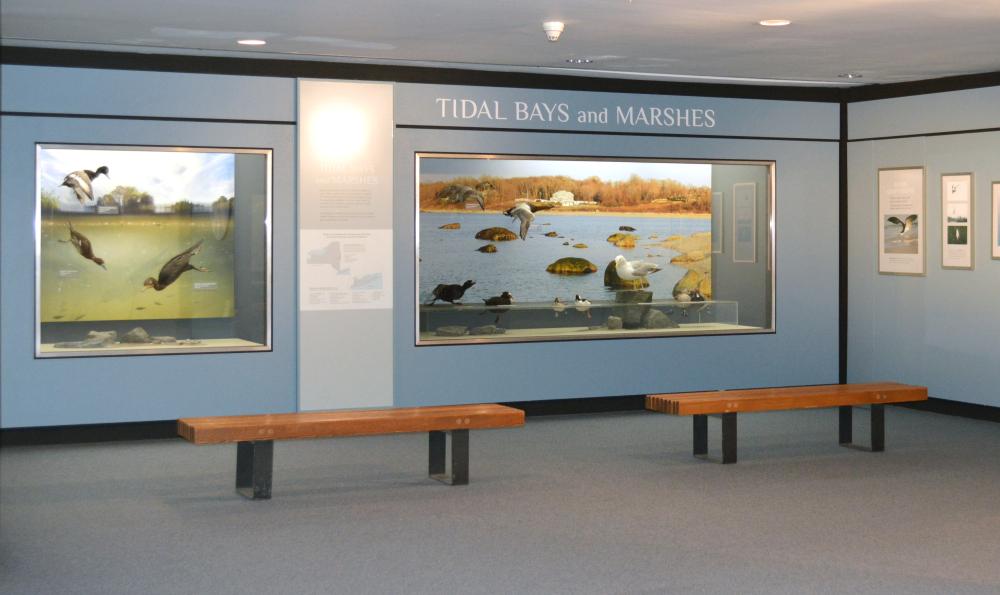
In October 2015 the Museum opened a newly renovated area of Bird Hall - "Tidal Bays and Marshes". There are a total of six "bays" in Bird Hall, and Museum staff will be renovating each bay to give visitors a renewed Birds of New York exhibition experience.
A major goal of the renovation is to place bird specimens in more realistic-looking environments so visitors have a better understanding of bird habitats. Museum staff conducted extensive image searches to obtain photographs that accurately depict these habitats. Also, bird specimens were refreshed by carefully cleaning them and applying paint to areas, such as the beaks, where colors had faded.
The Museum will continue Bird Hall renovations over the next few years. In addition to renovating all the current bays, two additional cases will be renovated to include a case on extinct birds and a case on New York State bird success stories. Stay tuned for the next bay to be renovated: Ponds and Marshes.
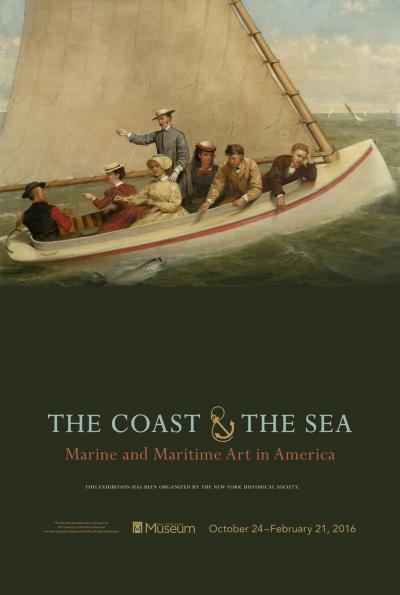
The Coast & the Sea: Marine and Maritime Art in America


The Coast & the Sea features more than fifty paintings ranging in date from 1750 to 1904 along with a medley of artifacts culled from the New-York Historical Society's collection of marine paintings and maritime artifacts. This exhibition offers audiences a rich trove of maritime works set in a meaningful historical and cultural narrative.
Exhibition organized by the New-York Historical Society
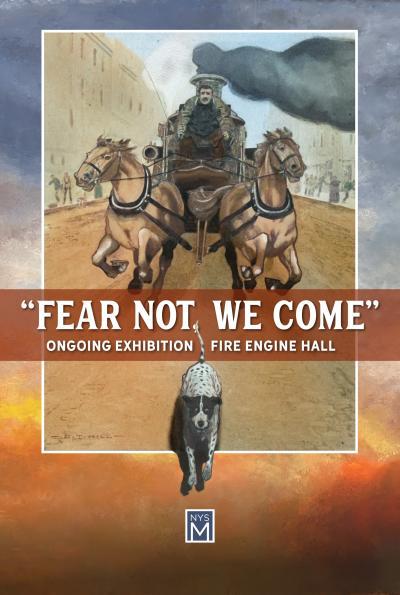
Fire Engine Hall
Ongoing Exhibition
Fear Not, We Come!
More than machines, fire engines can be seen as works of art and are symbols of civic spirit.
Since the colonial period in America, fire companies and their engines have played a central role in protecting and celebrating their communities. New York State was a leader in innovation and production of fire-protection apparatus and gear during the 19th and 20th centuries. Hand engines, steam engines, water systems, hydrants, motorized fire apparatus, equipment, and gear were all produced in New York State.
This exhibition highlights trends in the evolution of firefighting apparatus, starting from the colonial period through the mid-20th century. From villages to army bases to New York City, each piece of equipment represents a community’s effort to more efficiently battle fires, and to save lives and structures.
Apparatus in this gallery has helped firefighters save countless lives over the centuries! See everything from hand-drawn and horse-drawn apparatus to motor-powered vehicles. Additional objects—including gear, tools, and other ephemera—show how technology has changed over the years, and offer insight into the culture and tradition of firefighting. Retired Fire Department of the City of New York Captain Brenda Berkman’s badge is on loan. Berkman led the charge to give women a fair chance to join FDNY. Historical images, many from our partners in the New York State Library, Manuscripts and Special Collections show firefighters in action and equipment in use.
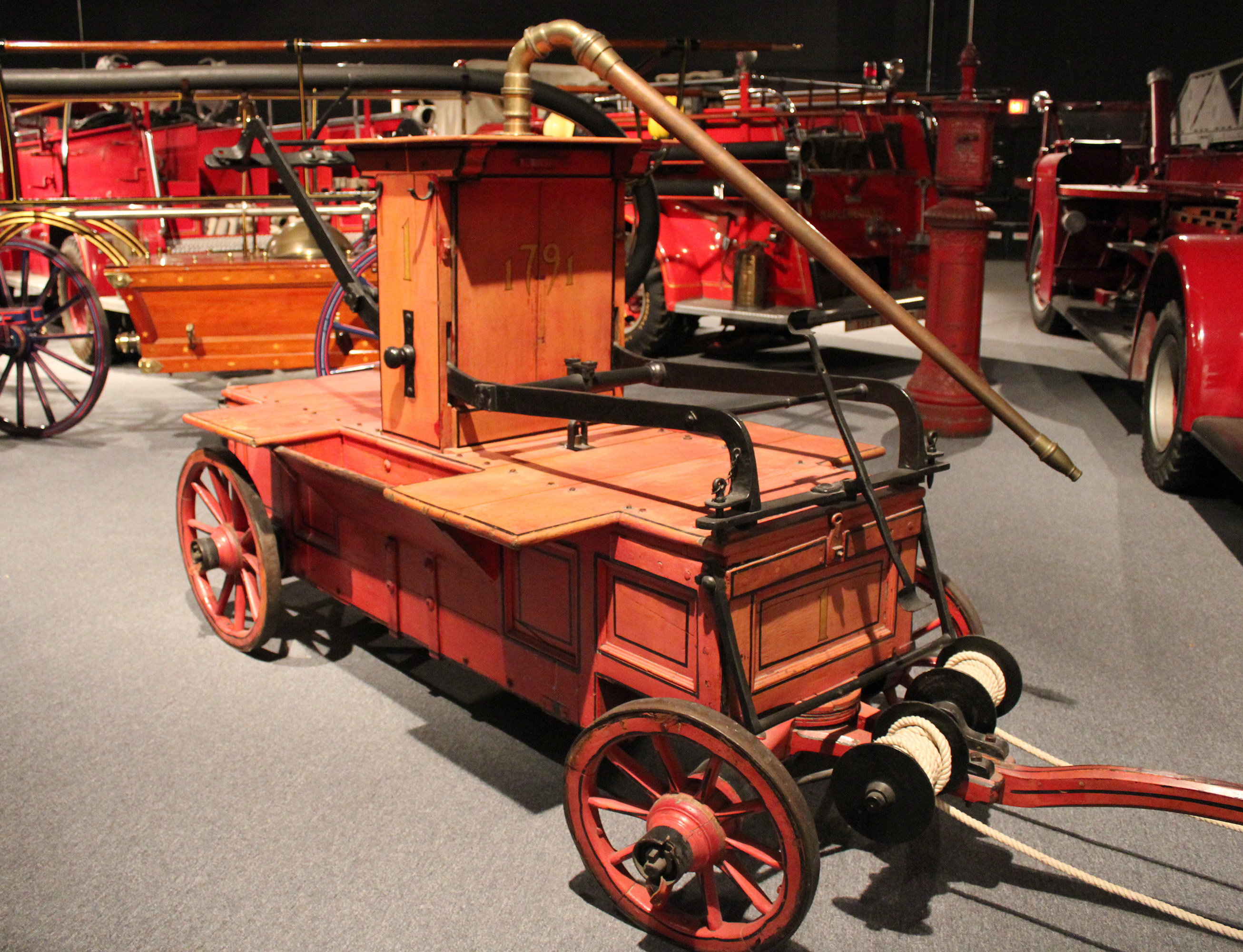
1791 Tub
This hand engine, filled by buckets instead of a hose, is the Musuem's oldest piece of fire equipment on display in Fire Engine Hall. Retired in 1832, it was preserved by the Lansingburgh volunteer fire department for over 100 years until it was donated to the State Museum in 1937.
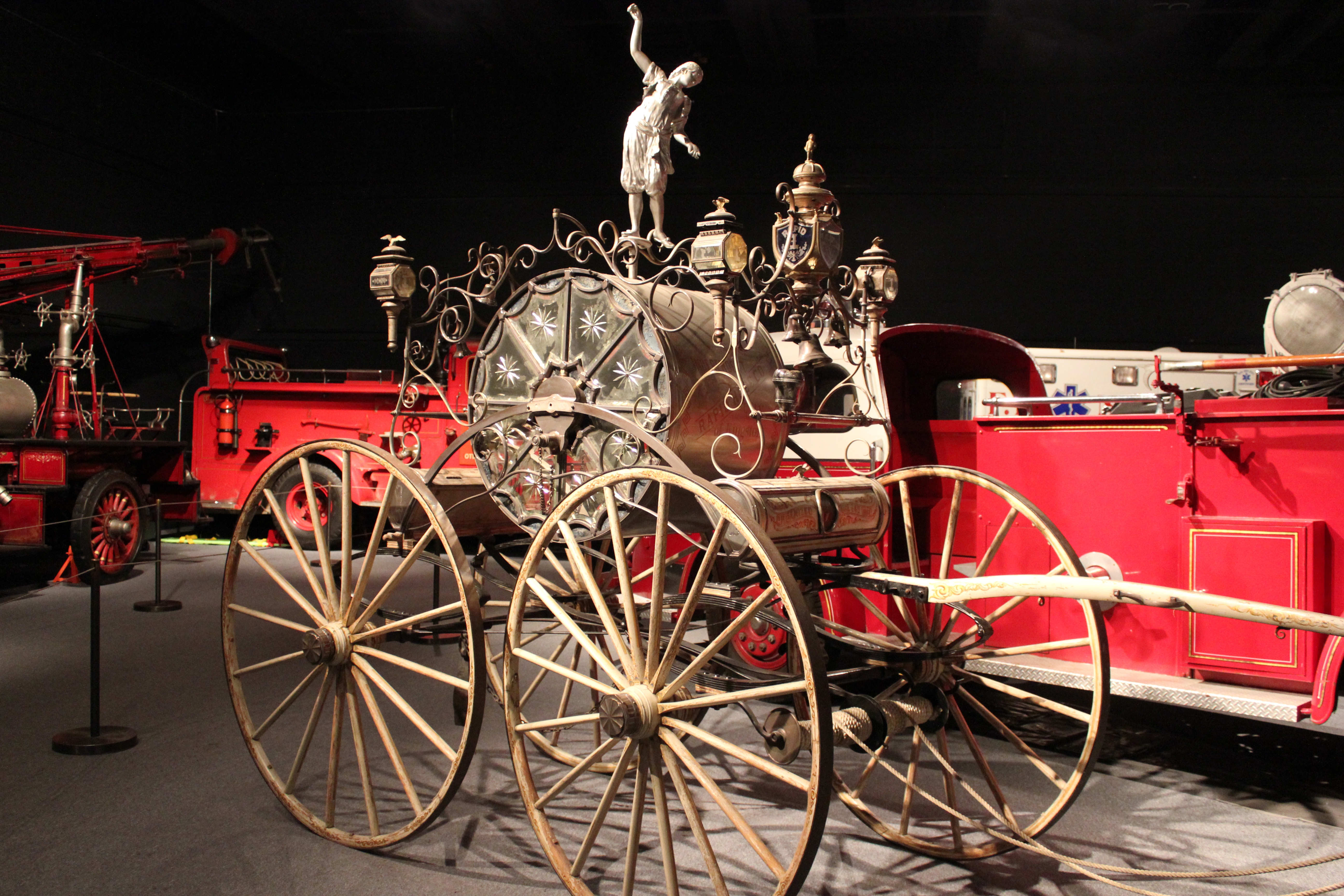
1875 Parade Carriage
This intricately adorned fire carriage was never intended to actually fight fires. Rather, it represented the pride that 19th-century volunteer fire departments took in their apparatus and was meant to dazzle on display in community parades. This hand-pulled carriage, with a dummy hose reel, featured velvet panels, beveled mirros, engraved gas lamps, and even an oil portrait!
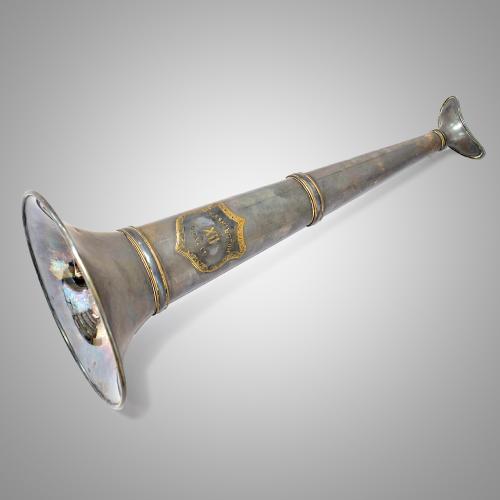
Speaking trumpet, Washington Hose Company #12 of New York City, c. 1850
Before radios and bullhorns, speaking trumpets were used to amplify verbal orders at a fire scene. Ceremonial speaking trumpets with elaborate designs were often given to retiring chiefs or as gifts from one company to another when visiting. In parades today, firefighters still carry ceremonial trumpets, often with a bouquet of flowers placed in the horn.
Fun Facts: Did you know?!
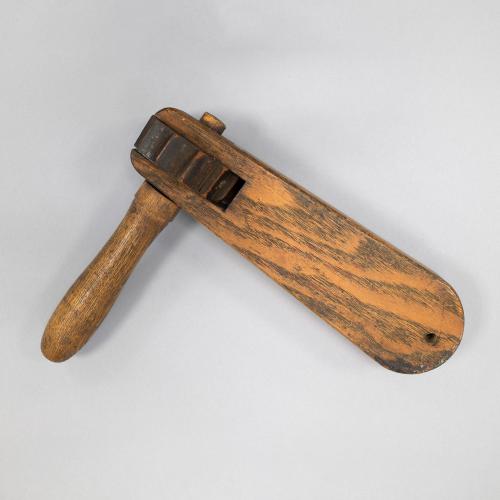
Sounding the Alarm
Early fire alarm systems included the "rattlewatch." Initiated in 1658, it consisted of a group of men who patrolled the towns at night and would shake loud wooden rattles to alert the townspeople of a fire.
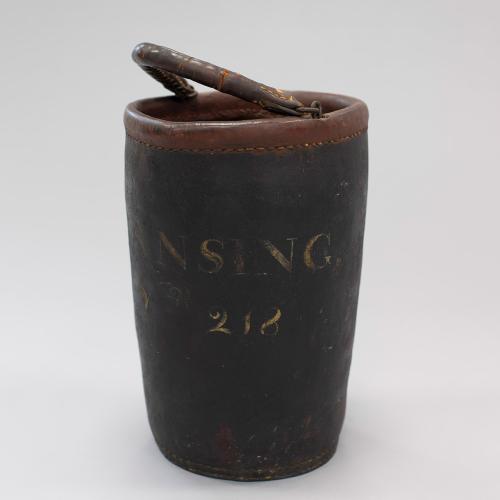
The Bucket Brigade
The earliest weapon colonists had to fight fires was the leather bucket. Most municipalities had rules requiring homeowners to have a certain number of them. In the event of a fire, all able-bodied adults were expected to bring their buckets to assist in the bucket brigade. Most commonly, men would pass the filled buckets, weighing around 12 pounds, and women would pass back the empty ones.
Here’s a behind-the-scenes look at the creation of a custom mural produced by our Museum staff as part of our updates to Fire Engine Hall in 2024.
Related Videos
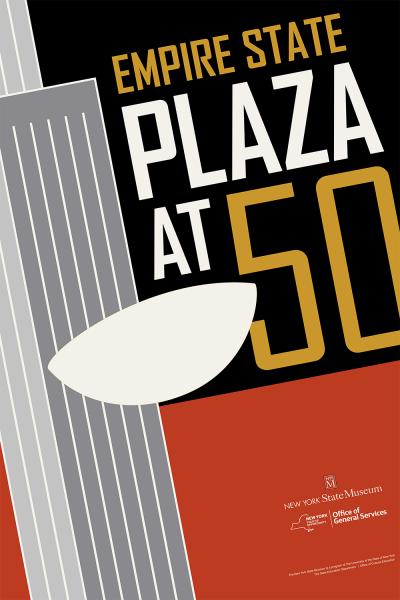
Empire State Plaza at 50
In June 1965, the cornerstone was laid for what would become The Governor Nelson A. Rockefeller Empire State Plaza. Marketed at the time as a “Design for the Future,” the Plaza exists today as an icon of 20th century Modernist architecture. This exhibit commemorates the 50th anniversary of the Empire State Plaza and tells the story of how the center of New York’s capital city became a public space where government, culture, and community converge
Online Feature
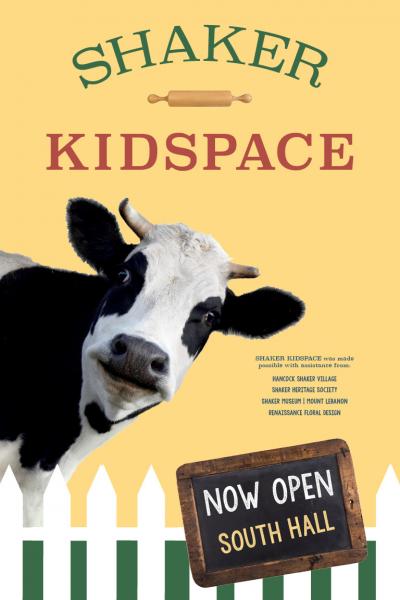
Shaker Kidspace
Discover the lives of Shaker children in a fun, creative, hands-on learning experience for young visitors Explore Shaker innovation through their inventions and then design your own!
Enjoy learning about the innovation, spirituality, education, and culture of the Shakers through an interactive experience for the whole family! Make sure to visit for special educator-led programming that gives families a chance to enjoy in-depth aspects of the Shaker community through engaging, hands-on opportunities.
Bird Egg Collection
Ornithology
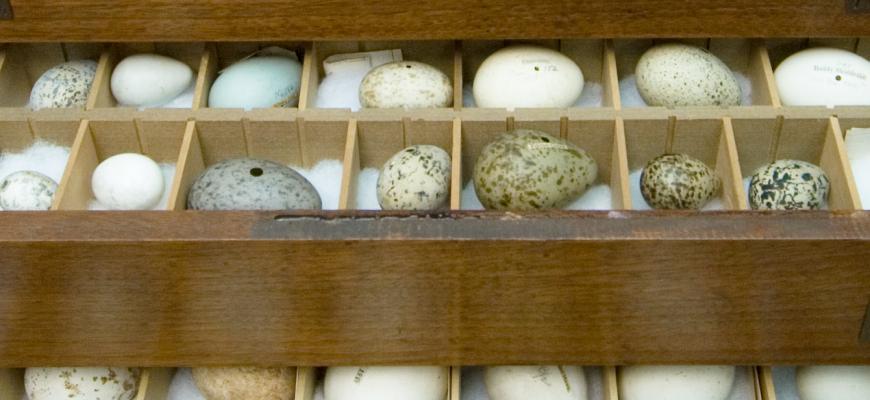
The New York State Museum’s collection of blown bird eggs is one of the world’s largest and most diverse, ranking 23rd in the number of specimens and 12th in the number of species. Nearly all of the eggs were obtained from three large private collections that were donated to the Museum by Benjamin W. Arnold (in 1912), Beecher S. Bowdish (in 1952), and Roy C. Latham (in 1969). For these men, and other wealthy amateur naturalists of the 19th and early 20th centuries (including the young Franklin D. Roosevelt and E. A. McIlhenny, inventor of Tabasco Sauce), egg collecting was a hobby that involved searching for nests in nature as well as trading and purchasing eggs from other collectors. The size and diversity of one’s egg collection was a source of pride, and collectors competed against one another much the same way that birders today compare “life lists” of the bird species they’ve seen.
A new conservation ethic, developed in the early 1900s, and the 1918 federal Migratory Bird Treaty Act, protecting birds and their nests and eggs, effectively ended the era of private egg collections. Some professional ornithologists obtained permits to continue collecting wild bird eggs, but for most of the 20th century, very few eggs were added to museum collections. Fortunately, the NYSM and other museums have maintained their historic egg collections, and these are proving to be valuable to scientists investigating a wide variety of new research questions.
Million Dollar Beach Site
Archaeological Excavations in the Village of Lake George, NY
The Million Dollar Beach Site is a multi-component archaeological site directly adjacent to the famous waterfront in the Village of Lake George. Limited excavations of the site toward the goal of better preserving it in place while maintaining use of the beach parking lot, road, and campground, are currently underway in a collaborative effort between the New York State Museum’s Cultural Resource Survey Program and the Department of Environmental Conservation.
Project Directors: Barry Dale, Aaron Gore and Steve Morange
Open File
Geological Collection
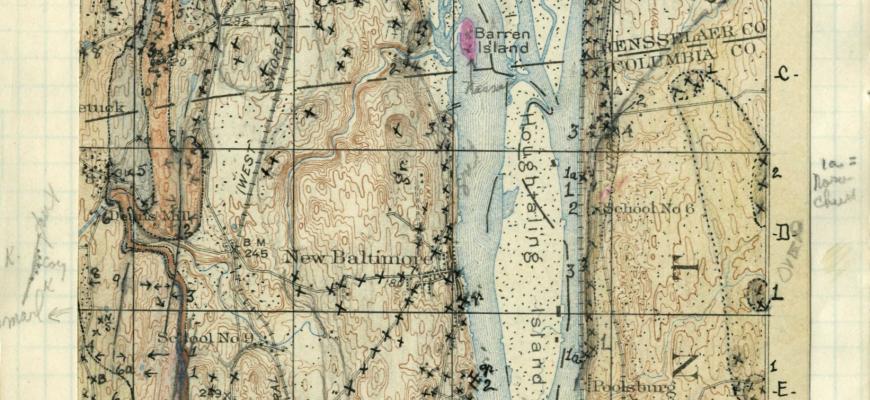
The New York State Museum Open File collection is a rare assemblage of one-of-a-kind unpublished geologic data from researchers across the state and nation. This paper collection, consisting of approximately 30,000 items, contains maps, theses, field notebooks, and aerial photographs. It dates back to the late 1800s, including works from the earliest researchers from both within and outside of the Museum.
The information in the Open File Collection is in demand by researchers, state agencies, and members of the general public. Data in the collection have been used for projects such as landslide mitigation, resource planning, and habitat protection.
Meltwater Routing & Catastrophic Drainage
During the last -- and almost certainly previous cycles -- of glaciation (Ice Ages), large ice sheets advanced southward into existing topography. The huge ice sheets depressed and repeatedly blocked streams acting as dams. The blocked drainage pooled and formed lakes, many of which were large such as glacial Lake Albany, glacial Lake Iroquois and glacial Lake Newberry. As these lakes filled they would find new outlets to drain. In many circumstances the flows of water were very large in comparison to modern streams. As a result they eroded and cut large channels across the landscape. Episodically, the water levels would become so deep -- perhaps on the order of 1000 feet or more --and the glaciers margin would become buoyant and start to float, sometimes causing the dam to fail rapidly and huge flows of water would be unleashed on the landscape as catastrophic floods. It has been suggested that some of these flows may even play a part in abrupt climate change. My research interests are in using technology to map and identify such glacial flood tracts and deposits, estimate flow volumes, and determine the timing of these events. Our recent work on the Montezuma Wetlands Complex has involved reconstructing former glacial lake levels and evaluating meltwater flow paths. My other projects have worked on a vast network of spillways and meltwater channels known as the Syracuse Channels.
Related Publications:
Kehew, A.E., Lord, M.L., and Kozlowski, A.L., Fisher, T.G., 2009, Proglacial Megaflooding along the margins of the Laurentide Ice Sheet. Burr, D. (Ed.), Megaflooding on Earth and Mars. Cambridge University Press. p.104-123.
Kehew, A.E., Lord, M.L., and Kozlowski, A.L. 2007 Glacifluvial landforms of erosion. In: Elias, S.A. (Ed.), Encyclopedia of Quaternary Science. Elsevier, p.818-830.
Kozlowski, A., Kehew, A. E., Bird, B.C., 2005, Origin of the central Kalamazoo River Valley southwest Michigan, USA. Quaternary Science Reviews, Vol. 24, no. 22, 2354-2374
Landslides in New York State
The geologic history and processes that operated in New York set in place the conditions that make landslides, slope failures, and mass movements possible. A combination of rock type, topography, structural integrity, and climate has created a scenario where slope failures may occur in materials ranging from crystalline rocks to glacial soils. Landslides have occurred across all of New York State, from the Adirondacks to Long Island. However, the most common (prevalent) types of landslides that occur in New York are the result of the combination New York's physiography and glacial history. Expansive lakes become a basin to trap fine-grained sediments, such as clays and silts. It is these fine-grained sediments, combined with topography and climate, that form a recipe for slope failures in New York. My research interests are in mapping the extent of these former glacial lake sediments, estimating their age, classifying the type of failures, and using LiDAR to identify paleolandslides and predict where future hazards may occur.
Related publications
Laura Sherrod1, Kenneth Schlosser1, Andrew Kozlowski2, Brian Bird2, D. Dale Werkema Jr.3 and Jarred Swiontek1; September, 2014, Geophysical Characterization of the Keene Valley Landslide in New York State, Journal of Environmental and Engineering Geophysics, Volume 19, Issue 3, pp. 139–155
Glacial Landsystems – Ancient & Modern
As glaciers modify the landscape the conditions upon which they operate (flow) can change for example glaciers may be flowing over loose sediment as they advance and may transition onto a bedrock surface absent of soils. The amount of subglacial water at the base of a glacier also vary in the above example and in soils subglacial meltwater may infiltrate into permeable soils where it may not be able to on solid bedrock, hence subglacial conditions can change over broad areas and distances along a glacier flow path. Accordingly as conditions change patterns of deposition and erosion by the glacier may change with the result that groups of landforms reflecting those conditions may appear that are characteristic of subglacial, ice marginal or proglacial settings. The patterns of landforms and deposits that result are known as landsystems. In New York and many locations around the Great Lakes scientists can compare the sediments left by glaciers in combination with the landforms (sediment-landform assemblage) and try to reconstruct the glacial conditions. Further scientists can compare the ancient landscape to landscapes that are emerging from modern glacial environments.
Related publications:
Kozlowski, A.L.; Graham, B.L. (Eds), June 2014, Glacial Geology of Cayuga County of the Eastern Finger Lakes: Lakes, Lore and Landforms; Guidebook for the 77th annual Reunion of the Northeastern Friends of the Pleistocene Meeting, Auburn, NY 140 pp.
Kehew, Alan. E.; Kozlowski, A.L.; Brian C. Bird; Esch, J. M., May 2013, Contrasting Terrains of the Lake Michigan and Saginaw Lobes of the Laurentide Ice Sheet in southern Michigan. In Gillespie, Robert (ed.) Insights into the Michigan Basin: Salt deposits, Impact structure, Youngest Basin Bedrock, Glacial Geomorphology, Dune Complexes, and Coastal Bluff Stability. Geological Society of America Field Trip Guide 31 pp15-36,
Kehew, Alan. E., Esch, J. M., Kozlowski, A. L. and Ewald, S. K. 2011, Glacial landsystems and dynamics of the Saginaw Lobe of the Laurentide Ice Sheet, Michigan , USA, Quaternary International, Vol. 24, no. 22, pp.1-11
Kehew, A.E., Lord, M.L., and Kozlowski, A.L. 2007 Glacifluvial landforms of erosion. In: Elias, S.A. (Ed.), Encyclopedia of Quaternary Science. Elsevier, p.818-830.
Kehew, Alan. E., Beukema, S. P., Bird, B. C. and Kozlowski, A. L. 2005, Fast flow/surge dynamics of the Lake Michigan Lobe: evidence from sediment-landform assemblages in southwestern Michigan, USA Quaternary Science Reviews, Vol. 24, no. 22, 2335-2353
Quaternary Landscape Materials (QLM)
Geological Collection
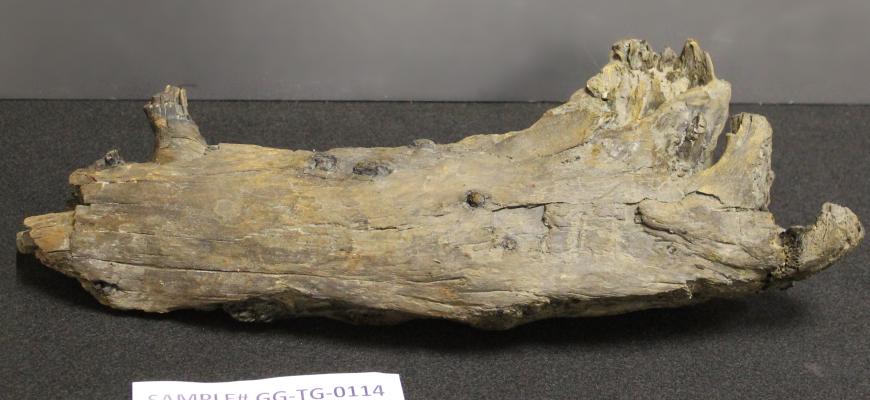
The purpose of the QLM Collection is to curate soil and sediment samples, continuous cores, and non-faunal organic materials that document the past 2 million years of New York State history (the Quaternary Period). Several of the scientific staff of the NYSM have overlapping specialties in the field of Quaternary studies. These interdisciplinary studies in geology, archeology and biology are associated with landscapes. Previously many of these types of materials have been collected and temporarily stored at NYSM, but not archived. Primarily, the collection materials will consist of samples of unconsolidated soils and sediments, organic materials (plants, pollen, shells), cave sediments, and other samples that relate to the reconstruction of Quaternary landscapes.
Principally this collection will grow with the addition of cores, unique important glacial soils and recovered paleobotanical remains from stratigraphic investigations. We live in a dynamic environment that is constantly adjusting; exposures of glacial stratigraphy today may be buried by slope failures, washed away by floods or built over by new developments in the future. This collection helps insure that important samples--perhaps containing information about past environments and climates--are documented and preserved for future researchers to analyze and study.
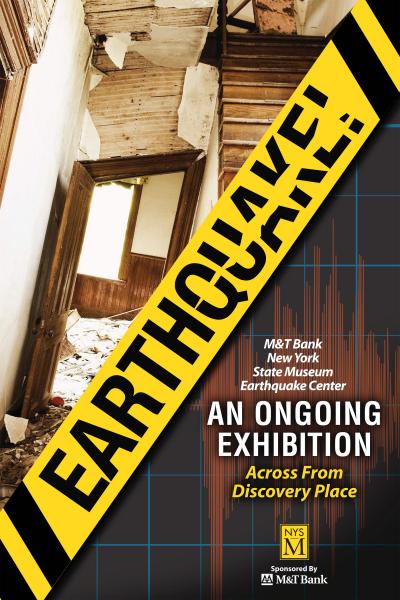
New York State Museum Earthquake Center
Ongoing Exhibition
While most people associate earthquakes with California, New York State does experience an average of 18 earthquakes per year. Although most of these quakes are not strong enough to be felt by residents, New York has endured a few large and destructive events throughout its history.
Visit the NYSM's ongoing earthquake exhibit to gain a greater understanding of both local earthquakes and significant events happening around the world.
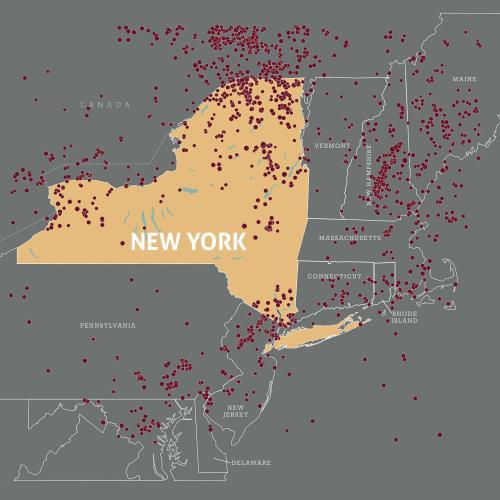
Interactive displays include a real-time seismographic showcase, allowing you to observe ongoing seismic activity around the world and understand how earthquakes are measured. From minor tremors to the notable 1944 St. Lawrence County quake, this exhibit provides a comprehensive look at New York's earthquake history, impact, and monitoring.
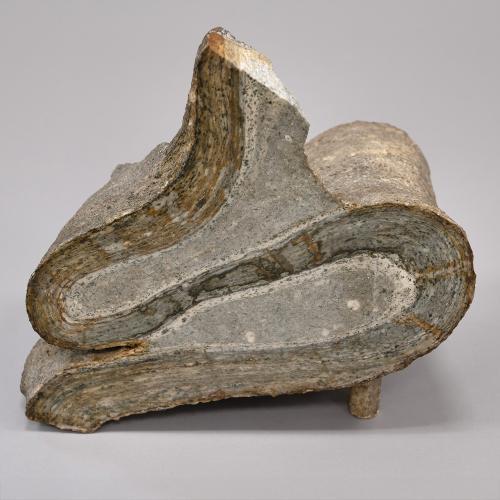
This exhibit features a captivating array of geological specimens, including folded, faulted, and polished rocks that vividly illustrating the forces created during quakes.
Fun Facts: Did you know?!
- Hundreds of earthquakes have and continue to occur in and near New York. These are mostly small events located within about nine miles of the surface.
- On September 4, 1944, New York endured it's largest earthquake measuring 5.8. Centered between Massena, NY, and Cornwall, Ontario, Canada, it caused an estimated two million dollars in damage to the two cities.
- Other notable New York earthquakes include the 5.5 magnitude quake in New York City in 1884, the magnitude 5.6 quake in Attica in 1929, and the 5.1 magnitude quake in Blue Mountain Lake in 1983..

View this Exhibit Online!
Visit this online feature to learn more about the Earthquake! exhibit, to access resources that monitor seismic activity in upstate New York, and to view the geological specimens that illustrate the effects of earthquake forces.
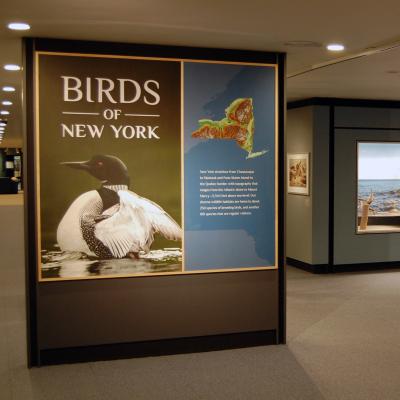
Birds of New York
Ongoing Exhibition
New York’s diverse wildlife habitats attract over 240 species of birds that breed within the state, and over 450 different bird species that spend at least part of the year here. From Chautauqua to Montauk, and from Staten Island to the Quebec border, the birds and their habitats change according to the landscape, altitude and proximity to urban centers.
This exhibit highlights many of the incredible birds that call New York State home, placing them each in their unique natural environment.
Online Feature
Dynamic Dioramas
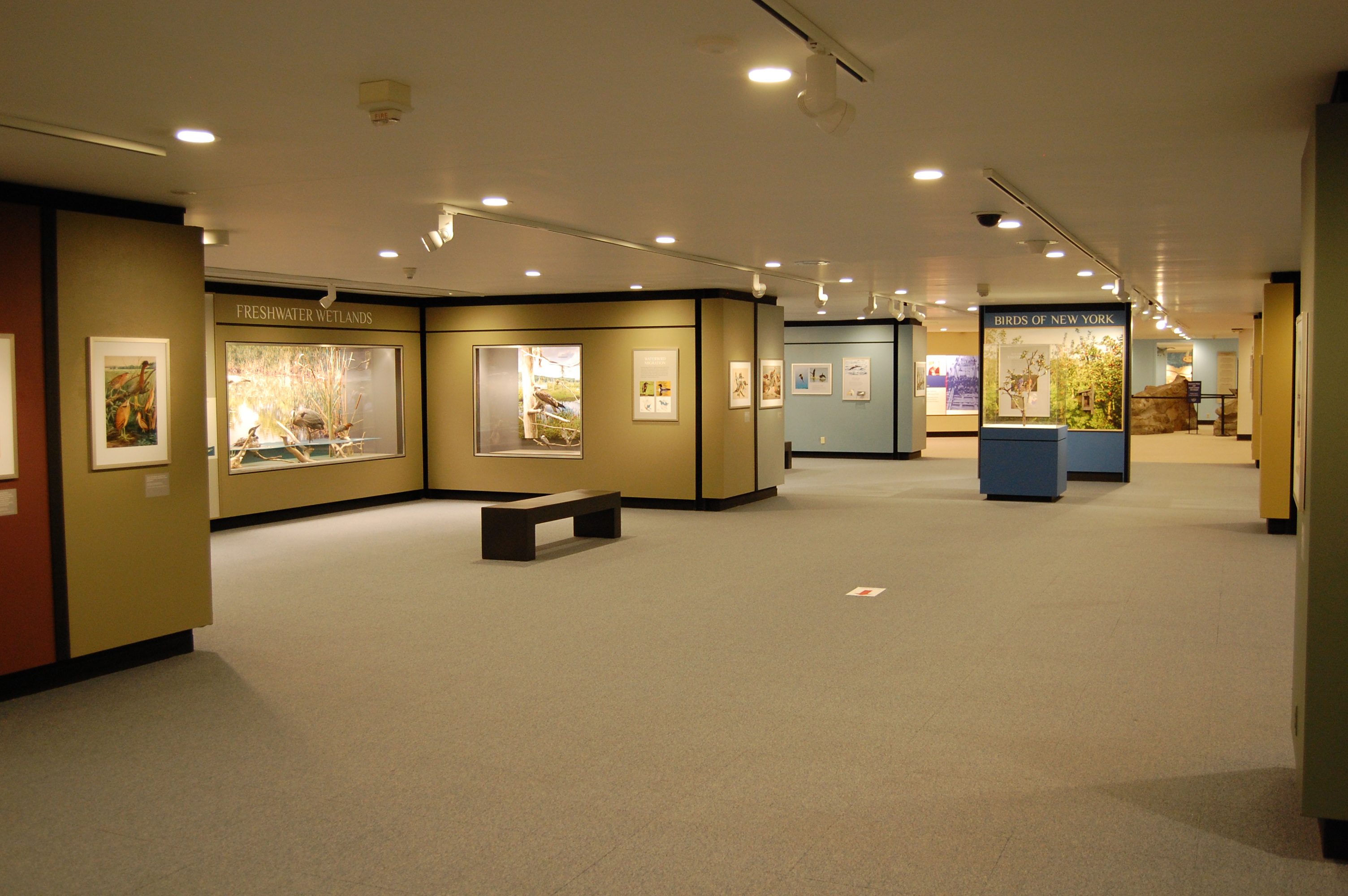
View 17 dioramas displaying over 130 taxidermy mounts of New York birds, organized by habitat.
Beautiful Birds
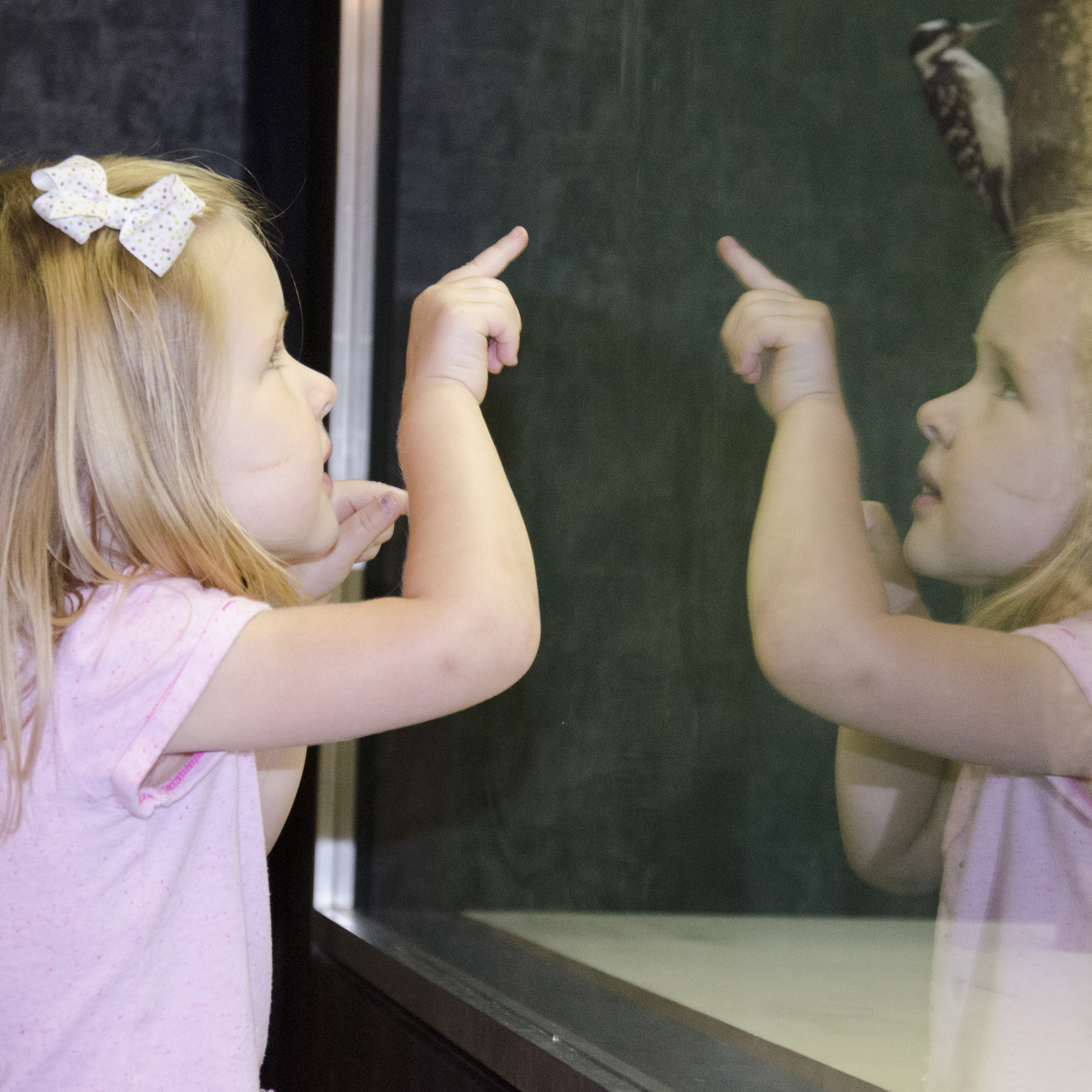
Observe up close New York’s smallest birds, like warblers, to some of the largest including owls, hawks, and herons.
Fun Facts: Did you know?!
- The Eastern Bluebird (Sialia sialis) was designated the official state bird of New York in 1970
- Ring-necked pheasants are originally from China
- In winter, huge flocks of water fowl that breed in the arctic call New York’s tidal bays and marshes home.
- The New York State Museum’s Ornithology Collection contains over 20,000 egg specimens
Related Videos
Educator and Student Guides




The Paul J. Higgins Site
The Paul J. Higgins site is a lithic site in the Town of Cortlandt, northwestern Westchester County. The initial identification of the site was made in the early fall of 2007 in advance of future roadwork by the Department of Transportation. The following two summers, archaeologists returned to the Paul J. Higgins site to complete Phase II and Phase III excavations, to mitigate deposits prior to impact. The site was determined to be a small lithic production site due to several factors: primarily on the amount of stone tool remains, lack of prehistoric architecture, and the lack of features relating to food storage and preparation.
Some 1,733 prehistoric and historic artifacts were recovered. The overwhelming majority of artifacts recovered (88%) were prehistoric, and of those, 99% related to stone tool production/refining, with less than 1% of those prehistoric artifacts relating to food preparation and storage. Included with the types of stone tools recovered include: projectile points, bifaces, hammerstones, choppers, and a drill. The lack of architecture or architectural elements merely means that was no evidence of a formal structure, which would include postholes. The lack of food preparation and storage refers to the fact that no features relating to the making and storing of food was found, which includes features such as hearths or storage pits. A few fragments of prehistoric pottery were recovered, but they were greatly overshadowed by the stone tools.
About 57 square meters, approximately 13%, of the total area of the site was excavated at the end of our study, most of which occurred during the last phase of excavation in 2009. It was at this time that archaeologists were able to date the site useing both relative and absolute dating methods. Two periods of prehistory were represented: the Late Archaic (4000-1400 BC) and Late Woodland (AD 700-Contact) Periods. The radiocarbon dates taken from samples associated with diagnostic projectile points all fit within these date ranges.
The Late Archaic Period, which was concentrated in the southwestern portion of the site was comprised of mainly lithic debitage (or the stone material produced while making a tool or projectile point), as well as projectile points. Three Lamoka or Lamoka-like stemmed projectile points were recovered which date the site to as early as the Late Archaic Period. These projectile points were all made of quartz, which is a material that is very difficult to shape and is primarily seen at sites further to the south.
Through analysis of the artifacts recovered, and the comparison with known archaeological sites both in the Lower Hudson Valley as well as elsewhere in New York State, archaeologists can paint a more complete and clearer picture of the prehistoric environment of the areas in which we live.
The Bailey Site
The New York State Museum completed excavations at the Bailey Site near Belgium, Onondaga County, New York prior to renovation of the Route 31 bridge over the Seneca River by the New York State Department of Transportation. The site consists of the remains of a small horticultural hamlet dating circa A.D. 1400-1450. Excavations produced evidence of one structure as well as small hearths, small and large storage pits, and debris scatters associated with pottery manufacture and stone tool production. Analysis of the contents of the storage pits, suggests that the site was occupied for much of the year.
Artifacts recovered from the site include remnants of incised, cord-marked, and stamped pottery, projectile points, bifaces, scrapers, ground stone adzes, hammerstones, and netsinkers. The majority of these artifacts were manufactured from local materials acquired from clay and stone outcrops located near the site. Clay smoking pipe fragments were also recovered and document leisure activities at the site.
Subsistence remains including wild turkey, white-tailed deer, black bear, beaver, freshwater trout, turtle, and eastern cottontail rabbit were recovered along with the charred remains of corn, beans, sunflower, squash, strawberry, elderberry, pin cherry, blueberry, hawthorn, and wild grape. Plants possibly used for medicinal purposes were also recovered including sumac, bedstraw, pokeweed, smartweed, and vervain.
In addition to this occupation, debris associated with the occupation of the site as the Kenyon-Remington store and as a Late Archaic camp were also recovered. The material from the site is curated in the Anthropology Collections of the New York State Museum.
The Schoharie Creek II Site
The Schoharie Creek II site was identified by museum archaeologists prior to the renovation of Route 7 in the Town of Schoharie, Schoharie County. Mitigation of the site produced artifacts associated with an Early to Middle Woodland camp. This project produced over 40,000 prehistoric artifacts. Twelve prehistoric features, including hearths, postmolds, and charcoal stains, were identified within the project limits. Accelerator mass spectrometry dates deriving from four different features document the site's occupation between 2500 and 1000 B.P. Carbonized plant remains indicate that the site's occupants consumed locally available wild plants (chenopodium, strawberries, wild grapes) and nuts (hazelnut, butternut, and walnut). These plants may have thrived in the wooded areas that aligned Schoharie Creek and may have attracted prehistoric groups to this site. Calcined bone from medium sized mammals and fish scales were also recovered from feature fill and suggest that local fauna and aquatic species were consumed.
The majority of the artifacts consist of chipped stone tools (bifaces, projectile points, side and end scrapers, unifaces, drills, etc.) and pieces of lithic debitage. Most of these artifacts were manufactured from locally available Onondaga chert. Small flakes manufactured from quartz and Pennsylvania Jasper were also recovered and suggest interaction between the site's occupants and other non-local groups. Ground stone tools, including pitted stones, hammerstones, and netsinkers, and undecorated ceramic sherds were also recovered and point to the use of the site for food processing and resource collection tasks. In addition to formal tools, expedient utilized flakes were used for plant processing.
A later historic occupation was also identified and provides information about the domestic use of the site during the mid to late 19th century. The 19th century is an important period in the history of Schoharie County. This period can be associated with the construction of the Albany-Susquehanna Railroad and the increasing importance of Schoharie County as a producer of agricultural products. Related to these changes were important changes in the socio-economic status and organization of individual households. Analysis of historic artifacts from the Schoharie Creek II site suggest that the site's mid to late 19th century occupants were part of a growing middle-class. The recovery of matched table and teawares suggests that the historic occupants of this site sought to convey their middle-class status to other members of the community through the use of expensive household items. The recovery of non-locally manufactured household and architectural items also suggest that the site's occupants may have also participated in a larger regional economy.
Archaeology for the Classroom Workshop
The New York State Museum is pleased to offer a three-day workshop entitled “Archaeology in the Classroom!”. Archaeology is a science that reaches into many disciplines making it particularly useful for teaching not only about archaeology but other subjects including the natural sciences, history, math, language arts, geography, social science, and the arts. This approach is consistent with the Core Curriculum changes being implemented across New York State.
This workshop provides educators with classroom lessons, activities, and projects designed to expose students to the excitement of archaeology that are stand-alone or connect to other curricula. Information about the advantages of object-based learning, using a museum as an educational resource, and applications to the State Learning Standards will also be presented. The workshop is open to all teachers although content is particularly geared toward teachers in grades 2-8.
"Home" Work: Educational Activities from the NYSM that You Can Do from Home!
Enjoy Learning about Maritime Art!
In 1609, when Henry Hudson’s ship, de Halve Maen (the Half Moon), dropped anchor near present-day Manhattan, two very different worlds met. One was the world of the Dutch Republic, a new country created from bitter conflict and new economic realities. The other was the world of Native Americans, people whose ancestors had lived along the “Great River” for thousands of years. This meeting would change both worlds in profound ways. It would also produce many of the ideas and values that define us as Americans.
Learn more about the journey of the Half Moon (de Halve Maen) and what life was like for the sailors aboard. Introduce your kids to basic nautical vocabulary with games and activities! Have students
MEASURE, PLAY, CREATE, AND LEARN!
MEASURE:
The Halve Maen: It was 85 feet in length—an impossibly small-seeming vessel for crossing an ocean—and must have been crowded for its 16 or so crew members. Can you measure out 85 feet?
PLAY:
Captains Coming! This is a great game to learn some basic ship vocabulary and get some energy out. This game is best played in an open space. Same rules as Simon Says. Explain to the crew (kids) that they are on a ship and that the crew will need to follow certain instructions. Point out the 4 sides of the ship that the crew will need to know (bow, stern, port, and starboard). Have the caller practice with the crew running to those 4 directions. Now, give the crew other instructions that they will need to follow. The most important rule—when the caller yells “Captain’s Coming!” the crew must stand at attention and they are not allowed to move until the caller says “at ease”—anyone that moves is out for that round. Optional instructions include: Raise the Sail (pretend to hoist the sail), Rowboat (sit on the ground and pretend to row away), Seasick (run to the side of the ship), Jellyfish (get on the ground and shake your arms and legs in the air). Or make up your own rules!
CREATE:
Try to draw a sailing ship—can you identify the parts of the boat?
LEARN:
Below are two NYSM videos aboard the Half Moon replica.
Today's artwork from NYSM Ethnology collections recognizes Indigenous medicinal knowledge
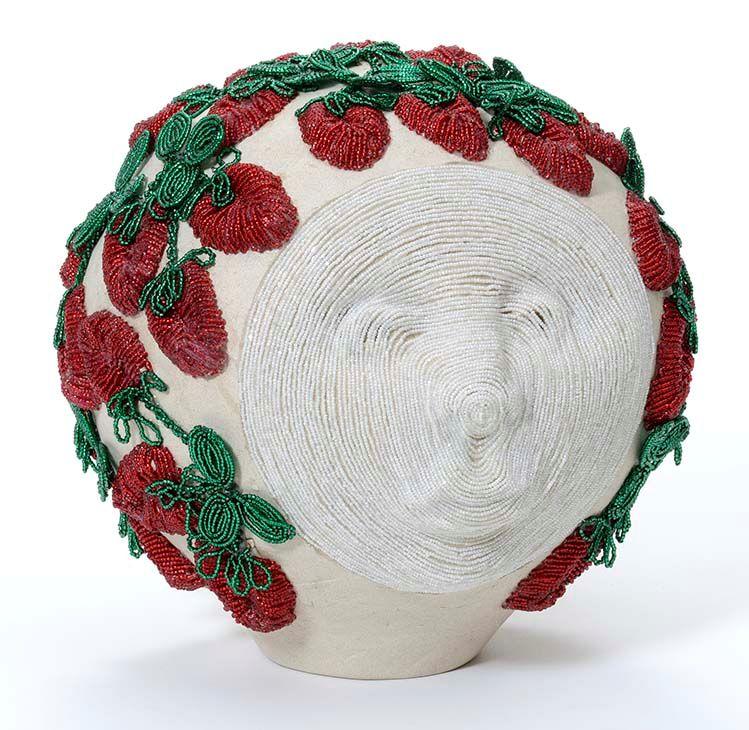

E2014.24 "Strawberry Moon" by Tammy Tarbell-Boehning (Mohawk) Raised glass beadwork on clay
One sub-discipline within cultural anthropology is the medical anthropology, or the focus on how humans think of medicine, illness and practice health and well-being. Today's artwork from NYSM Ethnology collections recognizes Indigenous medicinal knowledge!
In 1536, French navigator Jacques Cartier and his crew arrived in Mohawk territory on the Kaniatarowanenneh (St. Lawrence River) sick with scurvy, caused by malnourishment and poor diet. Scurvy is a severe deficiency of vitamin C, and Mohawk people were familiar with the illness and able to provide a cure to Cartier's crew made by boiling and preparing a concoction of the bark and leaves of the White Pine tree.
Strawberries are another source of vitamin C and could be dried and eaten during the long winter months. Strawberries are considered a precious gift in Haudenosaunee communities. According to the epic Haudenosaunee Creation narratives, Sky Woman falls from Sky World to Turtle Island (Earth) carrying the seeds for strawberries in her hands, a gift to the future peoples of Turtle Island.
Color the New York State Museum!
Get creative while "exploring" some of the New York State Museum's favorite exhibits and objects! Each colorful activity features a "Fun Fact" about the object on display.
The New York State Museum is excited to present a new outdoor experience that can be enjoyed while social distancing during our closure. From Madison Avenue, make your way to the Empire State Plaza and up the steps to the Museum Terrace. We’ve highlighted popular items from our 4th Floor Gallery, along with new objects from our collections that can be viewed from outside.
We invite you to revisit this page regularly, as we’ll be adding more content throughout the summer!
Please be considerate of fellow visitors. Allow at least 6 feet of space between yourself and others; wear a mask if that distance can’t be maintained; and please do not congregate in groups or touch the windows.
Objects on View:
Click on any of the images below to learn more about that object.
The NYSM Carousel
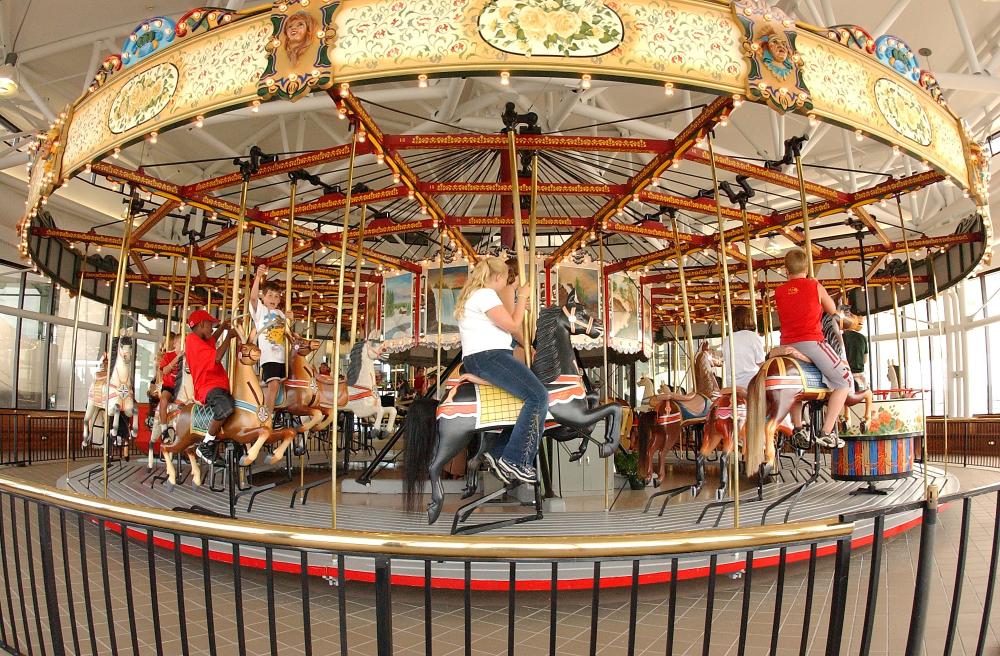
This full-sized carousel, made between 1912 and 1916 by the Herschell-Spillman Company of North Tonawanda, New York, represents the heart and soul of amusement rides at the turn of the 20th century. Did you know there are more carousels in New York than anywhere else in North America?
NYSM H-1975.134.NN
Carousel History
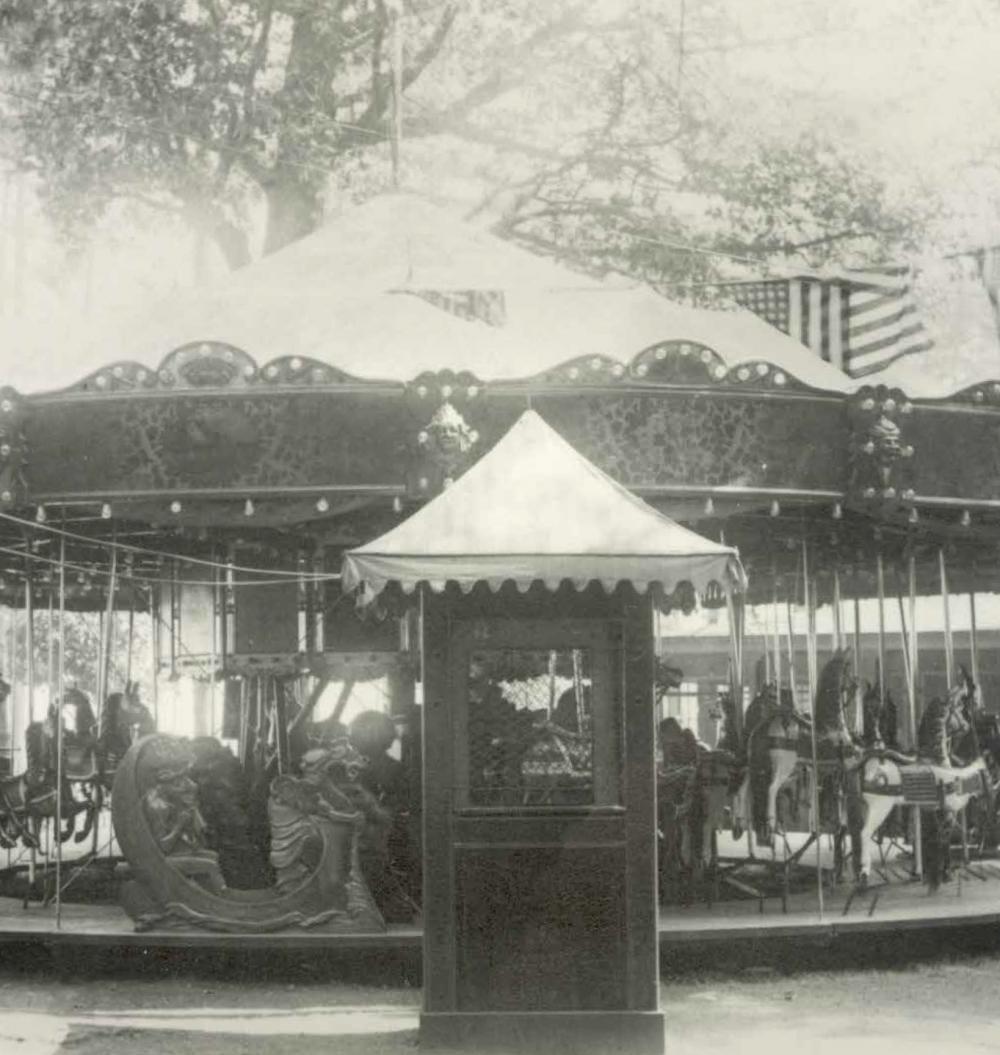
This carousel was first used in Wellsville, Allegany County, in 1916 and was transported to local fairs around the Southern Tier of New York and northern Pennsylvania. During the 1930 and 1931 seasons, the carousel was based at Olcott Beach on Lake Ontario (pictured). It later was located at Cuba Lake’s Olivecrest Amusement Park in Cuba, Allegany County, where it operated until the early 1970s. The Museum purchased the carousel in 1975 from Robert Hopkins of Cuba and fully restored and installed it here in 2001.
Carousel Horses, Deer, and Donkey

NYSM Carousel Horse
The animal figures pre-date the machinery and platform and are some of the oldest in the country. The horses were hand-carved in 1895 by German immigrant and toymaker Charles Dare in his Brooklyn shop. The deer and donkey appear to be of another make. They were originally mounted on a steam-driven track carousel, where they only moved in a circle, not up and down. They became “jumpers” around 1915 when the present frame was built.
Guiding Questions:
- Why does the carousel have so many lights?
- What animals are on the carousel?
- What makes the animals jump? (Hint: Look at the tops and bottoms of the poles.)
To learn more about the carousel, visit:
NYSM Carousel History:
http://www.nysm.nysed.gov/exhibitions/ongoing/carousel-0
NYSM Museum Moment Video (1:23 minutes)
www.youtube.com/watch?v=k9Ux86mE_6c.
Color Our Collections
Download this printable coloring page and get creative with this object from the NYSM Collections!
Sail Plane (hanging above)

Students at Rensselaer Polytechnic Institute’s Center for Composite Materials and Structures completed and flew this experimental two-passenger sailplane (glider) in 1999. It is built with fiberglass, Kevlar, and graphite—affixed with epoxy—to produce high stiffness-to-weight ratios ideal for aircraft construction. Its wingspan is 56 feet.
NYSM H-2002.15.1 Gift of Rensselaer Polytechnic Institute
Guiding Questions:
- Compare the sailplane to the biplane: How are they similar and different?
- What keeps the sailplane up in the air?
- What keeps the biplane up in the air?
- Why would the conservation department want to use an airplane?
Airplanes were used for spotting forest fires, as documented by these photos courtesy of NYS Archives:
Biplane (hanging above)

Purchased by New York State in 1931, this plane was used by the Conservation Department to spot forest fires. It could hold two to three passengers and has stick and foot-pedal controls.
NYSM H-1987.11.1
Guiding Questions:
- Compare the sailplane to the biplane: How are they similar and different?
- What keeps the sailplane up in the air?
- What keeps the biplane up in the air?
- Why would the conservation department want to use an airplane?
Airplanes were used for spotting forest fires, as documented by these photos courtesy of NYS Archives:

Color Our Collections!
Download this printable coloring page and get creative with this object from the NYSM Collections!
Papa Burger
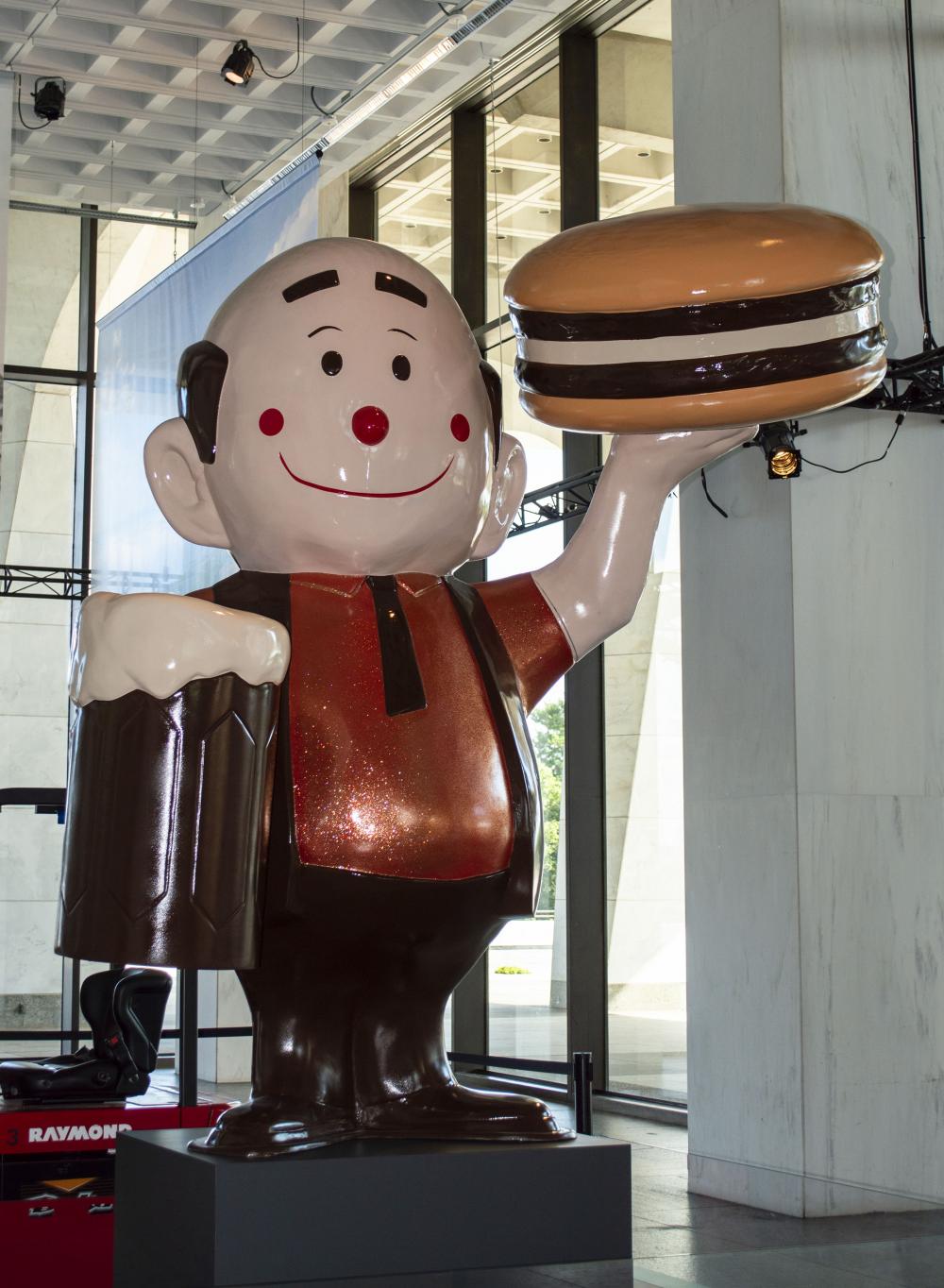
Papa Burger on exhibit at State Museum
Photo Credit: New York State Museum
This 9-foot-tall statue entered the Museum’s collection in 1998 as an “unknown fiberglass figure of a man holding a mug and a hamburger” from the Syracuse or Rochester area. Research soon revealed his identity as “Papa Burger,” an iconic mascot for the A&W Root Beer chain of restaurants dating back to the 1960s. The Museum recently restored Papa Burger to his original colors and details.
NYSM H-1998.26
Guiding Questions:
- Why would a store want a 9-foot-tall statue?
- What do you think A&W stores sold?
- Can you think of another mascot used by a business?
Hoffman’s Playland Ticket Booth

Hoffman's Playland Ticket Booth
1953
Photo Credit: New York State Museum
Hoffman’s Playland was a family-owned business located in Latham, New York, that opened in 1953 when Bill Hoffman purchased a carousel and this ticket booth and placed them on his father’s property; more rides were soon added. Bill’s son, Dave, later took ownership, and Hoffman’s continued to be a popular destination for family fun. When it closed in 2014, Dave and his wife, Ruth, donated this ticket booth to the State Museum.
NYSM H-2015.18 A-J
For additional information about the Hoffman's Playland Ticket Booth:
http://www.nysm.nysed.gov/about/press/state-museum-exhibits-papa-burger-statue-hoffmans-playland-ticket-booth-fourth-floor
Niagara Falls Barrels (hanging above)

These reproduction barrels replicate those used by daredevils who have taken a trip over Niagara Falls. In 1901 Annie Taylor became the first documented survivor of a ride over Niagara Falls in a barrel. Many others have since attempted it. Canadian stuntman Karel Soucek successfully went over the falls in 1984 in a barrel like the red one here bearing his name.
Guiding Questions:
- Why would daredevils choose a barrel to go over Niagara Falls?
Learn more about Niagara Falls and how it formed:
www.nysm.nysed.gov/research-collections/geology/resources/niagara-falls.
Watch the Falls live:
www.niagarafallslive.com/.
Color Our Collections!
Learn more about the New York State Museum’s diverse collections while creating your own works of art at home. Enjoy this family-friendly activity for all ages and then share your children’s artwork at NYSMEducation@nysed.gov. We’ll post new coloring sheets and submitted artwork on a regular basis so make sure to visit often!
New York State Education Department Statement on Museum Deaccessioning
The New York State Board of Regents (“the Regents”) charters museums in New York State as educational corporations and has governing authority over these incorporated organizations. In 2011, the Regents approved an amendment to its Rules regarding deaccession policies, including the practice of deaccessioning and the use of funds resulting from such practice.
Recently, there had been some confusion in the museum field regarding deaccessioning regulations. The Regents Rules are in alignment with the American Alliance of Museums (AAM) Code of Ethics for Museums that remain in place.
The relevant Regents Rules are listed below:
Title 8 of the Official Compilation of Codes, Rules and Regulations of the State of New York
§3.27
(a) Definitions.
(10) Deaccession means: (a) removing an object from an institution's collection or (b) the act of recording/processing a removal from an institution's collection.
(5) Facilities. The institution shall:
(e) Deaccession. The criteria and process (including levels of permission) used for determining what items are to be removed from the collections, and a statement limiting the use of any funds derived therefrom in accordance with subparagraph (vii) below;
(iv) ensure that collections or any individual part thereof and the proceeds derived therefrom shall not be used as collateral for a loan;
(v) ensure that collections shall not be capitalized; and
(vi) ensure that proceeds derived from the deaccessioning of any property from the institution's collection be restricted in a separate fund to be used only for the acquisition, preservation, protection or care of collections. In no event shall proceeds derived from the deaccessioning of any property from the collection be used for operating expenses or for any purposes other than the acquisition, preservation, protection or care of collections.
(7) Deaccessioning of collections. An institution may deaccession an item in its collection only in a manner consistent with its mission statement and collections management policy and where one or more of the following criteria have been met:
(i) the item is inconsistent with the mission of the institution as set forth in its mission statement;
(ii) the item has failed to retain its identity;
(iii) the item is redundant;
(iv) the item's preservation and conservation needs are beyond the capacity of the institution to provide;
(v) the item is deaccessioned to accomplish refinement of collections;
(vi) it has been established that the item is inauthentic;
(vii) the institution is repatriating the item or returning the item to its rightful owner;
(viii) the institution is returning the item to the donor, or the donor's heirs or assigns, to fulfill donor restrictions relating to the item which the institution is no longer able to meet;
(ix) the item presents a hazard to people or other collection items; and/or
(x) the item has been lost or stolen and has not been recovered.
Museum Reporting Requirements
§3.27 & §3.30
Each institution shall file with the commissioner an annual report, in a form prescribed by the commissioner, which records the educational and cultural activities of the institution and presents an accurate statement of all financial operations. Each institution shall include in its annual report a list of all items or item lots deaccessioned in the past year and all items or item lots disposed of in the past year.
More Information on Deaccessioning
NYSED
2011 Amendment of Regents Rule §3.27, Relating to Museum Collections Management Policies
https://www.regents.nysed.gov/meetings/2011/2011-02-12
American Alliance of Museums (Direct Care of Collections)
https://www.aam-us.org/programs/ethics-standards-and-professional-practices/direct-care-of-collections/
Association of Art Museum Directors 2020 Resolution regarding Deaccessions (AAMD)
https://aamd.org/for-the-media/press-release/aamd-board-of-trustees-approves-resolution-to-provide-additional
COVID-19 General Information:
NYS Department of Health: https://coronavirus.health.ny.gov/home
NYS Education Department: http://www.nysed.gov/coronavirus
Reopening Information:
New York Forward Reopening Guide: https://www.governor.ny.gov/sites/governor.ny.gov/files/atoms/files/NYForwardReopeningGuide.pdf
New York Regents Advisory Council on Libraries: Reopening of Libraries
American Industrial Hygiene Association: Reopening Guidance for Museums and Collecting Institutions
Online Computer Library Center: REALM Project: REopeing Archives, Libraries and Museums
REALM Project: Materials Testing and Resource Overview
American Alliance for Museums: Reopening Resources
American Association for State and Local History: Reopening Plans
Association of Children’s Museums: COVID-19: Resources for Children's Museums
Association of College and Research Libraries: Pandemic Resources for Academic Libraries, Preparing to Reopen
IMLS Research Partnership: Safe Handling of Collections and Reopening Practices for Libraries and Museums
Society for the Preservation of Natural History Collections: SPNHC Virtual Conference Plenary Session
Institutions Reopening:
Fort Plain Museum & Historical Park
Ganondagan: Seneca Arts and Culture Center
Greater Oneonta Historical Society
Museum of the City of New York
Grants and Financial Relief Information:
American Alliance for Museums: Financial Relief and Support Resources
Andrew W. Mellon Foundation Grant Call for Proposals to Community-Based Archives
Humanities New York: HNY CARES Emergency Relief Grants
Institute of Museum and Library Services CARES Act Grants for Museums and Libraries
Institute of Museum and Library Services: Cares Act Grants for Native American/Native Hawaiian Museum and Library Services
Museum Association of New York: Buidling Capacity, Creating Sustainability, Growing Accessibility
National Endowment for the Arts: CARES Act Grants
National Endowment for the Humanities: CARES Act Grants
NYC Cultural Affairs: Funding Resources for Cultural Organizations
New York Forward Loan Fund: https://esd.ny.gov/nyforwardloans-info
New York State Council on the Arts: COVID-19 Relief Funds and Business Support
William G. Pomeroy Foundation: Fund for NYS History
Guidelines for Handling Books, Paper, and Objects During the Pandemic
American Institute for Conservation COVID-19 Pandemic and Collection Care
American Library Association: Handling Library Materials and Collections During a Pandemic
American Libraries Magazine: How to Sanitize Collections in a Pandemic
Center for Disease Control Mitigating COVID-19 When Managing Paper-Based, Circulating, and Other Types of Collections
Canadian Conservation Institute COVID-19 Task Force: Caring for Heritage Collections during the COVID-19 Pandemic
Environmental Protection Agency: Disinfectants for Use Against SARS-CoV-2 (COVID-19)
LYRASIS: Collecting Archival Materials During the COVID-19 Pandemic
National Center for Preservation Technology and Training: COVID-19 Basics: Disinfecting Cultural Resources
Northeast Document Conservation Center: Disinfecting Books and Other Collections
Online Computer Library Center: REALM Project Test 1 Results
Online Computer Library Center: REALM: Scientists Find Virus Still Detectable After Six Days on Four Common Library Materials when Stacked
Online Computer Library Center: REALM: Results from Latest Tests of Coronavirus on Leather, Summary of Research
New York Library Association
Museum Association of New York
International Council of Museums
Association of College and Academic Libraries
American Alliance of Museums
Institute of Museum and Library Services
Other News and Articles Regarding Cultural Organizations and COVID-19
“Libraries Respond to COVID-19" - Times Hudson Valley Media, March 19, 2020. http://timeshudsonvalley.com/stories/libraries-respond-to-covid-19,15848
“Galleries, Auction Houses and Museums Are Joining Growing Efforts to Donate Their Protective Medical Gear to Hospitals—ArtNews, March 31, 2020. https://news.artnet.com/art-world/art-organizations-donate-medical-supplies-1818429
“Libraries lending out 3-D printers to make protective gear” - Newsday, April 1, 2020. https://www.newsday.com/news/health/coronavirus/printers-libraries-coronavirus-1.43563580
“Citizen Archivists Triple Contributions to National Archives Catalog During Pandemic”—National Archives, April 22, 2020. https://www.archives.gov/news/articles/citizen-archivists-triple-contributions
How Will Coronavirus Pandemic Be Remembered? Historians are Making Sure Story is Documented at Every Level—WLNY, April 23, 2020. https://newyork.cbslocal.com/2020/04/23/coronavirus-pandemic-historians-robert-snyder-louise-mirrer-new-york-historical-society/?fbclid=IwAR0D5fyxgodI6NZWhPDYn0NaoLh8cVjMQa42E1Ykcdt_MGeEHO2Si3t7yJc
“The city soundtrack: New York Public Library drops album featuring noises we’ve been missing during coronavirus lockdown” - Daily News, May 1, 2020 https://www.nydailynews.com/new-york/ny-sounds-library-city-spotify-20200501-jbgnitgrwbf4fcggjbaxk7vvye-story.htmlRK
Beyond the Hotline: Stories of grief, despair flood Schenectady County’s Call Center- Daily Gazette, May 2, 2020. https://dailygazette.com/article/2020/05/02/behind-the-hotline-stories-of-grief-despair-flood-schenectady-county-s-call-center?fbclid=IwAR1flisMqXiEbhzX67O9sO6KAgOcVkWWcLGeB6YAOhpq22yljDqob514CvE
Local History Project Marks 160 Audio Stories – Adirondack Almanac, May 3, 2020. https://www.adirondackalmanack.com/2020/05/local-history-project-marks-160-audio-stories.html
“The Strange, Smelly Chores that Keep Natural History Museums Running”—Atlas Obscura, May 12, 2020: https://www.atlasobscura.com/articles/unusual-essential-workers-natural-history-museums
“Museums Are Reopening Around the World, But Visiting Them Is Now Very… Odd. See Surreal Images of Post-Lockdown Museums”—ArtNet News, May 13, 2020 . https://news.artnet.com/art-world/views-of-reopening-cities-1860222
“Italy’s museums reopening, using Social Distancing necklaces”—ArtNet News, May 19, 2020: https://news.artnet.com/art-world/italys-museums-reopen-1864938/amp-page
“Virtual resources for experiencing historical sites from the National Trust for Historic Preservation” https://savingplaces.org/coronavirus?utm_medium=email&utm_source=newsletter&utm_campaign=weekly#.XsalNmhKhyw
“Humanities New York Pandemic Reading List” https://humanitiesny.org/community-pandemic-perspectives/?utm_source=Newsletter&utm_campaign=7278e6de08-EMAIL_CAMPAIGN_2017_10_04_COPY_01&utm_medium=email&utm_term=0_4156e3c688-7278e6de08-289259873&mc_cid=7278e6de08&mc_eid=db25f71283
Librarians Recruited as COVID-19 Hunters, May 22, 2020: https://americanlibrariesmagazine.org/blogs/the-scoop/contact-tracing-librarians-recruited-as-covid-19-hunters/
How Will We Remember the Pandemic? Museums are Already Deciding—New York Times, May 25, 2020: https://www.nytimes.com/2020/05/25/arts/design/museums-covid-19-collecting.html?action=click&module=Well&pgtype=Homepage§ion=Arts
State of the Art: How Museums are Preparing to Open Amid Coronavirus Crisis—NBC News, May 27, 2020: https://www.nbcnews.com/business/consumer/state-art-how-museums-are-preparing-open-amid-coronavirus-crisis-n1213396
NYS School Librarians Lead Through the Pandemic, May 28, 2020: https://www.wevideo.com/view/1727092285
New York City School Library COVID-19 Free E-Books https://nycdoe.libguides.com/COVID-19ebooks/free
Library to Introduce Curbside Pickup, June 1, 2020: https://www.uticaod.com/news/20200601/library-to-introduce-curbside-pickup
Humanities New York Announces $1 Million in CARES Act Funding, June 23, 2020: https://humanitiesny.org/humanities-new-york-awards-1-million-in-cares-act-funding/
Pomeroy Fund Awards $50,000 in Grants to Support 18 NYS History Organizations, June 24th, 2020: https://www.wgpfoundation.org/pomeroy-fund-awards-50000-in-grants-to-support-18-nys-history-organizations/
Mellon Foundation Invests $1.5 Million in Federal COVID-19 Research Project to Support Libraries, Museums Reopening, June 25, 2020: https://www.imls.gov/news/mellon-foundation-invests-15-million-federal-covid-19-research-project-support-libraries
This Year Will End Eventually, Document it While You Can, New York Times, July 14, 2020: https://www.nytimes.com/2020/07/14/style/museums-coronavirus-protests-2020.html
Picture This: Historical Approaches to Data Visualization, History Associates Incorporated: https://www.historyassociates.com/data-visualization/
New York City Museums Plan Reopenings, Even with no Official Return Date, The Wall Street Journal, August 10, 2020: https://www.wsj.com/articles/new-york-city-museums-plan-reopenings-even-with-no-official-return-date-11597104001?mc_cid=c357089185&mc_eid=2218141061
Smithsonian Museums are the Latest to Shutter as Virus Surges, The New York Times, November 19, 2020: https://www.nytimes.com/2020/11/19/arts/design/smithsonian-museums-closing-covid-dc.html
Smithsonian Archives of American Art Gathers an Oral History of 2020, George Washington University, November 30, 2020: https://historynewsnetwork.org/article/178328
Gotham Center for New York City History: COVID-19 NYC Documentary Project, https://www.gothamcenter.org/covidnyc-documentary-project
Museum of the City of New York: April 28, 2021: Final Weeks: New York Responds Exhibit, https://www.mcny.org/exhibition/nyresponds?utm_source=Museum+of+the+City+of+New+York&utm_campaign=8b6ffe0ca1-Exhibitions_May2021_NYResponds&utm_medium=email&utm_term=0_4336ff1f8c-8b6ffe0ca1-153539057&mc_cid=8b6ffe0ca1&mc_eid=671041bea3
Dispensing Justice from a Distance: Journal of the NYS Courts During the Pandemic, Historical Society of the New York Courts, September 2021 https://mailchi.mp/nycourts/dispensing-justice-courts-never-closed?e=dee5748a07
Webinars and Other Resources
Institute of Museum and Library Services: December 15th, 3:00pm Museums and COVID: How to Use the Latest Research to Your Advantage Registration Required
Museum of the City of New York: New York Responds the First Six Months Exhibit
Museum of the City of New York: New York Responds: A One-Year Remembrance
REALM Project: April 15th, 3:00pm Understanding COVID-19 Vaccines Registration Required
National Documentation Efforts
National Building Museum: Documenting Crossroads: The Coronavirus in Poor, Minority Communities
National Council for Public History: COVID-19 Survey for Public Historians
National Museum of American History “National Museum of American History Implements Collecting Strategy" in Response to COVID-19 Pandemic”
Programming Librarian: Getting (Through) This Together: A Community-Based Archival Collaboration Webinar Oct. 7, 2020 1:00pm
Rockefeller Institute of Government: Covid-19 State Relief Dashboard
Rhode Island Historical Society and Providence Public Library: Rhode Island Covid-19 Archive
Capital District
22 Whitney Place
Saratoga Springs, NY 12866
United States
Help make history by sharing your story of the COVID-19 pandemic. Just as we relied on information about the Spanish Flu epidemic in 1917-1918 to inform our response to COVID-19, future generations may benefit from understanding what we experienced. By collecting your stories, we become witnesses-to-history, providing insight into daily life during this global pandemic and adding to the historic record.
How can you get involved? Please take some time to fill out this form -- and feel free to share with your friends, family members, and neighbors -- the more people participate, the better understanding we’ll have of the impact of COVID-19.
This survey consists of 20 questions -- you do not have to answer them all. Answer what you like -- each one you answer helps paint a portrait of our community during COVID-19.
Feel free to fill out this survey multiple times. For example, if you answered the questions on May 27th and have more information that you wish to report on June 15th (random dates selected), submit a second survey response. Thank you for participating. Read more...
32 Washington Ave
Schenectady, NY 12305
United States
From the Schenectady County Historical Society website.
We are all making history right now, as we live through the COVID-19 pandemic. It’s an emergency of historic proportions, and has been compared to the Black Plague, or the 1918 Spanish Flu. Like those past crises, COVID-19 will be a major topic of study for future historians. Years from now, Schenectadians will look back and wonder, “how did the COVID-19 pandemic affect Schenectady County? How did our ancestors respond to the crisis?” “What was life like for people quarantined, for months?”
You can help future researchers understand for themselves what life right now is like. You can help future historians understand the pandemic’s immense impact on our community, and on ourselves, and on our way of life. You can help future historians understand how this international emergency changed your life, and changed our world, forever.
Consider recording your unique perspective for inclusion in the SCHS archives. Diaries, scrapbooks, photo albums, letters, songs, poems, short stories, and other works of art are all important sources for future historians. Be creative: there are infinite ways you can express yourself, and document the impact of COVID-19 on you, your loved ones, and your neighbors. Read more...
Central New York
1608 Genesee Street
Utica, NY 13502
United States
From the Oneida County History Center website.
We are all living through a historic moment in time. The History Center wants to preserve your story for future generations and is inviting the public to submit their COVID-19 stories. These narratives will become part of the History Center's collections and will be available for future researchers to learn how our community was impacted by this global pandemic. Read more...
Finger Lakes

321 Montgomery Street
Syracuse, NY 13202
United States
From the Onondaga Historical Association.
Does history repeat itself? As I re-read the cover story of our Spring/Summer 2018 issue of History Highlights magazine titled, “The Great Pandemic of 1918”, I can’t help but think that it does. Thanks to those who documented and preserved that history, we learned from past experience. That record allows us to compare the extent and consequences of two pandemics separated by over a hundred years.
The Spanish Flu pandemic killed more than 900 people in Syracuse from 1918-1920. The way the world mobilizes to limit the spread of COVID-19 has much to do with what we learned from that crisis.
We continue to fight this new pandemic together by staying apart, and we know from our history that it will eventually end. How much we learn over the long term depends on how much future generations pay attention to the historical record.
OHA has preserved our history for nearly 160 years to educate the public in order to craft a better future. Prior experience teaches us that we can accomplish anything if we work together. OHA is documenting that effort by collecting newspaper and magazine articles, recordings of the daily briefings from our Mayor and County Executive, and Governor, and the stories that define the impact of the pandemic on daily life. Read more...
5 Murray Hill Drive
Mt. Morris, NY 14510
United States
The County Historian is requesting assistance from the public to help document the impact of the COVID-19 pandemic.
Please consider sharing firsthand experiences, images, and reactions on how COVID-19 has altered your life and community. All information gathered will become part of the County Historian's permanent archival collection and made accessible for researchers. Stories and images may also be used for future exhibits. Read more...

110 North Tioga Street
Ithaca, NY 14850
United States
From the History Center in Tompkins County website.
We are living through one of the most demanding and disturbing times in modern history. The whole world is grappling with the unsettling realities of the Coronavirus outbreak. Tompkins County is no exception, and our community hascompletely restructured in the past month with the goal of protecting our most vulnerable, and slowing down the spread of the virus locally so our local health workers can continue to provide the best care to all patients. Many historians have been comparing the COVID-19 outbreak to the global influenza pandemic of 1918. In this instance however we have an opportunity to better document this pivotal time in our community than we've ever had before.
The History Center in Tompkins County and the Cornell University Archives are collaborating in creating ongoing archival collections related to the impacts of COVID-19. Cornell is focusing on the impacts nationally, while we at The History Center are focusing on the issues locally. To this end we need your help! Read more...
543 S Main Street
Geneva, NY 14456
United States
From the Geneva Historical Society website.
The Geneva Historical Society’s mission is telling Geneva’s stories. Join us in documenting this historic moment.
What might future historians and generations need to understand the COVID-19 Pandemic? All of us have a story to tell and we invite you to share your story on how the Pandemic is affecting your life. Are you in an at-risk group or have someone in your home who is? How has the stay-at-home order affected you? Do you shop less or use grocery delivery service? What has been your experience at the store? If you eat out regularly, do you continue to get takeout or delivery from those restaurants? If you are on Facebook or Instagram, do you have a favorite meme or post (PG-13) that sums up your experience? For students at home, what has your experience been like? What is your new normal?
Do you have any images, audio, narratives, files, or video documenting your experiences? Examples: photos of empty shelves, church newsletters about cancelled services, or screenshots of online services? Did you have digital meetups or parties, meetings? Screenshots? Do you have photos of closed places, i.e. church signs that say CANCELLED. If so, please be sure to mark the question below and a Historical Society staff member will be in contact with you. Read more...
595 Long Pond Road
Greece, NY 14612
United States
From the Greece Historical Society website.
Tell us "your story" of how you are coping with the current coronavirus situation or tell us how your organization is engaging with the community.
As your local historical society, it is our responsibility to record and preserve the history of our Town. If you send us your story, an account of life in Greece (and Charlotte) during this unusual time can then be recorded and preserved in our permanent collection, published in a book, and shared with our libraries and the New York State Historian's Office. We can only do this if you tell us your story.
The stories you tell your friends or share on social media will be impossible to retrieve decades from now, but your written word and/or photographs can be cataloged and retrieved for future generations. Please help us preserve our history of this current crisis.
Email us "your story" and photographs to greecehistoricalsociety@yahoo.com or mail to Greece Historical Society, PO Box 16249, Greece, NY 14616.
Hudson Valley
22 Market Street
Poughkeepsie, NY 12601
United States
From the Dutchess County Historian Office website.
We are living in unprecedented times, the events of which will have a lasting impact on our society for generations to come. Historians often regret the lack of direct eye-witness testimony to such formative events from the past.
We have an opportunity now to collect and preserve this rarest class of historical source for future generations.
There are several ways you can participate in this documentation effort. Read more...

133 Clinton Street
Montgomery, NY 12549
United States
From the Montgomery Village Museum website.
Today we are living in one of the most defining moments of our lifetime. The national headlines, cable networks, and social media channels will effectively chronicle the stories and headlines of the day. However 10, 20 or even 50 years from now, the questions from future generations will become more personal. They will wonder and ask: What was it like for you? How did the community respond? What impact did it have on the village, businesses, schools, churches, family, friends and daily life?
How are you documenting your experience during the COVID-19 pandemic? I know that many village residents are keeping diaries, journals, taking photos etc. Documenting your personal story or even making a few notes each week during this period, can be a wonderful “Stay at Home” activity. Later these documents can be donated, archived, and shared to tell our village story. Read more...
131 Main Street
Irvington, NY 10533
United States
From the Irvington Historical Society website.
The Irvington Historical Society seeks your help in chronicling the extraordinary circumstances we are living through as a result of the COVID-19 pandemic.
Please send personal reflections, stories, and photos that express your response to the crisis. The Society will collect, compile, and preserve your submissions as part of our mission to chronicle the history of the village.
We welcome contributions from villagers of all ages. Your contributions will provide a portrait of Irvington as it faces the challenges of this very complicated time. We plan to share some of your reflections on our website, on social media, and in our newsletter The Roost.
We hope that sharing our thoughts and feelings about this time will bring us together as a community and provide meaningful insight to future generations. Read more...
New York City

128 Pierrepont Street
Brooklyn, NY 11201
United States
From the Brooklyn Historical Society website.
Even as we cope with these difficult times, Brooklyn Historical Society is focused on our responsibility to document and preserve the borough’s history. Our collections are the heart of the institution. Through them scholars, students, and individuals from all over the world build knowledge about Brooklyn’s past and present.
Brooklyn Historical Society is actively collecting material related to the ongoing COVID-19 pandemic, which is impacting daily life on an unprecedented scale. Our goal is to document and preserve the collective experiences of our community during the crisis, including the health, economic, social, political, and religious impacts of COVID-19 on our borough. With your help, Brooklyn Historical Society will build a collection that reflects the many ways Brooklynites were impacted by, and responded to, this crisis. Read more...
170 Central Park West
New York, NY 10024
United States
From the New-York Historical Society website.
We are collecting materials related to the COVID-19 pandemic and its sudden, tragic disruption of lives around the world. Future generations will want to understand what it was like to live through this moment.
To tell that story, we need your help. Consider donating a meaningful item today.
Our focus is on New York and the surrounding region and our goal is to document all aspects of the crisis, including the heroic efforts of healthcare and other essential workers; the experiences of the sick; the effects on businesses, schools, and cultural groups; and the creativity borne of isolation. What items—no matter how modest or mundane—tells the story of the COVID-19 pandemic to you? Read more...
1220 5th Ave
New York, NY 10029
United States
From the Museum of the City of New York website.
For over a century, Museum of the City of New York has been documenting New York City’s stories--dating to its earliest days--regardless of the nature they take.
At any given moment, there are a myriad of stories playing out on our streets, public and private institutions, and in our homes. The Museum wants to share your stories as experienced through the lens of this COVID-19 crisis and related health and government guidelines, arguably one of the most challenging times in New York City history.
MCNY would like to see how the entire city, across all five boroughs, is viewing this moment in our collective history. We invite everyone to share photos—taken from an appropriately socially-distanced perspective—documenting personal experiences during this challenging time. Post those images on Instagram using the hashtag #CovidStoriesNYC, and tag @museumofcityny.
Museum staff will review the images on a rolling basis, selecting images to repost on our social media feed and other digital channels, reflecting on the impact of this event on life in this dense, creative, and resilient city. Read more...
103 Orchard Street
New York, NY 10002
United States
From the Tenement Museum website.
Become a part a new Tenement Museum collection.
So many of us have stories, passed down through the generations, illustrating our ancestors’ resilience through hardship and often these stories are attached to objects that bring us comfort. As the current crisis becomes a part of our history, will the objects that bring you comfort today become a part of your family’s history? Read more...
215 Centre Street
New York, NY 10013
United States
In response to these unprecedented times, MOCA invites you to email us at oneworld@mocanyc.org to submit your story, images and video to its OneWorld COVID-19 collection that seeks to document and share the stories of Chinese Americans and the Chinese diaspora resisting coronavirus-fueled hate with incredible acts of compassion and generosity, and creative and artistic expression. Read more...

119 W. 23rd Street
New York, NY 10011
United States
From the Poster House Museum website.
During this harrowing time, as the COVID-19 pandemic ravages New York and the nation, Poster House is committed to supporting our communities by sharing their stories. In January, one community in particular, New York’s Chinatown, had begun to unravel—at first slowly, then with terrifying speed—as both the virus and a concomitant shunning of Chinese restaurants began to take hold. It seemed a sadly auspicious moment for us to focus on this contemporary tale of unprecedented economic hardship, especially as it related, quite coincidentally, to a current exhibition. Read more...

Fifth Avenue & 42nd Street
New York, NY 10018
United States
This article originally appeared on the New York Public Library website.
The New York Public Library has always been committed to preserving and making accessible the stories that shape our history so that people today, and the next generation of scholars, students, and creators, can better understand our world and each other. We’re experiencing a pivotal moment in our history right now—and we want to hear and preserve your story.
The Pandemic Diaries Project invites you to submit, via an online form, audio recordings of yourself or your loved ones telling personal stories about life amid the COVID-19 pandemic. These audio diaries will be archived in NYPL’s world-renowned research libraries—the Stephen A. Schwarzman Building, the Schomburg Center for Research in Black Culture, and The New York Public Library for the Performing Arts—to be preserved and made available to future scholars, journalists, students, and the public.
The Pandemic Diaries Project seeks reflections on all kinds of topics, including families and parenting, education and cultural institutions, business and work, essential workers, life in quarantine, #BlackLivesMatter and protests for racial justice, health care and hospitals, trauma and mourning, the recession, mutual aid, art and literature, community organizations, politics, and much more. Read more...
2900 Bedford Ave
New York, NY 11210
United States
This article originally appeared on the Brooklyn College Journal of the Plague Year website.
Welcome to the Brooklyn College Journal of the Plague Year! We invite members of our Brooklyn College community—current students, staff, and faculty; alumni; and members of our larger borough and city—to share stories and experiences about Covid-19. You can contribute anything you like to this digital archive: personal narratives and family stories; interviews, whether as audio files or transcripts; artwork, music, and photographs; poems and other reflections; fictional accounts, graphic novels, and zines; images, videos, tweets, and other digital objects; Facebook and other social media posts, and Instagram and Snapchat memes; PDFs, screenshots of news reporting; etc. We welcome anything that helps to capture the pandemic and other issues related to this historic moment.
As members of one of the most diverse campuses in the world, students and alumni know struggle better than most, and have important stories to share, about this moment and for the education of future generations. Once you enter your submission to https://covid-19archive.org/s/brooklyncollege/page/share, whether individually, through a course assignment, via a club project, etc., a group of faculty and staff will evaluate your submission and assign key words to it. You will also have the opportunity to sign your name or keep your contribution confidential. Read more...
89-11 Merrick Boulevard
Jamaica, NY 11432
United States
This article originally appeared on the Queens Memory website.
Help us document the experiences of Queens residents during the COVID-19 pandemic. The stories we gather today will become a testament to the struggles and resiliency of the World’s Borough. Read more...
515 Malcolm X Boulevard
New York, NY 10037
United States
This information originally appeared on the Schomburg Center for Research in Black Culture Archive-It Profile.
This collection centers and documents the African diasporan experiences of COVID-19 including racial disparities in health outcomes and access, the impact on Black-owned businesses, and cultural production. The collection also seeks to document the community impact on New York City through state and local news, and government responses to COVID-19. Read more...
535 West 114th Street
New York, NY 10027
United States
From the Columbia University Archives website.
The University Archives is collecting materials to document the coronavirus pandemic. The University’s official response is being recorded by saving communications, emails, websites and other documents. In addition to these materials, we are inviting faculty, students, alumni, librarians and staff of the university to help us document this crisis. We would like to hear how the Columbia community is experiencing and reflecting on these tumultuous times. We are looking for a diverse set of voices, hearing about your lived experience, and learning about your new everyday lives. Historians of the future will want to know how we spent our days. Read more...
North Country

9097 NY-30
Blue Mountain Lake, NY 12812
United States
From the Adirondack Experience website.
As the country grapples with stopping the spread of the novel coronavirus, we in the Adirondack community are facing closed businesses and schools, increased demand for medical services, shortages in grocery stores, unemployment, and restrictions on the ways we interact with each other. The pandemic has made changes trivial and profound in each of our lives. The Adirondack Experience is collecting materials that document how Adirondackers are living and working during the crisis. Your photos, objects, and written and recorded stories will help future historians understand this moment in time, and allow us to share with each other as our history unfolds. Read more...
Western New York

433 Capen Hall
Buffalo, NY 14260
United States
From the University at Buffalo University Archives website.
The University Archives is launching a project to encourage students, faculty, and staff to document their personal experiences during the COVID-19 outbreak and contribute them to the University Archives. We acknowledge that this is a time of great uncertainty and stress for members of the UB community. Students have been impacted by great change to their learning environments, living situations, employment, and social connections. Faculty have adapted the ways in which they deliver course materials and interact with students. Staff have adjusted to changes in their work environments, both at home and on campus, all while coping with momentous change in daily routines, family life, and personal health and safety. The University Archives is actively documenting the university’s response to this public health emergency and recognizes the importance of also gathering a record of the community experience. By collecting and preserving these perspectives the University Archives supports the research mission of the university, allowing future students, researchers, and scholars to study the impact of the COVID-19 pandemic, an undoubtedly transformative event in the history of student life and the academic experience at UB. Read more...

1 Museum Court
Buffalo, NY 14216
United States
From the Buffalo History Museum website.
We at The Buffalo History Museum are dedicated to discovering and safekeeping the stories of our community. Held within our collections and entrusted to our care are stories of hardship, loss, challenge, and perseverance. As we navigate through these difficult times, we will continue to collect and ensure that the experiences of our community are preserved for later generations.
All lives have been greatly affected by the COVID-19 pandemic. By recording how the virus has changed our daily life, we can safekeep the stories to provide valuable insight for future generations. Your contributions ensure evidence of this time for future research, reference, projects, exhibits, and programs. Are you keeping a COVID-19 journal? Have you taken a porch portrait of your family? We encourage you to share and donate items to document these experiences. Read more...
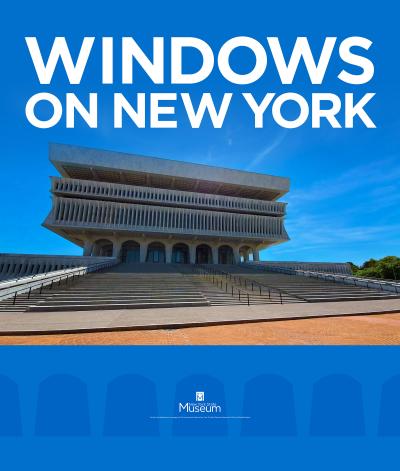
Windows on New York
Ongoing Exhibition
The New York State Museum is excited to present a new outdoor experience that can be enjoyed while social distancing during our closure. From Madison Avenue, make your way to the Empire State Plaza and up the steps to the Museum Terrace. We’ve highlighted popular items from our 4th Floor Gallery, along with new objects from our collections that can be viewed from outside.
Online Feature: Windows on New York
We invite you to view this online companion to our Lobby and 4th Floor Terrace exhibit. Discover additional fun facts and educational activities about many of the objects on display. New items will be added throughout the summer, so be sure to check back often!
ABOUT THE RECORDING: MISSING AUDIO
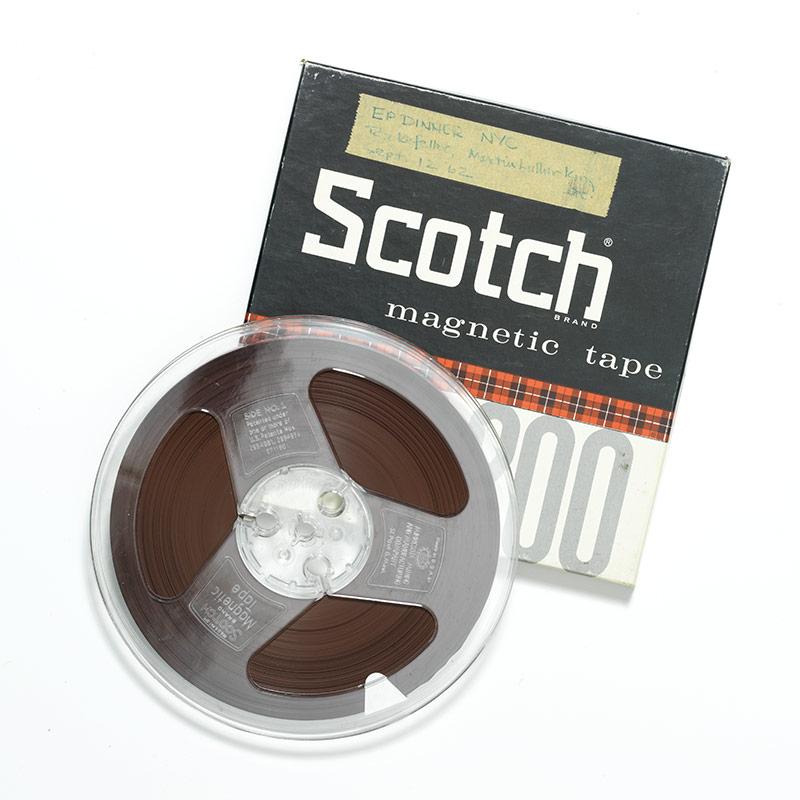
Martin Luther King, Jr.'s 1962 Address to the New York Civil War Centennial Commission was recorded using reel-to-reel magnetic tape that allowed for 65 minutes of recording time per side at a recording speed of 7.5 ips (inches per second). Although Dr. King only spoke for 26 minutes, his speech had been preceeded by several others and only 15 minutes remained on the first side of the reel when he took to the podium.
The missing audio marks the moment when the tape ran out and the recording technician, Enoch Squires, had to manually flip each reel over, re-thread the tape through the tape head assembly and onto the takeup reel, and then restart the recording. Almost an entire minute of Dr. King's recorded speech was lost.
LOST TECHNOLOGY
Reel-to-reel tape recording is a form of magnetic tape audio recording in which the recording medium is held on an open reel, threaded and fed through mechanical guides and a tape head assembly, and then transferred onto a second, initially empty, takeup reel. As the magnetic tape passes over the electromagnetic recording head, fluctuations in the magnetic field caused by electric impulses picked up from microphones or instruments, are transferred to tape.
Magnetic tape recording technology emerged in the 1930s, and it was the industry standard for audio recording and playback through the 1970s. While professional recording studios continued to use high-speed reel-to-reel recorders until the late 1980s, consumers were quick to switch to the smaller, light-weight cassette recorder by the 1970s. However, with the introduction of digital recording media, such as the compact disc, in 1982, the use of analog tape, whether reel-to-reel or cassette, declined significantly in the 1990s and has now become all but obsolete.
Portable Recording Equipment

Concorde Stereophonic 440
This Concorde Stereophonic 440 recording machine was considered to be a mid-range portable recording device and is probably similar to what Enoch Squires would have used when recording audio in remote locations. The New York State Museum maintains several reel-to-reel machines in its collections in order to preserve past technologies and, more significantly, to employ in the playback of donated audio reels that otherwise would be inaccessible.
Who was Enoch Squires?

Enoch Squires was born on March 24th, 1909 at Diamond Point in Lake George, New York. He began his career in radio in 1929 as a radio columnist for the Buffalo Evening News, and worked for several stations across the United States before being hired by WGY in 1953. There, he was best known for his work as the “Schenectady Traveler,” logging over 3,000 miles each month to gather the audio footage for the weekday show.
The New York State Museum’s collection contains nearly 400 reel-to-reel audio recordings of the “Schenectady Traveler,” donated to the museum in 1979 by Squires’ widow. Squires left WGY in 1961 to work as a research associate for the New York State Civil War Centennial Commission. It was in this capacity that he made the recording of the September 12, 1962 Commemoration Dinner, including Dr. Martin Luther King, Jr.’s address.
Sears Automobile Model K

This 14-horsepower vehicle could drive up to 25 miles per hour. It sold for $475 and featured fenders, a top, side curtains, running boards, and a “cozy storm front for use in rainy or cold weather.”
NYSM H-2001.25 Estate of Chester A. Lyons, Jr.
Guiding Questions:
- How could you start this car?
- Could you go fast in this car?
- How much would this car cost to purchase new today?
[Answer: $12,819.45]
To compare the value of yesterday’s dollar with today’s, visit:
https://www.usinflationcalculator.com/.
1931 Pierce-Arrow Type 43

This seven-passenger luxury sedan was manufactured by the Pierce-Arrow Motor Car Company in Buffalo, New York. It is one of 160 Type 43s produced and cost $2,995 at the time of sale in 1931—more than $50,000 by 2020 standards.
NYSM H-1970.51.1
Salamanca Back Bar

M. J. Bernhard Company of Buffalo made this back bar in the 1890s. The bar’s shingled roofing and stained-glass panels graced the Torge Hotel in Salamanca, Cattaraugus County, until 1971, when an urban-renewal project resulted in its removal.
NYSM H.1971.66.1 Gift of Frank Torge
Guiding Questions:
- Why would a back bar have such a large mirror?
- Other than food and drink, what function might a tavern or bar serve for adults in a community
Flour Packer and Testing Machine
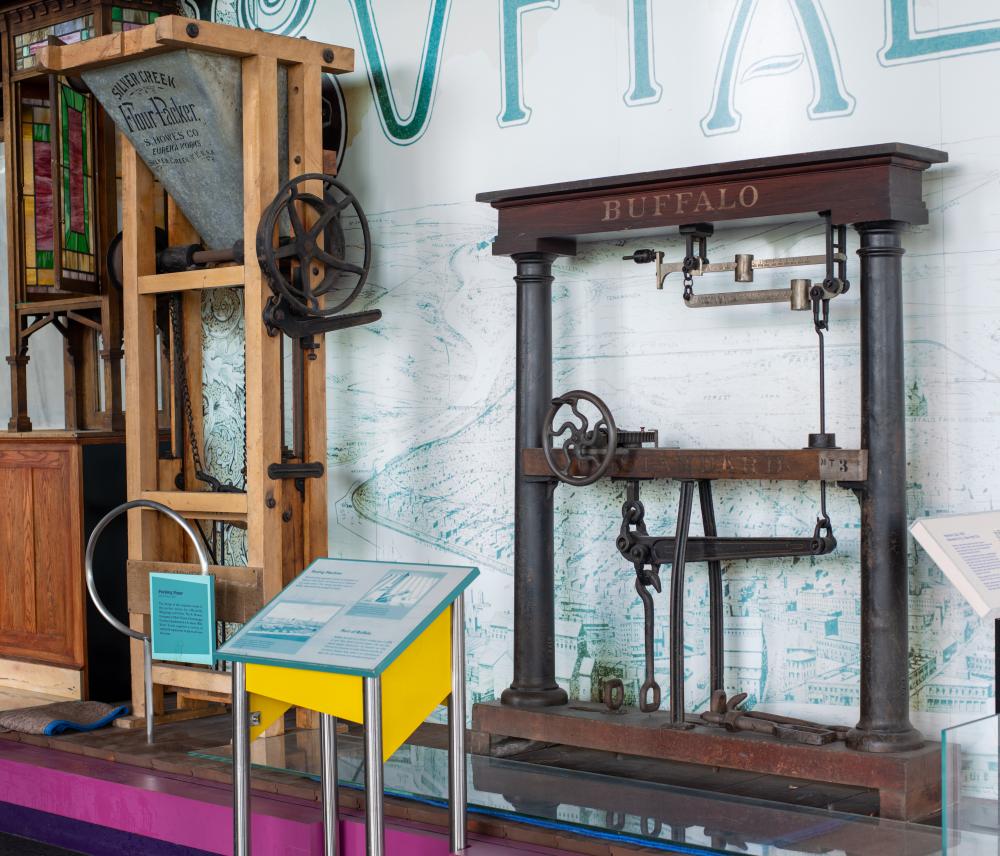
The design of this flour packer machine made it the perfect device for efficiently filling bags with flour. The S. Howes Company in Silver Creek, Chautauqua County, manufactured it around 1900.
The testing machine, made in Buffalo, determined the strength of metal. Manufacturing equipment like these examples serve as a testament to Western New York’s rich history as an industrial and trade center.
NYSM H.1972.94.2 Gift of Milton J. Hart; H-1976.236.2
Guiding Questions:
- Why would companies need machines like the flour packer or the metal-testing machine?
- Do machines today do the same job?
Humpback Whale Skull, Dolphin and Seals Skeletons (hanging above)

Many different whale and seal species inhabit New York’s marine waters, including humpback, fin, and right whales; harbor and gray seals; bottlenose dolphins; and harbor porpoises. The whale skull on display is from a juvenile humpback whale. Adult humpbacks can grow to over 50 feet long and weigh over 80,000 pounds.
NYSM ZM-13660 (skull)
Guiding Questions:
- What do you think a humpback whale eats?
- Can a humpback whale chew its food?
- In what ways are the dolphin and the seal similar and different?
Learn more about how humans used whales in the past:
www.youtube.com/watch?v=1tXqdVVdNVk
Have whales ever visited Albany?
Go to http://digitalcollections.archives.nysed.gov/index.php/Detail/objects/18959 to find out.
State Museum Exhibits Papa Burger Statue, Hoffman's Playland Ticket Booth on Fourth Floor
The New York State Museum today announced the opening of a new long-term exhibition on the Museum’s 4th floor featuring a newly restored 1960s A&W Restaurant “Papa Burger” statue, an original Hoffman’s Playland ticket booth, and models of Coney Island attractions. On exhibition near the Museum’s historic Carousel, these new artifacts create a nostalgic area for visitors of all ages to enjoy and learn from while visiting the State Museum.
“We’re proud to add these new objects to the Museum’s fourth floor where families and children already gather to enjoy the historic Carousel,” said Board of Regents Chancellor Betty A. Rosa. “A new generation of visitors can now enjoy these iconic objects that represent family-friendly attractions from New York’s past.”
“Papa Burger, the Hoffman’s Playland ticket booth, and the Coney Island models are great additions to the Museum’s fourth floor,” said Beth Berlin, Acting Commissioner of the State Education Department. “We’re confident these new additions will become a favorite among the hundreds of thousands of people of all ages who visit the State Museum every year.”
The 9-foot-tall Papa Burger statue entered the State Museum’s collection in 1998 as an “unknown fiberglass figure of a man holding a mug and a hamburger” from the Syracuse or Rochester area. Research soon revealed that he is “Papa Burger,” an iconic mascot figure for the A&W root beer chain of restaurants dating back to the 1960s. In the 1960s, Papa Burger joined other members of his family – including Mama Burger, Teen Burger and Baby Burger – outside A&W restaurant buildings. In 1974, a bear replaced the Burger family and the figures became obsolete. Original iconic roadside sculptures are rare, as most have disappeared due to their large size or have been repurposed and are often unrecognizable.
Over the past few years, Museum staff restored Papa Burger to his original colors and details. The restoration project included removing layers of paint to reach the statue’s original coat and researching paints to match Papa Burger’s original colors. Many repairs were made as well, including reconstruction of an internal support system to allow him to stand up. Photos are available on the Museum website showing Papa Burger through his various phases of restoration, from how he originally appeared when he entered the Museum’s collections to how he looks today.
In addition to Papa Burger, an original ticket booth from Hoffman’s Playland located in Latham, New York, is on exhibit. Hoffman’s Playland was a family-owned business that opened in 1953 when Bill Hoffman purchased a carousel and this ticket booth and placed them on his father’s property in Latham. He soon added more rides, and through his hard work Hoffman’s attracted legions of visitors. When Bill’s son, Dave, took ownership of the park, he added even more rides and made Hoffman’s Playland one of the Capital Region’s favorite fun family-friendly places. When Hoffman’s Playland closed in 2014, Dave and his wife, Ruth, donated this vintage portable ticket booth to the State Museum.
Models of two attractions from Coney Island – the Parachute Jump and the Ferris Wheel – are also on display. Originally built for the1939 World’s Fair in Flushing, New York, the Parachute Jump was moved to Coney Island’s Steeplechase Park in 1941. The park closed in 1964 and the Parachute Jump is the only original structure that remains from Steeplechase Park. Steeplechase Park also boasted the first Ferris Wheel on Coney Island, erected in 1894. The original ride had twelve cars that held eighteen passenger each; the model on exhibit was abbreviated by the artists to feature eight cars.
Photos are available for download on the State Museum’s website.
The New York State Museum is a program of the New York State Education Department’s Office of Cultural Education. Located at 222 Madison Avenue in Albany, the Museum is open Tuesday through Sunday from 9:30 a.m. to 5:00 p.m. It is closed on the Fourth of July, Thanksgiving, Christmas, and New Year's Day. Admission is free. Further information about programs and events can be obtained by calling (518) 474-5877 or visiting the Museum website.
Phone: (518) 474-1201
First Issue of New York History Journal Published Under New Collaboration Between New York State Museum and Cornell University Press
The first issue of the New York History journal has been published under a new collaboration between the New York State Museum and Cornell University Press. Published twice a year, the scholarly journal presents articles regarding New York State history as well as reviews of books, exhibitions, and media projects with a New York focus.
Now published by Cornell University Press working in coordination with an editorial team at the New York State Museum, New York History journal seeks to unify the diverse field of New York State history and meet the needs of a growing historical community that includes scholars, public historians, museum professionals, local government historians, and those seeking an in-depth look at the Empire State’s history.
“New York State has a rich and diverse history that is shared by cultural institutions, historians, and educators across the state,” said Board of Regents Chancellor Betty A. Rosa. “New York History journal will serve as an important resource to learn about our state’s past to help us make better decisions about our future.”
“The State Museum has a long history of sharing the state’s past with the people of New York and the New York History journal will add to those efforts,” said Interim State Education Commissioner Beth Berlin. “We’re proud to collaborate with Cornell University Press and publish this journal with the best content the field of New York State history has to offer.”
Co-editors of the journal include New York State Museum Chief Curator of History Dr. Jennifer Lemak, New York State Historian Devin Lander, New York State Museum Senior Historian Aaron Noble, and Senior Lecturer in the History Department at University of Maryland Dr. Robert Chiles. The Editorial Board actively solicits articles, essays, reports from the field and case studies to be featured in the journal. Submission guidelines are available on the State Museum website.
“New York History journal provides a great opportunity to bring together the diverse New York State history community,” said co-editors Dr. Jennifer Lemak and Devin Lander. “The State Museum is honored to lead the journal’s Editorial Board and work with Cornell University Press and historians across the state.”
“The New York State Museum-led Editorial Board has done a wonderful job continuing the excellent editorial work of Professors Thomas Beale, Susan Goodier, and Danny Noorlander of SUNY Oneonta,” said Michael J. McGandy, Senior Editor at Cornell University Press. “As the journal embraces the perspectives of public historians and museum curators, they have struck the right balance between scholarship and outreach.”
The summer 2019 issue features articles by historians across the state including:
- “The Sing Sing Revolt: The Incarceration Crisis and Criminal Justice Liberalism in the 1980s” by Lee Bernstein, professor of history at SUNY New Paltz
- “The Power of Women: Matilda Joslyn Gage and the New York Women’s Vote of 1880” by Sue Boland, local historian for the Matilda Joslyn gage Center for Social Justice Dialogue
- “Suffrage’s Second Act: Women in the NYS Legislature, 1919-1930” by Laurie Kozakiewicz, lecturer in history at the University at Albany
- “The Lost Poems of Jacob Steendam” by D.L. Noorlander, assistant professor of history at SUNY Oneonta
- “A Model Tenement in “The City of Homes”: George Eastman and the Challenge of Housing Reform in Rochester, New York” by Nancy J. Rosenbloom, professor of history at Canisius College
- “Consumption in the Adirondacks: Print Culture and the Curative Climate” by Mark Sturges, assistant professor of English at St. Lawrence University
Recurring feature articles in the journal include:
- Artifact NY – a feature about an object or document important to New York State history.
- Teach NY – a feature intended for history teachers at either the middle or high school level or university professors. Content includes lessons plans, utilizing primary source materials in a classroom setting, or using multimedia or new technology to teach history.
- Community NY – a feature that highlights state history at the local, community and project-based levels.
Individual and institution print subscriptions to New York History are available as well as individual electronic subscriptions. Subscriptions can be ordered online or by contacting Cornell University Press at nyhjournal@cornell.edu.
New York History, founded in 1919 as The Quarterly Journal of the New York State Historical Association, is the foremost scholarly journal addressing the state’s past. The New York State Historical Association, now known as Fenimore Art Museum, created and supported the journal. Since 2012 the journal has been published as a digital-only publication. In 2018 it was announced that Cornell University Press would manage and publish the journal in print and digital format working alongside an editorial team at the New York State Museum.
The New York State Museum is a program of the New York State Education Department’s Office of Cultural Education. Located at 222 Madison Avenue in Albany, the Museum is open Tuesday through Sunday from 9:30 a.m. to 5:00 p.m. It is closed on the Fourth of July, Thanksgiving, Christmas, and New Year's Day. Admission is free. Further information about programs and events can be obtained by calling (518) 474-5877 or visiting the Museum website.
Phone: (518) 474-1201
State Museum Hosts Lunchtime Talk Series "Brain Food for the Curious" 2019 - 2020
New York State Museum historians and scientists will share their knowledge and research in a series of lunchtime talks this fall and winter. “Brain Food for the Curious” will be held on select Tuesdays in October through March, from 12:10 – 12:40 p.m., in the Huxley Theater. Each program includes a 20-minute talk with a State Museum historian or scientist followed by a question-and-answer period. Attendees are encouraged to bring their lunch.
Following is a schedule of “Brain Food for the Curious” talks for the 2019 – 2020 season:
Museums & Criminal Justice: Finding Common Ground
Tuesday, October 15
Criminal justice reform has been called one of the most significant civil rights issues of the modern era. Museums and historic collections are increasingly being called upon to explain the history of mass incarceration in the United States, and museum galleries can serve as venues for dialogue and discussion about some of the most pressing concerns in today’s society. Join Senior Historian of Political and Military History Aaron Noble to explore recent examples of how museums have engaged diverse audiences in these complicated narratives and look at how New York State Museum collections can foster similar discussions across the state.
What is Tonalism?
Tuesday, October 22
The New York State Museum will host the exhibition, Tonalism: Pathway from the Hudson River School to Modern Art from February 15 – June 14, 2020. Senior Curator of Art and Culture Karen Quinn will explain what tonalism is and why this turn-of-the-twentieth-century style was all the rage and then fell out of favor.
Creative Women’s Collective Collection
Tuesday, November 5
“Craftivism”—using artistic skills and forms to spread an activist message—has had a resurgence in recent years, especially around feminist issues. Craftivism, in part, has roots in the artistic collectives of the 1960s, 70s, and 80s, which produced posters, t-shirts, and other materials to support various causes. This talk by Senior Historian and Curator of Social History Ashley Hopkins-Benton will focus on a collection of material produced by the Creative Women’s Collective in New York City in the 1980s and its ties to modern women’s movement materials.
Champions in a Changing World: New York Mets, Jets, and Knicks in 1969
Tuesday, November 19
Fifty years ago this year, Tom Seaver, Joe Namath, and Willis Reed delivered one of the most iconic years in New York sports history. The 1969 New York Mets, Jets, and Knicks triumphed on the field and court, winning championships in a fast-changing world. Join New York State Museum Sports History Curator Stephen Loughman as he explores this significant year in New York sports history.
Submerged Landscapes of New York
Tuesday, December 3
Beneath the waters of New York State lie hundreds of shipwrecks, but did you know there are also submerged landscapes, places that were once dry land? Some of these places were drowned intentionally, including several villages in the Catskill Mountains that were destroyed to create reservoirs to meet New York City’s water needs. Other more ancient landscapes have been drowned by rising sea levels. Join archaeologist Dr. Daria Merwin for a look at some of the state’s submerged landscapes and learn about the potential for underwater archaeology at these sites.
Earth's Earliest Life
Tuesday, December 17
The simplest lifeforms on Earth today are bacteria, and it is likely that Earth’s first living organisms were similar. But how do we recognize something as small and simple as a bacterium in the fossil record? This talk by State Paleontologist Dr. Lisa Amati will present evidence about when and where the first life evolved on Earth and how we identify it.
15th- and 16th-Century Iroquoian Agriculture
Tuesday, January 7
Native American farmers developed agronomic practices throughout the Western Hemisphere suited to local climatic conditions and the degree of reliance on agricultural production for subsistence. Dr. John Hart will discuss Iroquoian agricultural practices in New York and southern Ontario and how those practices maintained soil fertility and crop productivity for decades, producing enough food for village populations in the hundreds to thousands of people.
Glacial Fingerprints: How Glaciation Left Its Mark in New York State
Tuesday, January 21
With the increasing use of high-resolution LIDAR (Light Detection and Ranging) remote sensing technology, subtle topographic details of the most recent glaciation have never been more visible to researchers. Join geologist and Museum Curator of Quaternary Landscape Materials Andrew Kozlowski as he explains how this new technology works and displays glacial landforms that occupy New York State’s landscape.
New DNA Technology Reveals the Evolutionary History of Birds
Tuesday, February 4
Are penguins closely related to ducks? Are flamingos just goofy-looking herons, or are they something completely different? When did songbirds evolve? Curators of bird-specimen collections study the evolutionary relationships of birds using the fossil record and modern DNA-sequencing technologies. As these technologies have improved so has our understanding of the history of birdlife on Earth. Dr. Jeremy Kirchman, the State Museum’s curator of birds, will explain how a new revolution in DNA laboratory methods has changed what we know about bird evolution.
The Courtland Street Burying Ground, Lake George, N.Y.
Tuesday, February 18
When smallpox broke out among the troops in northern New York in the spring of 1776, a general hospital was established at Fort George on the southern end of Lake George. Thousands were admitted and many died. Their place of burial was unknown until 2019, when human remains discovered during construction were identified from the Revolutionary War. A major salvage effort of the heavily disturbed site was launched and Museum bioarchaeologists began the complex task of reconstructing human remains. Curator of bioarchaeology Lisa Anderson will share the history and progress of the ongoing research.
These Rock Layers in New York are the Same Age as These in Morocco
Tuesday, March 3
Dr. Charles Ver Straeten will explain how correlation, or recognizing same-age rocks from place to place, is one of the elemental tasks of a sedimentary geologist. Correlating rocks is done by finding the same features or patterns at different places, such as the same unique fossils, unique layers, or patterns of sedimentation in rocks.
You Are What You Eat: How Chemistry Informs About Ancient Ecosystems
Tuesday, March 17
The fossils of ancient individuals contain clues to how they lived. Dr. Robert S. Feranec, curator of Pleistocene vertebrate paleontology, will discuss how he uses different chemicals in fossilized teeth and bones to understand how and where ancient animals lived, and how that may have changed over time.
The State Museum is a program of the New York State Education Department’s Office of Cultural Education. Located at 222 Madison Avenue in Albany, the Museum is open Tuesday through Sunday from 9:30 a.m. to 5:00 p.m. It is closed on the Fourth of July, Thanksgiving, Christmas, and New Year's Day. Admission is free. Further information about programs and events can be obtained by calling (518) 474-5877 or visiting the Museum website.
Phone: (518) 474-1201
New York State Museum Scientists Conduct Fieldwork in Tompkins County this Fall
This fall State Museum scientists will join staff from the New York State Office of Parks, Recreation and Historic Preservation and Cornell University to conduct fieldwork into the Ice Age landscape of the Ithaca, NY area.
The scientists will core as deep as 700 feet underground and collect samples of sediment. These sediment samples are the record of glaciers advancing and retreating into New York during the Pleistocene (Ice Age). But what is core? Cores are cylindrical samples of rock and sediment that can be collected using a hollow drill bit. By collecting core, geologists can see the type of sediment and rock they are drilling through and have sample material to use in laboratory research.
The core is important because the existing subsurface data from the area is based on drilling conducted in the 1800s with now-outdated tools. The new cores drilled this fall are part of an ongoing surficial geologic mapping project and a collaborative research project with State Parks to learn more about the Ice Age glacial history of Buttermilk Falls State Park. The coring site location is near the end of West Buttermilk Falls Road on State Park property.
This coring project is an important and unprecedented opportunity for the New York State Museum and our partners to learn about the geology of the Finger Lakes. Scientists will collect important data on the geologic framework of the area with the potential to recover materials that could be suitable to radiocarbon dating. Upon completion, this core and others collected in Tompkins County will provide high resolution geologic data for officials to utilize when making decisions about how to manage and protect groundwater and natural resources. The data collected in this project will also provide a critical anchor point in developing a regional stratigraphic model on the glacial history of central New York.
The core retrieved will be added to the Museum’s Quaternary Landscape Materials (QLM) collection initiated in 2015 that currently contains more than 15 continuous cores of Pleistocene stratigraphy from central New York. The New York State Museum is the only scientific repository for a collection of this kind in the northeastern United States. Core is a valuable asset to geologists and scientists around the world because it represents a physical record of the natural history of the region and can help create stratigraphic diagrams and geologic maps. One of the most important elements of the core is the recovery of plant fossils that can be radiocarbon dated. Due to multiple glaciations across the Great Lakes Region over the last 2 million years, the geologic record is very complex. The plants can tell us about the climate and ecosystems during interglacial periods (ice-free warm periods) that occurred between glacial periods. The fossils also can be used by future researchers using new techniques still in development.
State Museum, Library and Archives Celebrate New York State History Month in November 2019
The New York State Museum, State Library, and State Archives will celebrate New York State History Month in November with a variety of free public programs for children, families and adults.
"As we celebrate New York State History Month, we thank historians and educators help us understand our past," said Board of Regents Chancellor Betty A. Rosa. “I urge both adults and children to visit the extraordinary cultural institutions, museums, libraries, archives and historic sites across New York not only during New York State History Month, but every day.”
“The State Museum, State Library and State Archives tell the story of New York’s history every day through artifacts, documents and photographs,” said Interim State Education Commissioner Beth Berlin. “During New York State History Month we highlight the importance of learning about our history and highlight the local historians and cultural institutions across the state who keep New York’s history alive.”
“I continue to be amazed at the vastness of New York’s history,” said New York State Historian Devin Lander. “History Month provides an opportunity to highlight this history and the vital work of historians across New York State.”
The following is a schedule of free programs in November related to New York State history at the Cultural Education Center, located at 222 Madison Avenue, Albany:
Brain Food for the Curious: Creative Women’s Collective Collection
Tuesday, November 5 | 12:10 – 12:40 pm
Craftivism—using artistic skills and forms to spread an activist message—has had a resurgence in recent years, especially around feminist issues. Craftivism, in part, has roots in the artistic collectives of the 1960s, 70s, and 80s, which produced posters, t-shirts, and other materials to support various causes. This talk by Senior Historian and Curator of Social History Ashley Hopkins-Benton will focus on a collection of material produced by the Creative Women’s Collective in New York City in the 1980s and its ties to modern women’s movement materials.
Genealogy Online with Ancestry Library
Thursday, November 7 | 3:00 – 4:00 pm
Learn how to access Census records, genealogy and history book, maps and other resources included in this database, as well as, the resources on Ancestry NYS page which are freely available to all New Yorkers. Seating is limited and registration is required.
Walking Tour of the Local History and Genealogy Resources at the New York State Library
Saturday, November 9 | 11:00 am – 12:00 pm
Join us for a tour highlighting published genealogies, local histories, church records, Daughters of the American Revolution records, United States and New York State Census records, newspapers on microfilm, city directories and more. The tour is limited to 15 individuals and registration is required.
Lunch Bite Gallery Tour: The Historic Woodstock Art Colony: The Arthur A. Anderson Collection
Wednesday, November 13 | 12:00 – 12:30 pm
Come discover Woodstock’s importance as an art colony long before the famous music festival in 1969. The remarkable range of work produced there has been the focus of collector Arthur Anderson for three decades, resulting in the largest comprehensive collection of its type—some 1,500 objects by 170 artists—all of which he recently donated to the New York State Museum.
Bringing It Back Home – New York State Archives Magazine Speaker Series
Wednesday, November 13 | 5:00 – 6:00 pm
Get a sneak peek inside New York Genealogical and Biographical Society’s forthcoming research guide to the New York State Archives. Written by Jane E. Wilcox, this publication is geared towards genealogists and family historians who want to explore the vast collections of the New York State Archives. Jane will share some of her favorite discoveries in the stacks, anecdotes that will leave you chuckling, and challenges encountered along the way. Registration encouraged.
Lunchtime Book Talk: Erie Canal Boats, Stagecoaches, and Wagons: Traveling and Living in New York State in 1826
Thursday, November 14 | 12:10 – 12:40 pm
Bring your lunch and enjoy a short, informative, entertaining talk by Paul Schneider, author of Everything Worthy of Observation: The 1826 New York State Travel Journal of Alexander Stewart Scott. On September 25, 1826, a young Canadian traveler by the name of Alexander Stewart Scott arrived in Albany, New York. Keeping a daily travel journal, he jotted down the incidents of his extended trip across the state. Paul Schneider, who transcribed and edited Scott’s unique journal, will discuss the world this young traveler encountered and some of the remarkable historical coincidences linking this story to the present.
Happy Birthday to the Bronx Zoo
Saturday, November 16 | 2:00 – 4:00 pm
This year the Bronx Zoo is turning 120 years old. Visitors will learn more about the zoo’s history and create birthday cards. The cards will be sent to and archived in the collection of the Wildlife Conservation Society, the organization that founded and opened the zoo in 1899.
Woodstock at 50: The Festival, the Film, the Legacy
Sunday, November 17 | 1:00 – 4:30 pm
The New York State Museum will screen the critically acclaimed 1970 documentary, Woodstock, about the legendary three-day 1969 music festival in Bethel, New York.
Brain Food for the Curious: Champions in a Changing World: New York Mets, Jets, and Knicks in 1969
Tuesday, November 19 | 12:10 – 12:40 pm
Fifty years ago, Tom Seaver, Joe Namath, and Willis Reed delivered one of the most iconic years in New York sports history. The 1969 New York Mets, Jets, and Knicks triumphed on the field and court, winning championships in a fast-changing world. Join New York State Museum Sports History Curator Stephen Loughman as he explores this significant year in New York sports history.
Researching New York Conference Public Event: Edward Berenson presents his book, The Accusation: Blood Libel in an American Town
Thursday, November 21 | 7:30 pm
Scholar Edward Berenson presents his new book, The Accusation: Blood Libel in an American Town (2019), a chilling investigation of an incident of antisemitism in the upstate town of Massena, New York in 1928. This program is a featured public event of the University at Albany History Department’s annual Researching New York Conference.
The First Grand Slam
Saturday, November 23 | 1:00 pm
The first grand slam in Major League Baseball history was hit on September 10, 1881, in a game between two long-defunct teams: Troy and Worcester. So how did the home game that was supposed to be in Troy end up being mislabeled as Albany and actually end up in what's now the city of Rensselaer? Speaker Matt Malette will discuss how he proved that the first grand slam in Major League Baseball history was hit in Rensselaer, NY.
Happy Birthday Sesame Street
Friday, November 29 and Saturday, November 30 | 1:00 – 4:00 pm
Join the New York State Museum and WMHT to celebrate the colorful characters, entertaining videos, and magical music of Sesame Street. Visit the Sesame Street exhibit to see the famous set, create your own character mask, and more.
In addition, the State Museum’s Office of State History website offers an online portal of information about historical research, news, grant opportunities and events happening around New York State. The website is an online resource for historians throughout the state to learn about the work of fellow historians and identify opportunities for increased coordination and collaboration. The website offers a New York State History Month promotion kit to encourage cultural institutions and historians statewide to plan and promote public programs in their community. Cultural institutions are encouraged to submit their History Month events and programs for listing on the Office of State History website. The Office of State History also produces a podcast, “A New York Minute in History,” in collaboration with WAMC/Northeast Public Radio and Don Wildman of Mysteries at the Museum on the Travel Channel.
The first issue of New York History journal was published in September 2019 under a new collaboration between the New York State Museum and Cornell University Press. Published twice a year, the scholarly journal presents articles regarding New York State history as well as reviews of books, exhibitions, and media projects with a New York focus. Co-editors of the journal include New York State Museum Chief Curator of History Dr. Jennifer Lemak, New York State Historian Devin Lander, New York State Museum Senior Historian Aaron Noble, and Senior Lecturer in the History Department at University of Maryland Dr. Robert Chiles. The Editorial Board actively solicits articles, essays, reports from the field and case studies to be featured in the journal. Submission guidelines are available on the State Museum website.
The New York State Archives preserves and makes accessible over 250 million records of New York’s State and colonial governments dating from 1630 to the present. The State Archives provides free access to photographs, artifacts, documents, manuscripts and other materials that tell the story of New York’s history via its Digital Collections on the Archives website.
The New York State Library’s collections include over 20 million items that support State government work and the research needs of the public. The State Library’s Manuscripts and Special Collections unit consists of rare books, maps, photographs, posters and manuscripts that document the history of New York from the 17th century to the present. The Library’s Local History and Genealogy Section contains printed materials and records on individual families and is used by researchers, genealogists and historians.
In 1997, the New York State Legislature established November as New York State History Month with the goal “to celebrate the history of New York state and recognize the contributions of state and local historians.” New York State History Month represents the opportunity for historians, museums and cultural institutions to highlight importance of New York State’s history through public programs, exhibitions and other learning opportunities.
The State Museum, State Library and State Archives are programs of the New York State Education Department’s Office of Cultural Education. Further information about programs and events can be obtained by calling (518) 474-5877 or visiting the Office of Cultural Education website.
Phone: (518) 474-1201
November 2019 Newsletter - It's New York State History Month
Read the November 2019 newsletter and learn about upcoming programs at the Museum, including our New York State History Month programs: https://conta.cc/2Ns2RAA
State Museum Hosts Taste NY Holiday Market on December 8, 2019
Visitors can shop at more than two dozen made-in-New York food and beverage vendors at the New York State Museum’s Taste NY Holiday Market on Sunday, December 8 from 11:00 a.m. – 4:30 p.m. Admission is free.
Vendors will offer samples and sales of chocolates; cheese; apple and maple products; hand-crafted beer, wine, spirits and cider; and other edible gifts. All participating vendors produce their products in New York State. There will also be a cooking demonstration, educational activities and a chocolate fountain station courtesy of We Do Fondue and Price Chopper/Market 32. For more information, including a list of vendors, visit the Museum’s website.
Following is a schedule of demonstrations and educational activities at the event:
- Culinary Historian Lavada Nahon – Nahon will showcase colonial cooking depicting 17th, 18th, and 19th century culinary skills. A display table with reproduction cooking and dining equipage, recipe books, and simple kitchen tools will allow visitors to learn about the development of New York State’s rich culinary legacy.
- Second Regiment of the Albany County Militia’s Colonial Foodways – Participate in demonstrations of colonial activities that depict 18th century cooking and beer making practices.
- Chocolate Historian Paul Supley – Supley will teach the process of making 18th century drinking chocolate! Learn about the use of chocolate in New York State during the colonial period with photographs, historical artifacts, and reproductions. A chocolate demonstration will explain the history behind the beverage and its connection with New York’s history.
The annual Holiday Tree Lighting and Fireworks Festival at the Empire State Plaza will also be held on December 8.
Taste NY is an initiative that highlights the quality, diversity, and economic impact of New York’s food and beverage industry. Taste NY provides an opportunity for New York growers and producers to receive increased exposure of their products to consumers, restaurateurs, retailers, wholesalers, and distributors.
The State Museum is a program of the New York State Education Department’s Office of Cultural Education. Located at 222 Madison Avenue in Albany, the Museum is open Tuesday through Sunday from 9:30 a.m. to 5:00 p.m. It is closed on the Fourth of July, Thanksgiving, Christmas, and New Year's Day. Admission is free. Further information about programs and events can be obtained by calling (518) 474-5877 or visiting the Museum website.
Phone: (518) 474-1201