

Science Lab: Pre-lab Bird Research (PDF)

Just as bird beaks are different from one another depending on what kind of food a bird eats, the wings and legs of different bird species can also be different from one another. The wings and legs of birds are a refection of each bird’s “feeding niche,” that is, its method for searching for and catching its food. Some birds, like the nighthawk, may have long, pointed wings and short legs, because they are adapted for catching insects during fight. Other birds, like chickens, are adapted for foraging on the ground and have long legs and short wings. In this lab, you will test to see if data from bird skeletons supports this theory. But frst, you must learn more about the species you are testing.
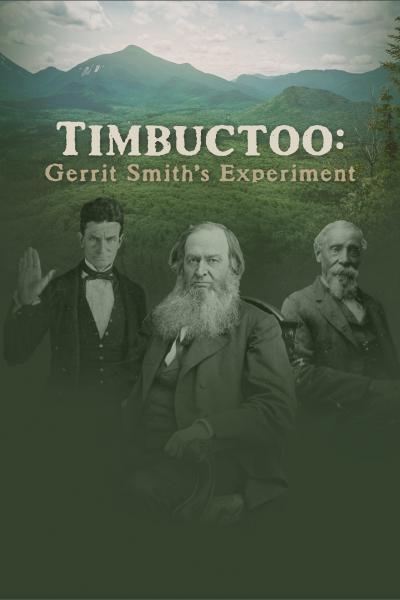
Timbuctoo: Gerrit Smith’s Experiment


In 1846, New York State enacted a law requiring African American men to own $250 worth of property to vote. To circumvent this unjust law, radical abolitionist Gerrit Smith gave away 120,000 acres of land in Essex and Franklin Counties, New York, to 3,000 free Black men, thereby qualifying them to vote.
Timbuctoo: Gerrit Smith’s Experiment presents a short video about the insurmountable challenges its settlers faced as they fought to establish their unique community amidst New York's Adirondack mountains.
Filmmaker Paul A. Miller created this exhibit component for the NYS Museum based on his documentary titled, Searching for Timbuctoo. The film, which officially airs on WAMC/PBS in June 2022, tells the history of this forgotten settlement and New York State on the brink of civil war and follows an archaeology team looking to unearth evidence of the community.
New York State Museum To Host Screening of Documentary ‘Searching for Timbuctoo’
Screening to be Followed by a Question-and-Answer Session with Filmmaker, Paul Miller
The New York State Museum will host an in-person screening of the documentary, “Searching for Timbuctoo” on Thursday, May 5, 2022, at 7 p.m. in the Huxley Theatre, Commissioner Betty A. Rosa announced today. The film will be followed by a Q & A session with the filmmaker, Paul Miller. Visitors are also invited to visit the State Museum’s new exhibition feature on Timbuctoo, located in Adirondack Hall, beginning at 6:30 p.m. on May 5th.
The film “Searching for Timbuctoo” tells the story of Gerrit Smith, a wealthy New York landowner and well-known abolitionist leader who in 1846 gave away 120,000 acres of wild land to nearly 3,000 Black men so they could have the right to vote in the State of New York. One of the settlements from Smith’s land donation became known as Timbuctoo. The film also follows an archaeology team from SUNY Potsdam looking to unearth evidence of the forgotten community.
“Unknown to many, Gerrit Smith is a storied abolitionist and social reformer whose philanthropy contributed to the freeing of countless enslaved people of African descent at a time when the country was on the verge of civil war,” said Chancellor Lester W. Young, Jr. “Many of the issues raised in the film are still being grappled with even today. It’s through historical lessons, such as Paul Miller’s film, that we can open a dialogue to address inequities and forge a sustainable path forward as a nation.”
“Bringing history to life through documentaries and film is one of the great forms of art and plays an important role in learning from our past as we look to create a better future in our communities,” said Commissioner Rosa. “I thank the filmmaker Paul Miller and our staff at the Museum for organizing this screening and telling this important story.”
Paul Miller is a writer, filmmaker, and photographer based in upstate New York. As a 20-year veteran of broadcast and cable television, he has worked for national shows and networks, including The History Channel, National Geographic Channel, PBS, and The Oprah Winfrey Show.
Continuing Teacher and Leader Education (CTLE) credit is available to educators who attend this program. The museum is an approved provider of CTLE. If interested in attending and receiving a certificate of attendance, educators can register by sending their name and contact information to the contact person listed on the registration page. More information about teacher workshops is available on the Museum’s website.
The State Museum is a program of the New York State Education Department’s Office of Cultural Education. Located at 222 Madison Avenue in Albany, the Museum is open Tuesday through Sunday from 9:30 am to 5:00 pm. In observance of Veterans Day this year, the Cultural Education Center will be closed on Thursday, November 11, 2022. It is also closed on Thanksgiving, Christmas, and New Year’s Day. Admission is free. For information about COVID-19 safety and policies, visit the State Museum’s website.
JP O’Hare or Jeanne Beattie
(518) 474-1201
The NYS Museum Goes to Peebles Island State Park
Join NYS Museum scientists and historians to explore and learn about the ecology and history of Peebles Island State Park and surrounding areas. Registration is required for each program. Masks are not required but are highly recommended for visitors and non-staff.
New Exhibit Feature: Timbuctoo: Gerrit Smith’s Experiment
In 1846, New York State enacted a law requiring African American men to own $250 worth of property to vote. To circumvent this unjust law, radical abolitionist Gerrit Smith gave away 120,000 acres of land in Essex and Franklin Counties, New York, to 3,000 free Black men, thereby qualifying them to vote.
Timbuctoo: Gerrit Smith’s Experiment presents a short video about the insurmountable challenges its settlers faced as they fought to establish their unique community amidst New York's Adirondack mountains.
Filmmaker Paul A. Miller created this exhibit component for the NYS Museum based on his documentary titled, Searching for Timbuctoo. The film, which officially airs on WAMC/PBS in June 2022, tells the history of this forgotten settlement and New York State on the brink of civil war and follows an archaeology team looking to unearth evidence of the community.
Related Programs
Searching For Timbuctoo
View the full-length documentary, Searching For Timbuctoo, by filmmaker Paul A. Miller.
Available on WMHT's website: https://video.wmht.org/video/searching-for-timbuctoo-6fzspp/
A New York Minute in History Podcast: Discovering Timbuctoo
Devin and Lauren dive into the history of Timbuctoo, an African American settlement founded by philanthropist Gerrit Smith in response to an 1846 law requiring all Black men to own $250 worth of property in order to vote in New York state. To counter this racist policy, Smith decided to give away 120,000 acres of land to 3,000 free, Black New Yorkers, hoping to enable them to move out of cities and work the land to its required value.
The Trailblazers: George Inness and James Abbott McNeill Whistler
Although they had vastly different approaches, George Inness (1825–1894) and James Abbott McNeill Whistler (1834–1903) are seen as the forefathers of Tonalism. Subsequent artists practicing the style found inspiration in one or the other, or both.
George Inness became one of the most important landscape painters in the United States after the Civil War. His early work bore similarities to that of the artists of the Hudson River School in its tight paint handling and detail, but his subject matter differed in that he favored domesticated views rather than the awe-inspiring wilderness depicted by America’s first group of landscape artists. In his travels abroad, Inness was exposed to the work of the French Barbizon painters, realist artists who depicted rural subjects with loose brushstrokes and a deep, rich palette. Drawing on this, Inness developed a personal style that eschewed the narrative elements often found in Barbizon work. He gradually relied more upon memory, woven with his belief in the relationship between natural and spiritual worlds.
If George Inness was the most important late nineteenth-century American landscape painter, James Abbott McNeill Whistler was overall one of the most influential artists of the century. Unlike Inness’s efforts to realize spirituality in his landscapes, Whistler espoused Aestheticism, or “Art for Art’s Sake.” He stated,
Art should be independent of all clap-trap—should stand alone, and appeal to the artistic sense of eye or ear, without confounding this with emotions entirely foreign to it, as devotion, pity, love, patriotism, and the like. All these have no kind of concern with it, and that is why I insist on calling my works “arrangements” and “harmonies” (Endnote 1).
Aestheticism encouraged artists to move away from traditional representation and subject matter. This departure from the depiction of visual reality set the stage for the rise of modernist approaches, including abstraction, in the twentieth century.
Whistler also immersed himself in the avant-garde artistic and literary circles in Paris and London whose members believed that contemporary life should be the source of creative work. In the visual arts, this radical concept rejected the Renaissance tradition of historical painting—subjects taken from ancient Greek and Roman history or the Bible—long held to be the highest form of expression. In all media—painting, pastel, etching, and other works on paper—Whistler also embraced the principles of Japanese composition, then newly discovered by European artists via prints, with flattened forms and space, and often monochromatic colors.
Endnotes:
1. James McNeill Whistler to The World, May 22, 1878, in University of Glasgow, The Correspondence of James McNeill Whistler, https://www.whistler.arts.gla.ac.uk/correspondence/exhibit/display/?rs=…, accessed 7/24/19
Hudson River School to Tonalism
Like those of George Inness, the early landscape paintings of other artists who became Tonalists also revealed affinities with the Hudson River School. Homer Dodge Martin (1836–1897), Jervis McEntee (1828–1891), and Alexander Helwig Wyant, for example, all matured as painters when the Hudson River School was in its prime. Martin and McEntee studied with artists associated with the school, and Wyant was inspired to become a landscapist after seeing some of Inness’s work in an exhibition. While their early paintings employed detailed brushstrokes and frequently featured open vistas in full daylight, their later compositions became looser in paint handling, with evocative, more intimate glimpses of nature in subdued light. McEntee, not traditionally associated with Tonalism, made his intentions clear: “All art is based upon a knowledge of Nature and a sympathy for her; but in order to represent her it is not necessary to make a thing exactly like a thing. Imitation is not what we want, but suggestion…” (Endnote 2)
A later generation of artists, and the largest group in this exhibition, worked solely in a Tonalist style. Some studied with Inness or sought out Whistler, others saw their work in exhibitions or were influenced by those already immersed in the style, as it was one that prevailed at the end of the nineteenth century. Just a sample in this exhibition includes the softly glowing evening scenes of Carl Eric Lindin (1869–1942), the muted colors of the rocky hillsides favored by Ben Foster (1852–1926), and the sun filtered through milky skies in landscapes by Leonard Ochtman (1854–1934).
Other painters explored more than Tonalism. Walter Launt Palmer, for example, moved back and forth between Impressionism, characterized by short brushstrokes, pure colors, and scenes depicted in direct sunlight, and the subtler range of color and moodiness of Tonalism, demonstrating that the two approaches were not mutually exclusive. Agnes Richmond (1870–1964) began her career working in a rich Tonalist mode but became better known for her more brightly lit portraits painted with saturated colors.
Tonalism has often been discussed as old-fashioned rather than avant-garde, and its reputation plummeted in the twentieth century. In fact, in a mid-century survey of American painting the author wrote that “this movement is today completely forgotten.” (Endnote 3) Some of this may have to do with the dark, sometimes murky palette, the focus on mundane (though often beautiful) subject matter, and the retreat from depicting the contemporary world. Much about Tonalism, however, looks forward to Modernism and the subtle exploration of color relationships not bound by representation with which artists experimented in the twentieth century, sometimes leading to total abstraction. This is seen, for example, in the increasingly ethereal work of John Francis Murphy (1853–1921), in the thickly painted surfaces of the canvases of Charles Melville Dewey (1849–1937) that vie with the subject, or the opposite, in the thinly applied pigments that cast a veil over the landscapes of Leon Dabo (c. 1864–1960).
Endnotes:
2. Jervis McEntee in George William Sheldon, American Painters: With Eighty-three Examples of Their Work Engraved on Wood, London: Cassel Petter & Galpin; New York: D. Applewood and Company, 1879, pp. 51-52 as quoted in Lee A. Vedder, “Jervis McEntee: Painter-Poet of the Hudson River School,” in Jervis McEntee: Painter-Poet of the Hudson River School, Samuel Dorsky Museum of Art, State University of New York at New Paltz, 2015, p. 13.
3. E. P. Richardson, Painting in America: The Story of 450 Years, Thomas Y. Crowell Company, New York, 1956, p. 368, n. 5.
Tonalism to Modernism
Like those of George Inness, the early landscape paintings of other artists who became Tonalists also revealed affinities with the Hudson River School. Homer Dodge Martin (1836–1897), Jervis McEntee (1828–1891), and Alexander Helwig Wyant, for example, all matured as painters when the Hudson River School was in its prime. Martin and McEntee studied with artists associated with the school, and Wyant was inspired to become a landscapist after seeing some of Inness’s work in an exhibition. While their early paintings employed detailed brushstrokes and frequently featured open vistas in full daylight, their later compositions became looser in paint handling, with evocative, more intimate glimpses of nature in subdued light. McEntee, not traditionally associated with Tonalism, made his intentions clear: “All art is based upon a knowledge of Nature and a sympathy for her; but in order to represent her it is not necessary to make a thing exactly like a thing. Imitation is not what we want, but suggestion…” (Endnote 2)
A later generation of artists, and the largest group in this exhibition, worked solely in a Tonalist style. Some studied with Inness or sought out Whistler, others saw their work in exhibitions or were influenced by those already immersed in the style, as it was one that prevailed at the end of the nineteenth century. Just a sample in this exhibition includes the softly glowing evening scenes of Carl Eric Lindin (1869–1942), the muted colors of the rocky hillsides favored by Ben Foster (1852–1926), and the sun filtered through milky skies in landscapes by Leonard Ochtman (1854–1934).
Other painters explored more than Tonalism. Walter Launt Palmer, for example, moved back and forth between Impressionism, characterized by short brushstrokes, pure colors, and scenes depicted in direct sunlight, and the subtler range of color and moodiness of Tonalism, demonstrating that the two approaches were not mutually exclusive. Agnes Richmond (1870–1964) began her career working in a rich Tonalist mode but became better known for her more brightly lit portraits painted with saturated colors.
Tonalism has often been discussed as old-fashioned rather than avant-garde, and its reputation plummeted in the twentieth century. In fact, in a mid-century survey of American painting the author wrote that “this movement is today completely forgotten.” (Endnote 3) Some of this may have to do with the dark, sometimes murky palette, the focus on mundane (though often beautiful) subject matter, and the retreat from depicting the contemporary world. Much about Tonalism, however, looks forward to Modernism and the subtle exploration of color relationships not bound by representation with which artists experimented in the twentieth century, sometimes leading to total abstraction. This is seen, for example, in the increasingly ethereal work of John Francis Murphy (1853–1921), in the thickly painted surfaces of the canvases of Charles Melville Dewey (1849–1937) that vie with the subject, or the opposite, in the thinly applied pigments that cast a veil over the landscapes of Leon Dabo (c. 1864–1960).
Tonalism in Different Media
Tonalism: Pathway from the Hudson River School to Modern Art
Tonalism was not confined to oil painting. As seen in this exhibition, artists also worked in pastels, watercolors, printmaking, and photography, and the style reached across all media. The soft quality of pastels was conducive to subtle Tonalist effects in the work of Dwight William Tryon (1849–1925) or Walter Launt Palmer, for example. Charles Warren Eaton (1857–1937) explored the delicate washes of watercolor. The etchings of Margery Ryerson (1886–1989) relate to those of Whistler in the suggestive play between dark ink and light paper. Bolton Brown, who became known as the father of American lithography for his experiments in that medium, produced a body of work that includes evocative landscapes of subdued tonal ranges. Likewise, the soft-focus approach in photography, called Pictorialism, explored similar principles, as seen in moody images by Horatio Hendrickson (c.1866–1941) or George Seeley (1880–1955), among others.
Science Tuesday: Clues for dating Paleoindian sites in New York State
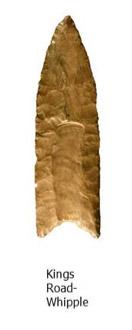
How old are the oldest archaeological sites in New York? Put another way, when did Native Americans first people the region that we now call New York? These questions are difficult to answer because there are no radiocarbon-dated sites of these early peoples that archaeologist call Paleoindians. However, characteristic artifacts recovered at these early sites in New York, especially stone weapons tips called fluted points, provide clues.
Dr. Jonathan Lothrop, NYSM curator of archaeology, and Dr. Chris Ellis of University of Western Ontario, were recently interviewed about their research on this topic in a podcast titled, "Clovis Points & Social Life in the Glaciated North East," part of a series on the Peopling of North America. This interview was hosted by Dr. Ash Lenton, producer of the Foreign Countries - Conversations in Archaeology program: Link to Podcast (hosted on dropbox)
The fluted point shown here (at left) is from the early Paleoindian site of West Athens Hill in Greene County. The form of this point and its methods of manufacture indicate that West Athens Hill and a handful of other sites in New York likely represent the earliest Native American presence in the region, dating to the Ice Age, shortly after 13,000 years ago.
As the illustration (at right) shows, fluted points found at early Paleoindian sites in New York were manufactured by percussion flaking and hafted on hunting weaponry.
Bolton Brown and Lithography
The Historic Woodstock Art Colony, The Arthur A. Anderson Collection
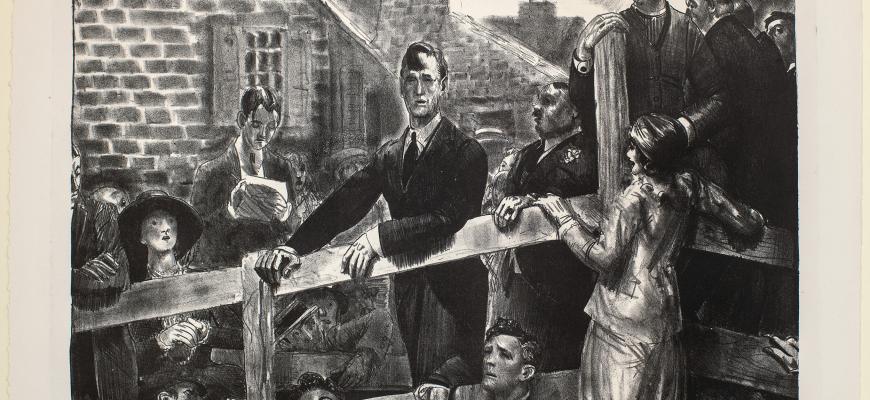
By 1915, Bolton Brown, a co-founder of Byrdcliffe, was immersed in lithography, a printmaking process using a stone plate. Although the process was invented at the end of the 18th century in Germany and used commercially and artistically throughout Europe and the United States in the 19th century, Brown is credited as the father of American lithography for his dedication to perfecting the medium scientifcally and artistically. He experimented with and invented new processes, wrote on the subject, printed for other artists, and had an output of over 400 lithographs. His own work ranges in style and subject matter, exploiting the expressive possibilities of the process— from delicate, tonal landscapes to sharply delineated still lifes.
1930s and Beyond

Although a wide range of artistic approaches in Woodstock continued in the 1930s, economic and social issues became more prevalent as subject matter with the onset of the Depression. Realism dominated much of the work, sometimes tinged with modernist elements, including abstraction. Various New Deal government programs—the Public Works of Art Project (1933–1934) and the Federal Art Project under the Works Progress Administration (1935–1943)—helped many Woodstock artists at this time. Some were commissioned to execute murals, others to produce prints, easel paintings, sculpture, posters, crafts, and more.
After World War II a new generation of artists arrived in Woodstock, joining those already established there. Along with the continued success of the earlier institutions, the return of the Art Students League Summer School (1947–1979) and annual events such as the Woodstock Art Conference (1947–1952) ensured the enduring vitality of the colony into the late 20th century to today.
George Bellows and His Circle
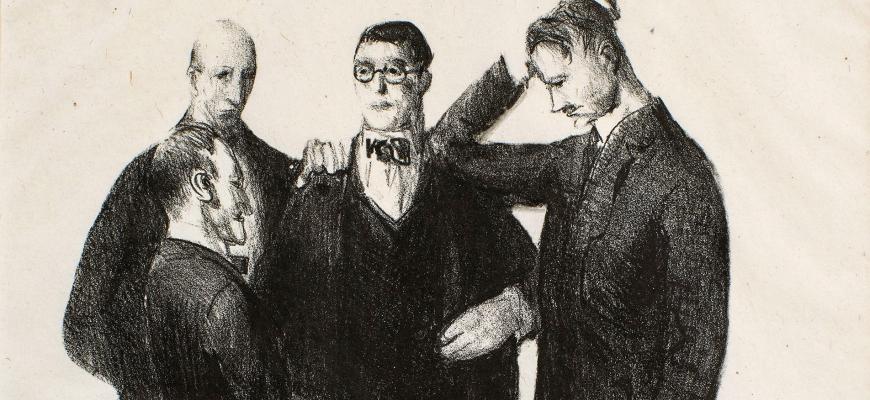
In 1920, at the invitation of Eugene Speicher, George Bellows spent his frst summer in Woodstock. Bellows belonged to the Ashcan School, a loosely associated group of early 20th-century artists working in New York City who favored urban subjects, often gritty in nature. They painted in a realist style that was in contrast to the prevailing and popular academic approaches. Both Speicher and Bellows had studied with its leader, Robert Henri, in New York.
Bellows became in many respects the backbone of Arthur Anderson’s collection and is richly represented by over 150 works, the most of any artist. His circle of artist friends in Woodstock included Speicher and Henri, as well as Leon Kroll, John Carroll, and Charles Rosen, among others.
Courage: The Black New York Struggle for Quality Education
This 20-panel exhibition explores the visions and aspirations of courageous leaders and parents who have been seeking to educate Black children. It looks at the obstacles Black children have faced, the comparative nature of learning environments, and belated examples of educational success that have been established in New York City’s public school system. It also asks the enduring question of what kinds of educational policies, environments, and instructional programs Black New Yorkers need in order to reach their fullest potential.
Originally curated by the Schomburg Center for Research in Black Culture, and updated under the direction of Deputy Director Kara Tucina Olidge, PhD. Donated by the Adelaide L. Sanford Institute in honor of Vice-Chancellor Emerita of the NY State Board of Regents Dr. Adelaide L. Sanford.
Resources

Discover a selection of dynamic works from the Woodstock Art Colony with a glimpse into Arthur A. Anderson's 1500-object collection, brimming with creativity and historical significance.
Behind the Scenes Virtual Tours
Educational Resources
The following three lessons have been designed to aid educators in teaching students about a variety of factors related to art making, including specific methods and techniques, stylistic movements, and the context and impact of place in creativity. The Educator Guides, downloadable as PDFs, provide both in depth information for the teacher as well as structured recommendations for student engagement. The Google Classroom slides can be utilized directly by students.
Exhibition Brochure
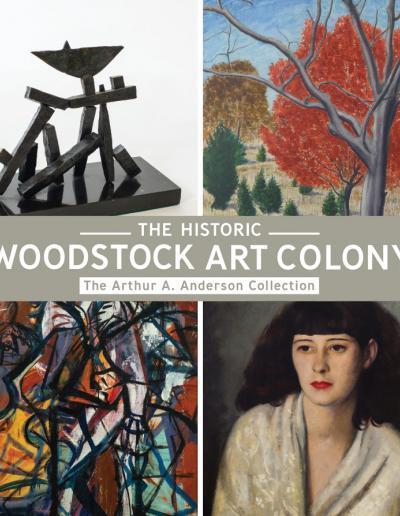
Bring all of the information about the history, art, and evolution of the Woodstock Art Colony anywhere you go with this concise (and downloadable!) brochure!
.
State Museum Opens Exhibition “Courage: The Black Struggle for Quality Education”
Exhibition on Loan from the Schomburg Center for Research in Black Culture
A new exhibition, Courage: The Black Struggle for Quality Education, is now open for the public to view at the New York State Museum, State Education Commissioner Betty A. Rosa announced today. The exhibition explores the visions and aspirations of courageous leaders and parents who have sought to equitably educate Black children. Developed by the Schomburg Center for Research in Black Culture in Harlem, and on loan to the State Museum, the exhibition will be on view in the Museum’s Photography Gallery through June 2022. The Adelaide L. Sanford Institute made the exhibition available to the Museum in honor of Vice Chancellor Emerita Dr. Adelaide L. Sanford of the Board of Regents.
“This exhibition shines a light on generations of courageous leaders in New York City who fought for educational quality and equality for Black students,” said Chancellor Lester W. Young. “For too long—centuries, in fact—the education system has failed our communities of color. This exhibition gives voice to that injustice, highlights the contributions of those who led the charge to right it, and demonstrates that we must continue to address systemic inequities in a system that puts our students at a disadvantage during critical developmental years.”
“The Department is proud to host the Schomburg Center’s Courage exhibition at the State Museum,” Commissioner Rosa said. “Sharing this story with the broader public and raising awareness of the history of unnecessary and unjust obstacles Black schools, students and teachers in New York City chronically face, aligns with our mission to raise the knowledge, skill and opportunity of all people in New York.”
“This exhibition provides an opportunity to both honor and bring attention to those who have fought tirelessly for equitable education for Black children,” said Vice Chancellor Emerita Sanford. “We must acknowledge and learn from the injustices faced by communities of color and celebrate those who have pushed for change while continuing to advocate for quality education for all.”
Before coming to the State Museum, Courage, which was originally developed in 2009, was updated under the direction of the Schomburg Center’s former deputy director, Kara Tucina Olidge, Ph.D., who is now executive director of the Amistad Research Center at Tulane University in New Orleans.
The State Museum is a program of the New York State Education Department’s Office of Cultural Education. Located at 222 Madison Avenue in Albany, the Museum is open Tuesday through Sunday from 9:30 am to 5:00 pm. In observance of Veterans Day, this year the Cultural Education Center will be closed on Thursday, November 11. It is also closed on Thanksgiving, Christmas and New Year’s Day. Admission is free. For information about COVID-19 safety and policies, visit the State Museum’s website.
-30-
Phone: (518) 474-1201
Unveiled: Wedding Wear in New York, 1910s–1940s
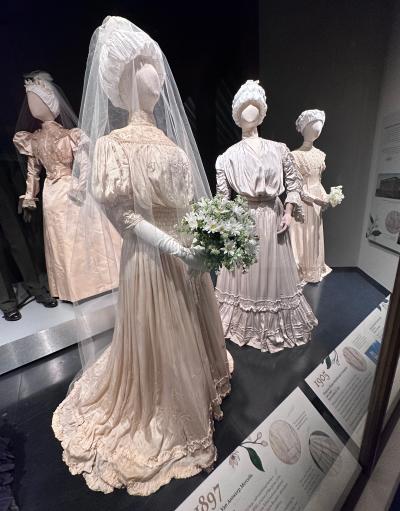
In choosing their wedding clothes, brides and grooms are influenced by fashion, economics, technology, religion, geography, celebrity, personal taste, and their role in society. This was as much the case in 19th and 20th centuries New York as it is today.
Wedding clothing holds memories, and pieces—dresses, shoes, suits, and head wear—are often preserved and passed to subsequent generations. A couple’s choices reveal historical information about both the individuals who wore them and those who made them. Some garments find their way to museum collections. This exhibition will unveil stories of select New Yorkers.
Visit
Path Through History

I Love New York’s Path Through History website offers a comprehensive listing of thematic historical attractions and sites searchable by location. This listing includes sites related to the Revolution, Colonial History, the Underground Railroad, Indigenous peoples, Women’s Rights, and more.
Changing New York

In 1929, after eight years in Europe, photographer Berenice Abbott (1898–1991) returned to New York City for what was planned as a short visit. During her absence, hundreds of 19th-century buildings had been razed to make way for dozens of skyscrapers. The unprecedented building boom inspired Abbott to give up her thriving Parisian portrait practice to photograph the new face of New York.
Soon after her return, the Stock Market crashed and the Depression began. For five years, Abbott struggled to pursue her project, reserving Wednesdays to photograph New York City. In 1935, the Federal Art Project offered her support: it gave her a $145 monthly salary, a field assistant, research assistants, a secretary, and a car. By 1940, Abbott had completed “Changing New York,” one of the monumental achievements of 20th-century photography.
When the Federal Art Project budget was cut in 1939, Abbott lost her job. She completed her project by creating two sets of 305 exhibition prints for her sponsor, the Museum of the City of New York, and a partial set for the New York State Museum. On view are the State Museum’s 40 prints, supplemented with enlargements from the Museum of the City of New York’s collection.
Ohio to Paris
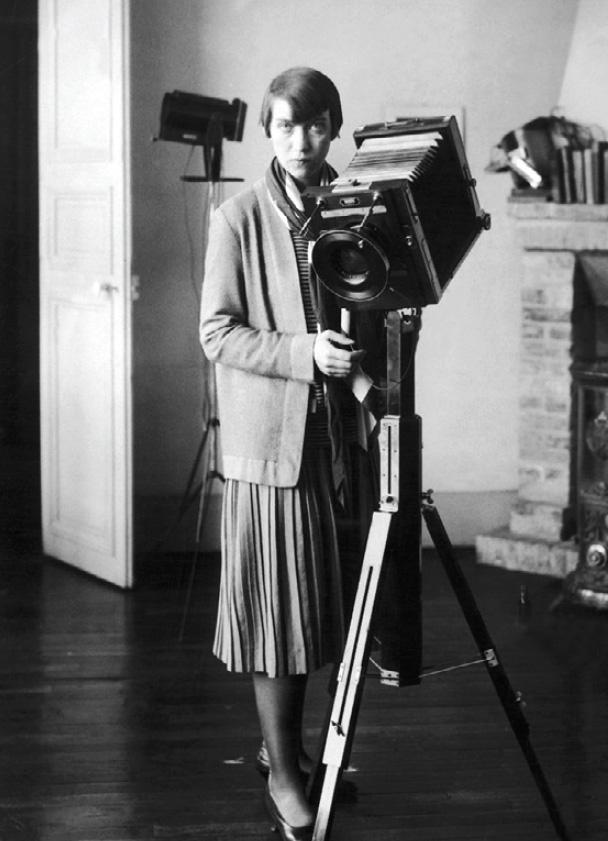
Born in 1898 in Springfield, Ohio, Berenice Abbott left Ohio State University after a year to become an artist in New York City. At age 19, she became a Greenwich Village denizen, taking bit parts in Eugene O’Neill plays and teaching Marcel Duchamp the latest dances.
In 1921, Abbott joined the bohemian exodus from New York to Paris, where she pursued her ambitions in sculpture and dance. After two years of travel between Paris and Berlin, she took a steady job as a darkroom assistant to Man Ray, a fellow expatriate with a successful photography practice. In three years time, she had become a skilled photographer and left Man Ray to open her own studio; soon her reputation as a portraitist rivaled his.
A Mentor
Through Man Ray, Abbott met Eugène Atget, an elderly photographer who had spent years documenting Paris. When Atget died in 1927, Abbott salvaged the contents of his studio and made his work her cause. His documentation of Paris inspired hers of New York. Like Atget, Abbott used a cumbersome large-format camera, which enhanced compositional control at the expense of capturing motion.
In her photographs, Abbott often expressed change by juxtaposing the old and the new—skyscrapers looming over tenements or billboards competing for attention with civic monuments. Roughly half of her photographs depict Manhattan below 14th Street, the oldest part of the city, where the contrast was most extreme. Abbott avoided tourist sites, Central Park, and uptown residential neighborhoods. In northern Manhattan and the outer boroughs, she was drawn to clapboard houses and Victorian public buildings, which recalled her Midwestern upbringing.
The Federal Art Project and Beyond
The Federal Art Project (FAP), a work-relief program for artists under the auspices of the Works Progress Administration, lasted only a few years. Begun in fall 1935, the FAP faced budget cuts in 1937 and deeper cuts in 1939. Although Abbott was an FAP star — her photographs were featured in exhibitions and were the subject of a book—“Changing New York” was ended against her will.
Almost immediately Abbott began thinking about her next “immense subject,” photographing science. Without scientific training and supporting herself by teaching and writing, Abbott labored for two decades inventing ways to visualize scientific phenomena, such as gravity and kinetic energy. In 1958, the Massachusetts Institute of Technology hired her to illustrate an innovative physics textbook and a series of popular books.
In 1961, health reasons forced Abbott to leave New York, and she retired to Maine, where she lived to the age of 93.
Pride Center of the Capital Region Panel Exhibition
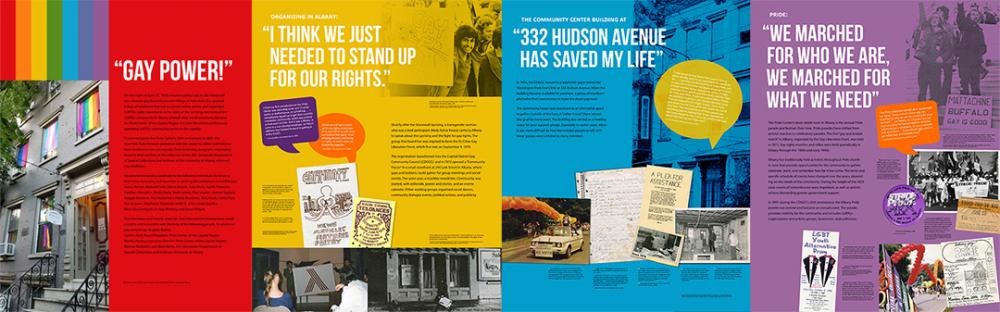
The New York State Museum is pleased to announce a panel exhibition highlighting the 50-year history of the Pride Center of the Capital Region, the oldest continuously operating LGBTQ+ community center in the country. To commemorate the Pride Center’s anniversary in 2020, the New York State Museum partnered with the Center to collect oral histories from members of the community. The exhibition includes their memories, as well as images and information from the Pride Center archives housed in the M.E. Grenander Department of Special Collections and Archives at the University at Albany.
The exhibition will be on view outside of the Museum's West Gallery throughout Pride Month, June 2021, with a closing date of September 5th.
Berenice Abbott: Changing New York
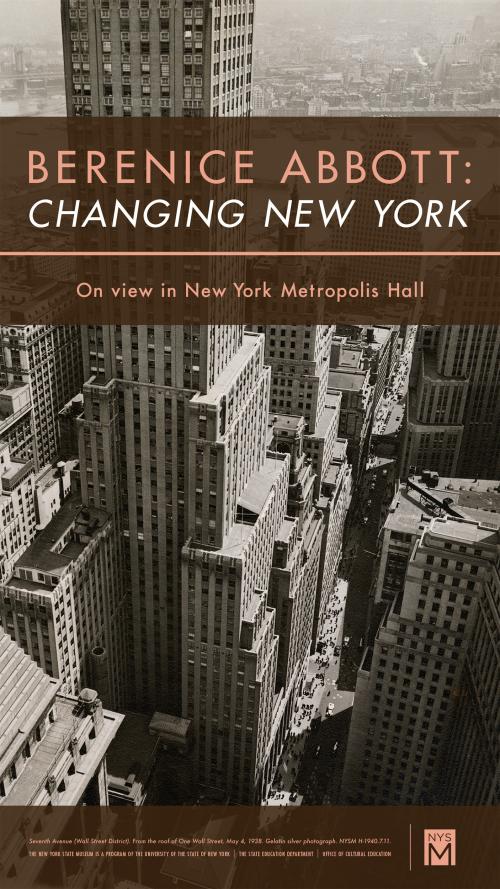
In 1929, after eight years in Europe, photographer Berenice Abbott (1898–1991) returned to New York City. She was inspired by its dramatic transformation. New construction was everywhere; hundreds of 19th-century buildings had been torn down to make way for dozens of skyscrapers. She was determined to capture this momentous change in photographs.
In 1935, with the support of the Federal Art Project, Abbott was able to devote her full energies to creating what she called Changing New York. By 1940, she had completed a collection considered to be one of the monumental achievements of 20th-century photography. Through the foresight of Director Charles Adams (1873–1955), the New York State Museum acquired a partial set of Abbott’s series, a selection of which is reproduced in this installation.
View this Exhibit Online!
Visit this online feature to learn more about the artist, discover the challenges she faced producing "Changing New York", and explore the New York State Museum's collection of Abbott's groundbreaking work.
Educational Resource
Byrdcliffe Arts Colony Collection
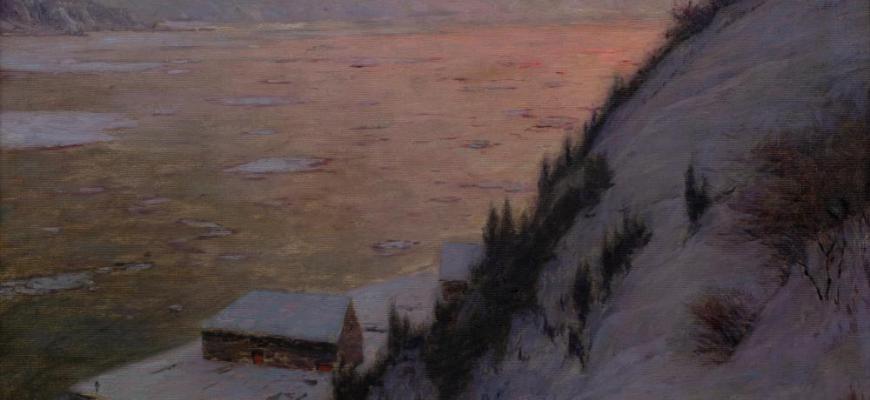
In 1902 the Byrdcliffe Arts Colony was established in Woodstock. The year-round utopian community promoted the Arts and Crafts movement, which emphasized individual, hand-crafted work over mass production. Wealthy Englishman Ralph Radcliffe Whitehead and his wife, Jane Byrd McCall, along with writer Hervey White and artist Bolton Brown, founded the colony; its name was derived from the middle names of the Whiteheads, who financed the project.
Byrdcliffe drew artisans from across all media: furniture makers, painters, printmakers, photographers, metalworkers, weavers, ceramicists, and others, as well as writers and musicians. Classes were offered, and notable teachers included co-founder Bolton Brown, Hermann Dudley Murphy, Birge Harrison, and William Schumacher. Byrdcliffe continues to flourish today under the auspices of the Woodstock Byrdcliffe Guild.
Maverick Arts Colony
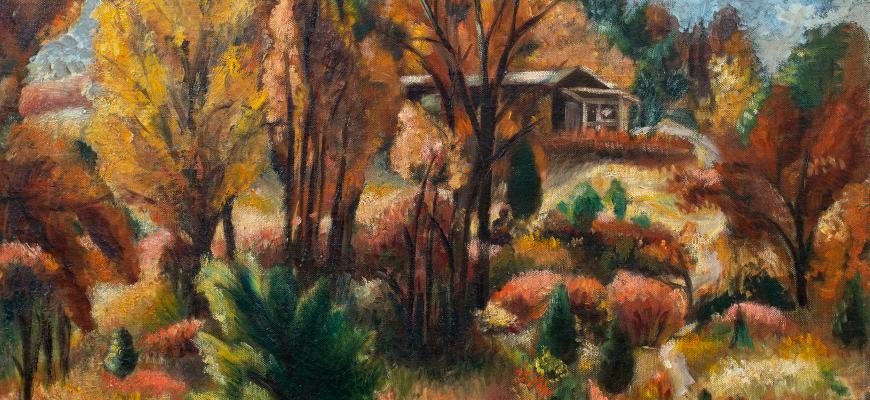
Hervey White left Byrdcliffe in 1904 and purchased a nearby farm to establish what would become the Maverick Arts Colony, a community more bohemian than Byrdcliffe. Early on, the colony attracted mostly writers and musicians, though by the 1920s visual artists of wideranging approaches had a large presence too. In 1910 White launched the Maverick Press, which published original literary and artistic material. A theater and concert hall also graced the grounds.
In 1915 White staged the first Maverick Festival, which would provide the main economic support for the colony. Held annually on the night of the August full moon, the festival featured music, dancing, food and drink, and attendees dressed in creative costumes. It is often seen as the forerunner to the famous Woodstock Music and Art Fair that was held in Bethel, New York, in 1969. Every summer Maverick Concerts still take place in the concert hall built by Hervey White in 1916.
Frank C. Eckmair (1930-2012) lived most of his life in central New York. He spent his early years drawing and working at his father’s hotel in Gilbertsville, a small village in Otsego County, west of Cooperstown. He earned a Bachelor of Arts degree from the State University of Iowa, where he studied with Mauricio Lasansky, who is considered to be the “Father of 20th-Century American Printmaking.” After teaching public school, Eckmair served in the U.S. Air Force in Korea, Japan, and the northwestern United States. He then received a Master of Fine Arts in printmaking from Ohio University. From 1963 to 1995 he was a revered teacher at Buffalo State College, where he influenced a generation of artists.
His work received its earliest recognition through American Associated Artists (AAA), a program founded to market affordable fine art prints to the American public. Like earlier artists such as Grant Wood, John Steuart Curry, and Thomas Hart Benton, Eckmair created prints of regional landscapes for AAA that had great populist appeal. He was also the artistic director of Birch Book Press, a publisher of hand-crafted letterpress books and art. Considered a master of the woodcut and represented in major collections around the world, Eckmair created haunting works evoking rural life in upstate New York.





Saratoga National Historical Park Getting $6.6M For Infrastructure

This article originally appeared on the New York Almanack website.
The primary visitor experience at Saratoga National Historical Park is about to benefit from $6.6 million in funding provided by the Great American Outdoors Act (GAOA).
Extensive work on the park’s self-guided battlefield Tour Road will begin in 2022 and is expected to result in increased accessibility and visible improvements to the parking areas, trailheads, walkways, seating, exhibits and viewing areas along the ten-mile-long route.
The current Tour Road experience is more than 50 years old. This renovation will expand physical access and safety enhancements for more than 100,000 visitors annually and eliminate $4 million of the park’s maintenance backlog. It will also be instrumental in preparing the park for the extra attention it will receive related to the upcoming 250th anniversary commemorations of the signing of the Declaration of Independence in 2026 and of the battles of Saratoga in 2027.
The parking areas and walkways are being revamped at all ten tour stops to meet universal standards for accessibility, including seating with companion seating, new improved exhibits, and audio description provided on an app for public use. 60 new outdoor exhibits constructed of steel, aluminum, and bronze will replace the existing informational waysides. Read more...
Educational Resource
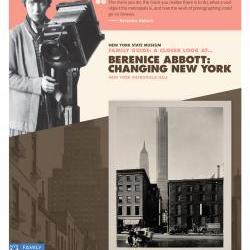
Family Guide: A Closer Look at Berenice Abbott: Changing New York (PDF)
Explore the work of this ground-breaking photographer with the children in your life through the Family Guide, “A Closer Look at Berenice Abbott: Changing New York.” This online feature helps young photographers and art historians learn about Abbott, engage with her photographs, and document their own changing communities.
World Trade Center Commuters - The Kristen Artz Collection
9/11
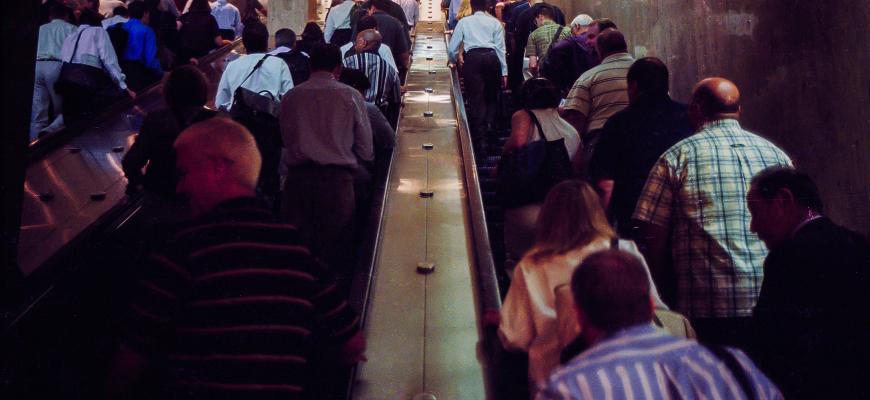
These photographs document morning commuters entering the World Trade Center Mall weeks prior to the attacks of September 11, 2001. The images include several dozen people from every walk of life in the original Mall at the World Trade Center. Shot in the days before handheld devices people are seen rushing by with coffee, others reading the paper, and some are just gazing into space.
If the Twin Towers were still standing, these would be merely snapshots of everyday people on their way to work in 2001. Instead they are a historical record documenting space that no longer exists and possibly people that are no longer with us.
New York State Museum Collection, H-2020.25
State Museum To Commemorate 9/11 With Window Display
The New York State Museum is offering programming to commemorate the 19th anniversary of the September 11, 2001 terrorist attacks. Beginning Friday, September 11, 2020, a display of World Trade Center artifacts will be added to the Windows on New York exhibition in the museum’s Madison Avenue lobby window. While the museum facility remains closed to the public, the display can be viewed outside while socially distancing during our closure.
Additionally, at 10:00 AM on Friday, September 11, 2020, Join the Museum’s senior historian and curator of the World Trade Center Collections, Aaron Noble, for a gallery tour of World Trade Center: Rescue, Recovery, Response as we commemorate the anniversary of September 11, 2001. Learn about the development of the Museum’s World Trade Center Collection and creating exhibitions about this seminal moment in American history.
Video of this program will be made available on the museum’s web page, as well as the NYSM's Facebook and YouTube pages:
The State Museum is a program of the New York State Education Department’s Office of Cultural Education. Located at 222 Madison Avenue in Albany, the Museum is currently closed. It is closed on the Fourth of July, Thanksgiving, Christmas, and New Year's Day. Admission is free. Further information about programs and events can be obtained by calling (518) 474-5877 or visiting the Museum website.
Phone: (518) 474-1201
Office of Cultural Education Highlights New Netherland Research and Collections
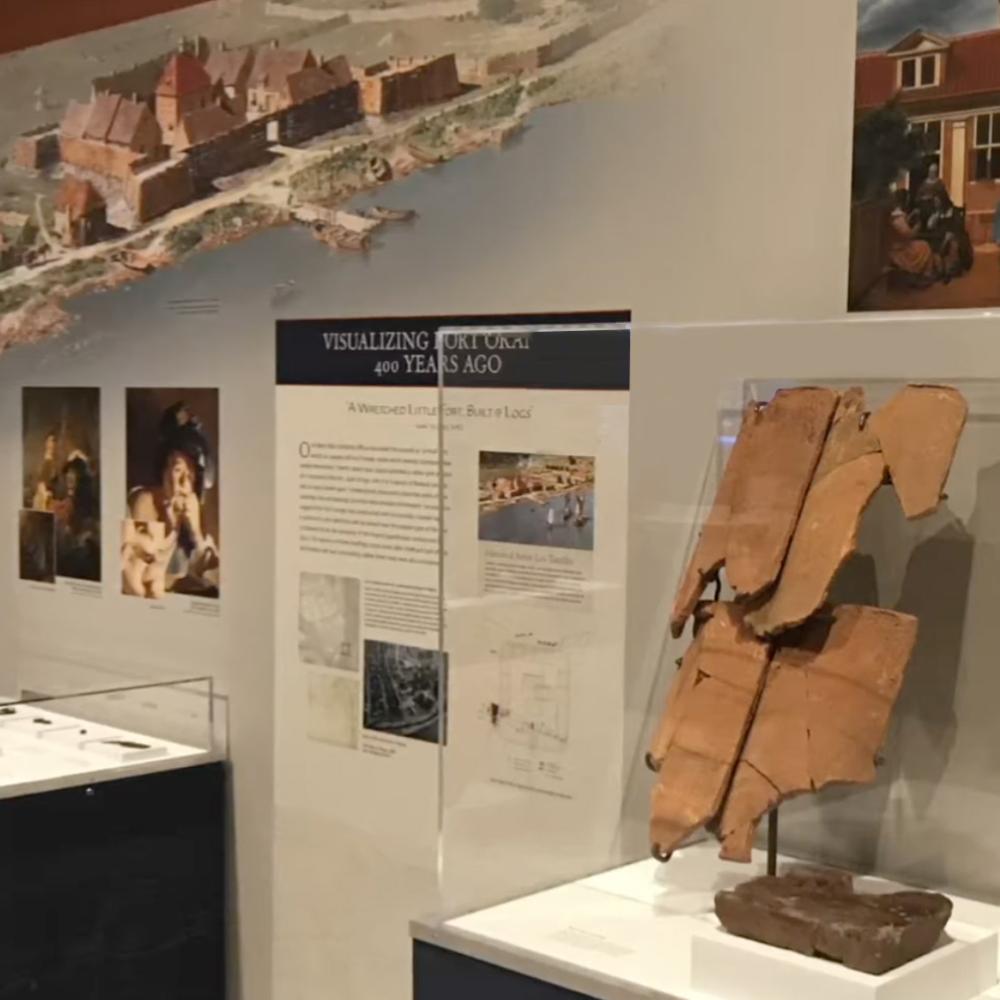
The State Archives, State Museum, and State Library are among the largest repositories of documents, artifacts, furniture, and decorative arts from the 17th century colonial Dutch settlements in what became New York. Join Dr. Charles Gehring, Director of the New Netherland Research Center, Dr. Michael Lucas, State Museum Historic Archaeologist, and Dr. Jennifer Lemak, State Museum Chief Curator of History, as they discuss their research and highlight important documents and artifacts in their respective collections.
The New York State Archives
The NYS Archives holds the surviving records of the Dutch colony of New Netherland, which encompassed the earliest European settlements that became the states of New York, New Jersey, Pennsylvania, and Delaware. These 17th-century records concern the full range of government functions including relations with native inhabitants, particularly the Mohawks, Mahicans, and various groups around New Amsterdam and the Delaware River.
The New York State Museum’s Historic Archaeology Collections
The NYSM Historic Archaeology Collections consist of thousands artifacts from colonial Dutch archaeological sites throughout the Hudson Valley and Manhattan, including over 36,000 artifacts from Fort Orange here in Albany – the first permanent Dutch settlement in New Netherland, built as a trading post by the West India Company in 1624.
The New York State Museum’s History Collection
The NYSM History Collection includes artifacts from 17th and 18th century that depict colonial Dutch life. The George Way Collection includes 17th and 18th century Dutch furniture, paintings, ceramics, and housewares. The Tompkins-Ten Eyck collection reflects the history of a colonial Dutch family that settled in Coeyman’s Hollow beginning in 1749 and spanned eight generations. There are also collections relating to the long lived Dutch influence on decorative arts, architecture, and agriculture in the Hudson Valley and Mohawk Valley.
The New York State Library
The NYS Library has a collection of 17th and 18th century Dutch family bibles – it was custom to record birth, death, and marriage dates in bibles. Many of these are written in Dutch well into the 19th century.
Additional Resources
For educational resources, worksheets, and additional videos about 17th century colonial Dutch settlements in New York, visit the NYSM Fort Orange Education Guide: http://www.nysm.nysed.gov/fort-orange-educational-guide
The McVaugh Donation: Insights on Hudson Valley Indigenous History
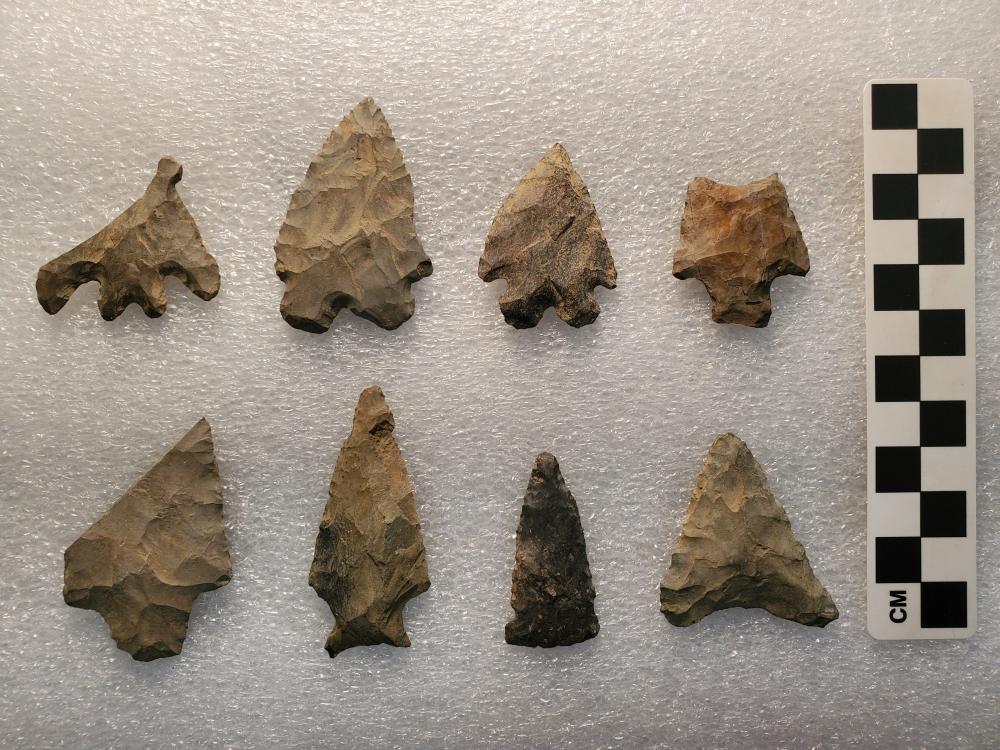
Over the years, the NYSM has received donations of some very large archaeological collections numbering hundreds of thousands of specimens, but small collections can also be important accessions. Born in 1909, Roger McVaugh grew up on his parents’ small hog farm north of Kinderhook, Columbia County, in the ancestral territory of the Mohican people. As a young man in the 1920s, Roger collected these stone tools while plowing his family's farmland, and recently, Roger’s son Michael donated the collection to the NYSM. This small group of about 50 objects consists mostly of projectile points. Made by percussion flaking of fine-grained stone, these points were lashed to the tips of hunting weaponry. Based on documented changes in form through time, this collection records as much as 9000 years of indigenous history in what is now Columbia County. The NYSM curates few archaeological artifacts from east of the Hudson, so the McVaugh collection represents an important accession that sheds light on the timing and duration of indigenous presence there. Importantly, these and other archaeological collections and sites from this part of the Hudson valley continue to hold special significance for the Stockbridge-Munsee Mohican Nation as part of their cultural heritage The NYSM takes its trust role in stewarding archaeological collections such as this seriously, recognizing the importance to indigenous Nations as well as the insights offered regarding the state’s human past.

Here are some examples of Native American projectile points in the recently donated McVaugh collection.
Examples of stone projectile points in the McVaugh collection. Top row: notched and stemmed points dating between circa 10,000 and 7500 years before present (BP). Bottom row: stemmed, side-notched and triangular point forms, ranging in age from about 4000 to 1000 years BP.
The McVaugh Donation: Insights on Hudson Valley Indigenous History
Over the years, the NYSM has received donations of some very large archaeological collections numbering hundreds of thousands of specimens, but small collections can also be important accessions. Born in 1909, Roger McVaugh grew up on his parents’ small hog farm north of Kinderhook, Columbia County, in the ancestral territory of the Mohican people. As a young man in the 1920s, Roger collected these stone tools while plowing his family's farmland, and recently, Roger’s son Michael donated the collection to the NYSM. This small group of about 50 objects consists mostly of projectile points. Made by percussion flaking of fine-grained stone, these points were lashed to the tips of hunting weaponry. Based on documented changes in form through time, this collection records as much as 9000 years of indigenous history in what is now Columbia County. The NYSM curates few archaeological artifacts from east of the Hudson, so the McVaugh collection represents an important accession that sheds light on the timing and duration of indigenous presence there. Importantly, these and other archaeological collections and sites from this part of the Hudson valley continue to hold special significance for the Stockbridge-Munsee Mohican Nation as part of their cultural heritage The NYSM takes its trust role in stewarding archaeological collections such as this seriously, recognizing the importance to indigenous Nations as well as the insights offered regarding the state’s human past.
Here are some examples of Native American projectile points in the recently donated McVaugh collection.
Examples of stone projectile points in the McVaugh collection. Top row: notched and stemmed points dating between circa 10,000 and 7500 years before present (BP). Bottom row: stemmed, side-notched and triangular point forms, ranging in age from about 4000 to 1000 years BP.
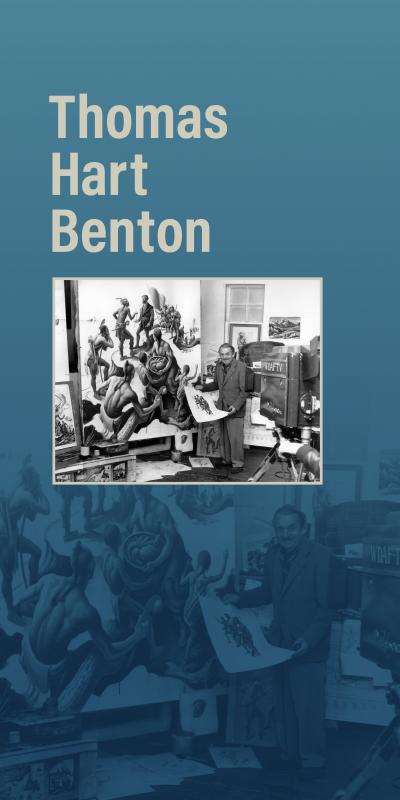
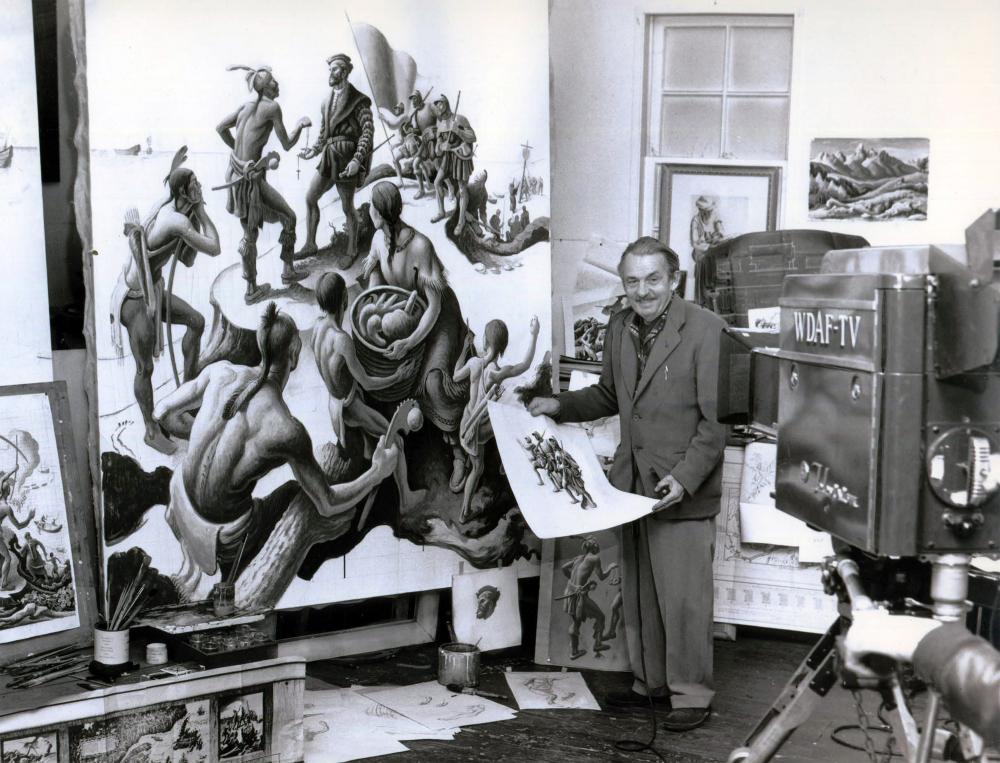
Thomas Hart Benton in his Kansas City, Missouri, studio presenting the right panel of the Jacques Cartier mural on NBC’s Wide, Wide World on January 20, 1957.
Photograph courtesy of Missouri State Parks/Thomas Hart Benton Home & Studio State Historic Site.
Thomas Hart Benton
In 1956 Thomas Hart Benton was commissioned by Robert Moses, chairman of the New York Power Authority, to create two murals for the powerhouse building of the state’s first hydropower facility in Massena. They feature Jacques Cartier’s explorations of the St. Lawrence River and the Gulf of St. Lawrence. Alternately titled The Seneca Discover the French and Jacques Cartier Discovers the Indians, the murals depict the 16th-century encounters from two points of view. Benton took liberties with the timing of two actual events in his representation, however, combining them into a single scene for, he noted, “the sake of historical meaning.” In spite of the inaccuracy, Benton had thoroughly researched the subject, studying Cartier’s accounts and working with prints made shortly thereafter, as well as a model of the ship. In addition, Benton noted, the “Indian costumes, war clubs, head dresses etc. are for the most part based upon exhibits of Iriquois [sic] life in the State Museum at Albany, N.Y.” These life groups were on view at the Museum when it was at the State Education Building.
The original building in Massena where these murals were displayed is now closed to the public. They were removed and conserved beginning in 2018 and are on loan to the New York State Museum.
Online Feature: Thomas Hart Benton Murals
Explore this online adaptation of the NYSM exhibit Thomas Hart Benton complete with gallery views, detailed information about the artist and the murals, and a video introduction by the exhibit's curator.
Thomas Hart Benton
Often considered among the most popular 20th-century American artists, Thomas Hart Benton was one of the leading Regionalists, a loosely associated group of realist painters who became best known for depicting rural American subjects, beginning during the Depression. In the 1920s and 1930s Benton consciously rejected abstraction in favor of a naturalistic approach expressed in undulating, rhythmic forms, and he developed a narrative style that focused on American social history. Although often associated with his native Midwest, Benton spent some two decades working and teaching in New York City.
In 1956 Benton was commissioned by Robert Moses, chairman of the New York Power Authority, to create two murals for the powerhouse building of the state’s first hydropower facility in Massena. They feature Jacques Cartier’s explorations of the St. Lawrence River and the Gulf of St. Lawrence. Alternately titled The Seneca Discover the French and Jacques Cartier Discovers the Indians, the murals depict the 16th-century encounters from two points of view. Benton took liberties with the timing of two actual events in his representation, however, combining them into a single scene for, he noted, “the sake of historical meaning.” In spite of this inaccuracy, Benton had thoroughly researched the subject, studying Cartier’s accounts and working with prints made shortly thereafter, as well as a model of the ship. In addition, Benton noted, the “Indian costumes, war clubs, headdresses etc. are for the most part based upon exhibits of Iriquois [sic] life in the State Museum at Albany, N.Y.” These life groups were on view at the Museum when it was housed at the State Education Building. The original building in Massena where these murals were displayed is now closed to the public. They were removed and conserved beginning in 2018 and are on loan to the New York State Museum.
Karen Quinn
Senior Historian/Curator, Art and Culture, New York State Museum
The Murals
In 1956 the Power Authority of the State of New York (NYPA) commissioned two paintings by Thomas Hart Benton (1889–1975) for display at the Robert Moses Power Dam in Massena, New York. Both panels celebrate French explorer Jacques Cartier’s 1534–1535 voyage into the Gulf of St. Lawrence to Lachine Rapids, just south of present-day Montreal. In these paintings, Benton portrays imagined scenes, drawn from details Cartier captured in accounts of his expedition.
The first panel depicts the local Iroquoian people running to investigate the strangers’ ship anchored near their palisaded village. Benton did considerable research for his murals, visiting historic sites, reading archival sources, and examining related artifacts in museum collections. The village portrayed is based on a 16th-century illustration of Cartier’s observations. Benton was careful to depict the Iroquoian people as skilled agriculturists, tending their crops of corn, beans, and squash. He found models for his subjects among the Seneca and Cayuga peoples living in Oklahoma (closer to Benton’s home in Missouri), and he based their weapons and headdresses on artifacts he had seen at the New York State Museum.
The second panel portrays Cartier presenting a wary elder with a cross, while French soldiers erect a much larger cross in the background. Benton wished to honor both the Indigenous peoples and the explorers in these paintings, depicting a fertile and inhabited land about to be changed forever.
Scott Manning Stevens, PhD
Director, Native American and Indigenous Studies, Syracuse University
Gallery View
Benton based his rendering of the village in the mural on this 16th-century image. This map is said to be the first printed depiction of an intact indigenous town in North America, and what would become Montreal. Note the protective wooden palisade surrounding a settlement of orderly streets and square buildings and homes, arranged around a central square, in an orthogonal, or grid, pattern. Credit: Wikimedia Commons
Thomas Hart Benton referred to the State Museum’s Iroquois Indian Groups exhibition when creating the Massena murals. The diorama shown here was titled “The Mohawk Warrior Group.” It was one of six such groups on display at the Museum when it opened in 1916 at the New York State Education Building. In 1975 the exhibition closed, and the life figures, painted backgrounds, clothing, and artifacts were placed in long-term storage.
Art Students League
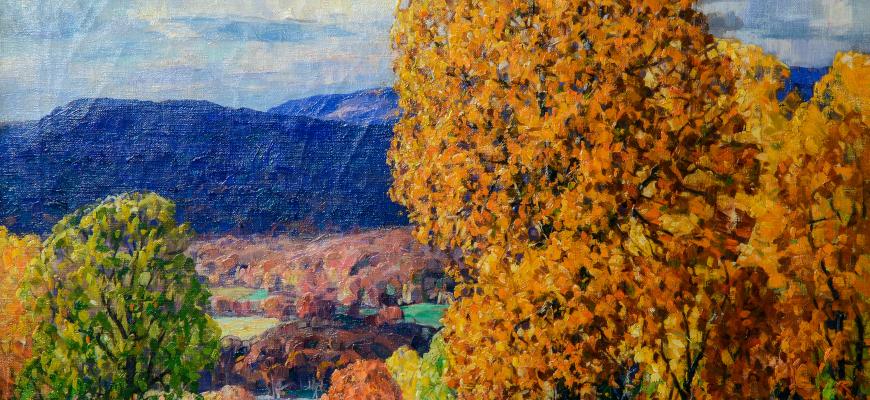
In 1906 the Art Students League moved its summer school to Woodstock. The League had been founded in New York City in 1875 as an alternative to the mainstream National Academy of Design and had become one of the most important art schools in the country. From 1906 to 1922, and again from 1947 to 1979, the Art Students League brought as many as 200 students to the Woodstock area each year.
Birge Harrison taught at the summer school in Woodstock for its first five years. He had been the painting instructor at Byrdcliffe in 1904 and indeed there was much overlap of artists, both students and teachers, among the various organizations in Woodstock. As Harrison noted, “The desire is to develop a number of individual painters and not to develop a ‘school.’” Landscape was emphasized as much as the figurative tradition, and naturally, given the bucolic location, it became a focus for many artists working in Woodstock.
Modernism in Woodstock

Throughout the 1910s and 1920s, Woodstock artists associated with the Art Students League and others worked in a variety of styles. Some favored Birge Harrison’s subtle Tonalist approach; others, the painterly brushstrokes and light of Impressionism; and still others the jewel-like tones of the Post-Impressionist palette.
Works influenced by a number of European avant-garde movements also made their marks in Woodstock. Among those experimenting with varying degrees of abstraction were Konrad Cramer, Andrew Dasburg, and Henry Lee McFee, who were dubbed the Rock City Rebels after the part of Woodstock where they lived. Cramer, born in Germany, drew upon his experiences there with the radical art of Der Blaue Reiter, a group that used exaggerated forms and highly keyed colors to convey emotion. Dasburg had visited France, where he met Henri Matisse, who emphasized color for its own sake—a style called Fauvism. In Paris, Dasburg also studied the work of Paul Cézanne and Cubism, perhaps the most influential of all modernist approaches, based on fragmented images seen from different viewpoints. Elements of all these styles are not only seen in the work of the Rock City Rebels but in that of other Woodstock artists as well.
Artists of all stylistic bents came together to establish the Woodstock Artists Association in 1919, a much-needed venue for exhibitions that remains active today as the Woodstock Artists Association and Museum
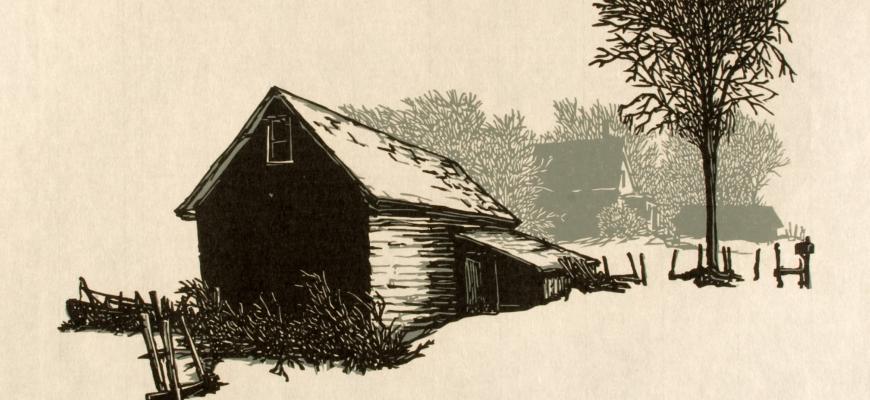
The Landscape of Memory explores a singular artistic vision through the Museum’s extensive collection of works by Frank C. Eckmair. An internationally recognized printmaker, Eckmair had an intimate affinity for the quiet landscape of rural central New York. His subjects included its farm fields, stone walls, abandoned homes, and old barns.
Through memory and direct observation, Eckmair created a poignant body of work that invites us to contemplate this historic and beautiful region. It is filled with, as he was known to say, “many things not to be forgotten.”
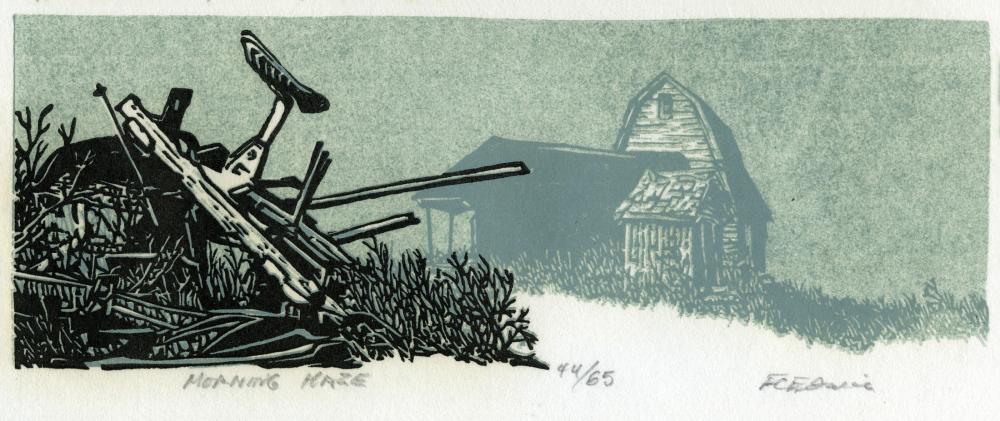
Frank C. Eckmair
Morning Haze
Educator Guide
Relief Printing and the Works of Frank C. Eckmair
This lesson encourages students to gain a basic understanding of printmaking. Students will use observation skills to evaluate, discuss, and connect to the art of printmaker Frank C. Eckmair. They will experiment with techniques and create their own linocut print, learn how to care for materials and use tools in a safe and responsible manner, and make connections between process and meaning.
The State Museum’s significant collection of material from the World Trade Center and objects from the international response to the events of September 11, 2001, tell the story of that day and its aftermath.
The World Trade Center: Rescue, Recovery, Response details the history of the World Trade Center, the September 11 attacks, the rescue efforts, the evidence recovery operation at the Fresh Kills facility, and the public response to the September 11th events. The exhibition includes many objects, images, videos, and interactive stations documenting this tragic chapter in New York and America's history.