


Be sure to visit the NYSM from February 11 to March 1, 2020, to view an original draft of the Preliminary Emancipation Proclamation written in Lincoln’s own hand.
Additional Resources

Resources from the New York State Archives
19th Century African American Voting Rights
The New York State Archives provides digital access to archival material documenting New York’s role in the enslavement of African Americans, the gradual manumission of enslaved people, and support for and against equal voting rights for African American New Yorkers.
This link provides access to these documents as well descriptions, transcripts, and links to other New York State Archival resources for educators using archival material in their classrooms.
http://www.archives.nysed.gov/education/19th-century-african-american-voting-rights-0

NYSM Online Exhibition: An Irrespressible Conflict
This website details the pivotal role New York State played in the Civil War. Additional information related the rights of African Americans during Reconstruction and after the passing of the 15th Amendment can be found under the heading "Reconstruction & Legacy" and "The Age of Reconstruction".
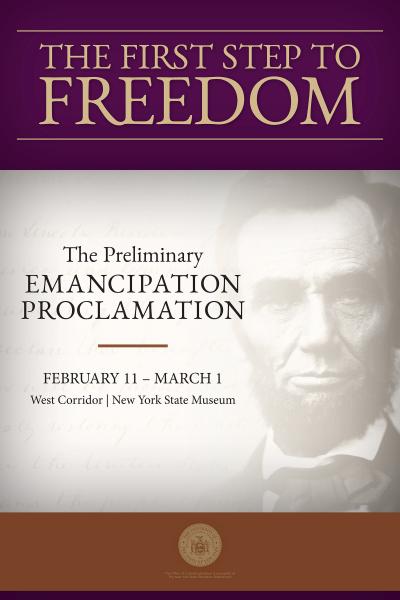
The First Step to Freedom: The Preliminary Emancipation Proclamation


President Abraham Lincoln issued two emancipation proclamations—one on September 22, 1862, and another one hundred days later. In the Preliminary Emancipation Proclamation, Lincoln declared that all slaves would be “forever” free on January 1, 1863, unless the Confederate states returned to the Union. Lincoln followed through with his promise, and on New Year’s Day 1863 he signed the final Emancipation Proclamation.
The document on display in the New York State Museum, from the collection of the New York State Library, is a draft of the Preliminary Emancipation Proclamation written in Lincoln’s own hand. This exhibition offers visitors the opportunity to learn more about this groundbreaking document that changed the fate of the nation.
President Lincoln's Handwritten Preliminary Emancipation Proclamation on Exhibit at State Museum
President Abraham Lincoln’s handwritten draft of the Preliminary Emancipation Proclamation will be on exhibit at the New York State Museum from February 11 through March 1, 2020. President Lincoln issued the Preliminary Emancipation Proclamation during the Civil War on September 22, 1862 ordering that in 100 days the federal government would deem all slaves free in states still rebelling against the Union. The iconic document, in the collections of the New York State Library since 1865, has been recently re-encased in a state-of-the-art, custom-designed encasement.
The exhibition is dedicated in honor of the late Regent Judith Johnson. The Board of Regents and the State Education Department commemorate Regent Johnson’s life and her unrelenting advocacy for educational equity and excellence for all children by dedicating this exhibition in her honor.
“The Preliminary Emancipation Proclamation, written by President Lincoln in 1862, is a treasured document in the New York State Library’s collections,” said Board of Regents Chancellor Betty A. Rosa. “This historic document presents a learning opportunity for adults and children to reflect on our nation’s past and celebrate the progress we have made and continue to work toward. We’re honored to dedicate this exhibition to the late Regent Judith Johnson and celebrate the countless lives she impacted with her compassion and knowledge and her vision that all students deserve equal opportunity to succeed in life.”
“The Preliminary Emancipation Proclamation is truly a national treasure,” said Interim State Education Commissioner Shannon Tahoe. “More than 150 years after President Lincoln drafted this iconic document, we are proud to exhibit it and commemorate this pivotal, transformative moment in our nation’s history. It also reminds us that America is still a work in progress as we continue to work towards freedom and equality. The document’s new encasement will ensure that President Lincoln’s handwritten draft will continue to be preserved for generations to come.”
On September 22, 1862, following the Union victory at the Battle of Antietam, President Lincoln issued the Preliminary Emancipation Proclamation, ordering that in 100 days the federal government would deem all slaves free in those states still rebelling against the Union.
The Preliminary Emancipation Proclamation is one of two surviving Proclamation documents in Lincoln’s own hand. Lincoln probably glued in sections of the printed Congressional Confiscation Act (laws passed in 1861 and 1862 with the intention of freeing enslaved people still held by Confederate forces) to save time—the fingerprint visible on the first page of the document could be his own. Although Lincoln’s handwritten final Emancipation Proclamation burned in the Chicago fire in 1871, the Preliminary Proclamation survived the State Capitol fire of 1911 and has been preserved by the State Library.
Phone: (518) 474-1201
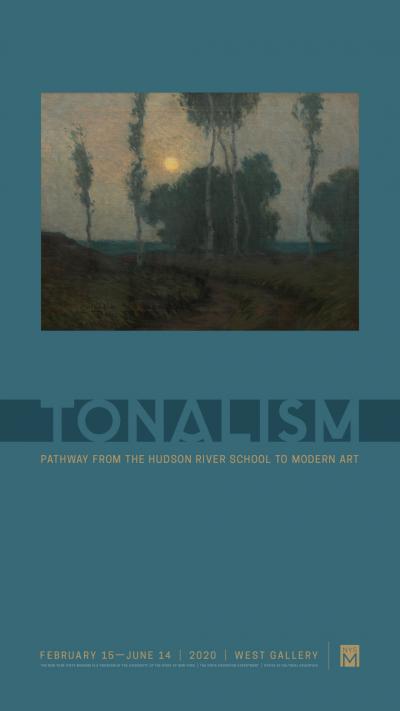
Tonalism: Pathway from the Hudson River School to Modern Art
Tonalism has long been considered a conservative approach to painting, often discussed as the antithesis to Impressionism. But recent publications have begun to reconsider this late 19th-century movement as innovative in its approach to representation both conceptually and as realized, an approach that helped to lay the groundwork for Modernism and contemporary art. This exhibition will reposition Tonalism in this new context.
Organized by the New York State Museum and the Samuel Dorsky Museum of Art in New Paltz, and following their institutional missions, this exhibition features Tonalism as practiced by painters and photographers with ties to New York. Although many were based in New York City, the work of artists across the state will be explored. Building on the renowned work of Tonalist trailblazers such as James A. McNeil Whistler and George Inness, the focus will be on mostly lesser-known masters of the movement in an effort to shed light on their contributions. They range from around the state, from Frederick Kost on Long Island, to Birge Harrison in Woodstock, to Alexander Helwig Wyant in Arkville and Keene Valley, to Walter Launt Palmer in Albany, and others.
Many of the works included in this exhibition have been loaned by private collectors, offering viewers the chance to see works that are not in the public domain. Tonalism: Pathway from the Hudson River School to Modern Art showed at the Dorsky Museum from August 28 through December 8, 2019. Additional Tonalist works from the newly acquired Historic Woodstock Art Colony: Arthur A. Anderson Collection at the New York State Museum have been added to the installation here.
A public opening reception and gallery tour will be held on Saturday, April 4, 2020, from 1–3 p.m.

View this Exhibit Online!
Briefly on view at the Museum in 2020, the exhibition closed early due to Covid-19. The lenders generously agreed to allow these works to be exhibited online indefinitely, giving viewers the chance to explore the exhibition at their leisure.
Tonalism Brochure
Download the exhibition brochure that includes in depth information about Tonalism along with highlights of featured New York State artists and their work.
“Tonalism: Pathway From Hudson River School to Modern Art” Exhibition at State Museum February 15 – June 14
The New York State Museum will open Tonalism: Pathway from the Hudson River School to Modern Art, an exhibition exploring a late 19th century movement in painting with deep connections to New York State, on February 15. On display through June 14, 2020, the exhibition features over 60 artworks – including paintings, prints, and photographs – from institutions across the state as well as private collections.
“We’re proud to present this new art exhibition at the State Museum,” said Board of Regents Chancellor Betty A. Rosa. “Art often conveys emotion and the Tonalism exhibition explores how artists created landscapes that evoke feeling and mood. Students and teachers will enjoy learning about this artistic style and exploring how it set the foundation for future art movements.”
“Art exhibitions are a great opportunity for visitors of all ages to learn not only about art but also about history and culture,” said Interim State Education Commissioner Shannon Tahoe. “The Tonalism exhibition at the State Museum invites visitors to see incredible artwork from cultural institutions and private collectors across the state, including some artwork that has rarely been exhibited in public.”
Emerging in the years after the Civil War, Tonalism appealed to audiences seeking respite from the devastation of war, the political turmoil of Reconstruction, and the rise of industrialization and urbanization. In the broadest sense, Tonalism can be understood as an approach to representation that relied less on faithfulness to visual reality than on creating an evocative mood, often through memory. Tonalist artists achieved a prevailing sense of quiet by depicting subjects at either end of the day, in soft light and with a delicate range of colors – thus, “tonal”. Landscapes dominated, but figurative works were not excluded. Overall, Tonalism encouraged contemplation.
Tonalism: Pathway from the Hudson River School to Modern Art is organized by the New York State Museum and the Samuel Dorsky Museum of Art. The group of artists included in the exhibition is a representation of those who practiced Tonalism. The artists range from Frederick Kost on Long Island, to those working in Woodstock, including Birge Harrison, Eva Watson-Schütze, and Bolton Brown, to Alexander Helwig Wyant in Arkville and Keene Valley, to Walter Launt Palmer and others who had ties to Albany. The goal is to cast a wide net and consider Tonalism as a broader concept than heretofore presented.
The public is invited to attend a reception for the exhibition on Saturday, April 4 from 1:00 p.m. – 3:00 p.m. The reception will begin with light refreshments at 1:00 p.m., followed by an exhibition tour led by senior historian and curator Karen Quinn at 2:00 p.m.
Photos of artwork from the exhibition are available on the Museum’s website.
The State Museum is a program of the New York State Education Department’s Office of Cultural Education. Located at 222 Madison Avenue in Albany, the Museum is open Tuesday through Sunday from 9:30 a.m. to 5:00 p.m. It is closed on the Fourth of July, Thanksgiving, Christmas, and New Year's Day. Admission is free. Further information about programs and events can be obtained by calling (518) 474-5877 or visiting the Museum website.
Phone: (518) 474-1201
Suffrage Wagon, c. 1820
New York State Museum
First proposed model of a statue honoring Stanton and Anthony
by Meredith Bergmann, courtesy of the Statue Fund
Photo credit: Glenn Castellano of the New-York Historical Society
"The Susan B. Anthony Dollar" by Kenneth Dardenne
2020 Quilt Project
Women's History Month Exhibitions
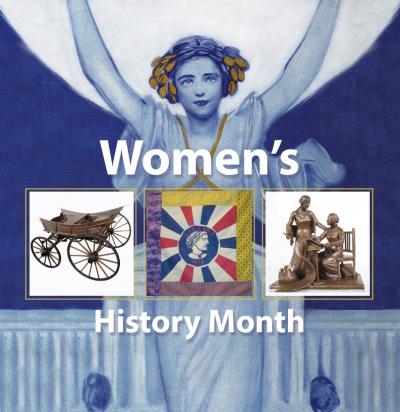
In honor of Women’s History Month and in recognition of the centennial of the passage of the 19th Amendment, which ended the exclusion of voters on the basis of sex, the State Museum is proud to display three installations.
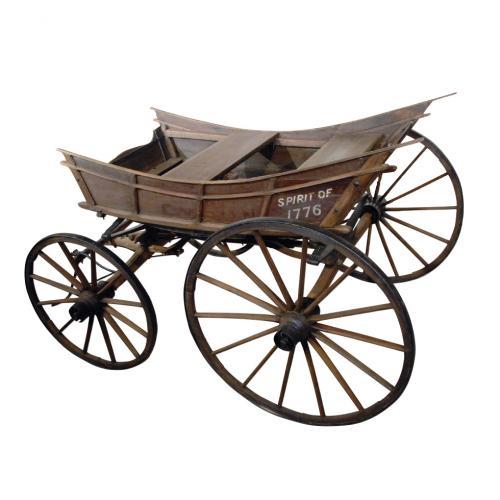
Suffrage Wagon
In 1913, this wagon was covered in suffrage banners and hand-painted signs. Suffragists equated their cause with that of our nation’s founders, and this wagon helped drive home that point. Claiming it was built in 1776 and belonged to patriots, suffrage activists used the wagon as both a prop and a speaker’s platform.
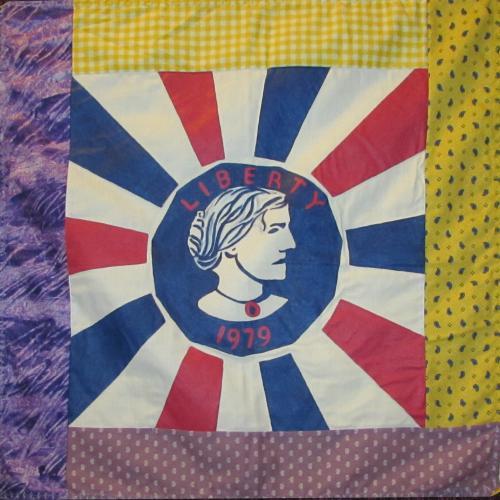
2020 Quilt Project
The 2020 Quilt Project is a collaborative textile art project initiated by the National Susan B. Anthony Museum & House in Rochester, New York. Created to mark the centennial of passage of the 19th Amendment in 2020, the quilt celebrates achievements women have made in fighting for equal rights and also addresses “unfinished business,” or rights yet to be won.
New York State granted women the right to vote in 1917, which helped shift the national conversation toward passage of the 19th Amendment to the U.S. Constitution, ending the exclusion of voters on the basis of sex. New York-based suffragists played an important role in the national fight for women’s suffrage.
Images of the more than 300 individual squares and information about the artists can be found at www.susanbanthonyhouse.org/2020quiltproject.
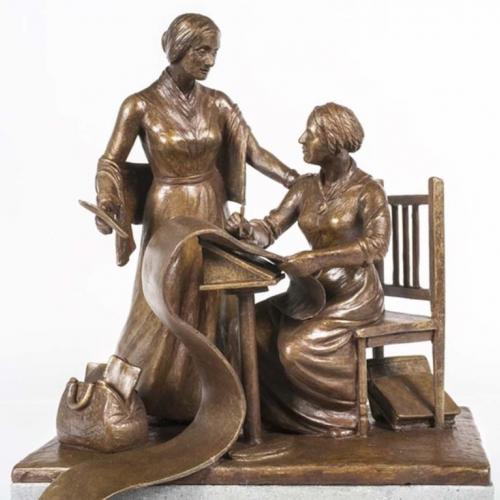
Woman Suffrage Movement Monument Maquette
This is the first version of a model for a statue that is scheduled to be unveiled in New York City’s Central Park on August 26, 2020.
In 2013, longtime women’s rights activists Pam Elam and Coline Jenkins formed the Statue Fund to create the first statue in Central Park that both honors and depicts real women. Sculptor Meredith Bergmann’s design was chosen out of 91 entries.
When the model was presented in 2018, the design prompted a discussion about the exclusion of contributions of women of color in the suffrage movement. Bergmann created a new design that represents three major leaders in 19th-century women’s rights movement: Sojourner Truth, Elizabeth Cady Stanton, and Susan B. Anthony.
More information can be found at the Statue Fund’s webpage, www.monumentalwomen.org
Wagon
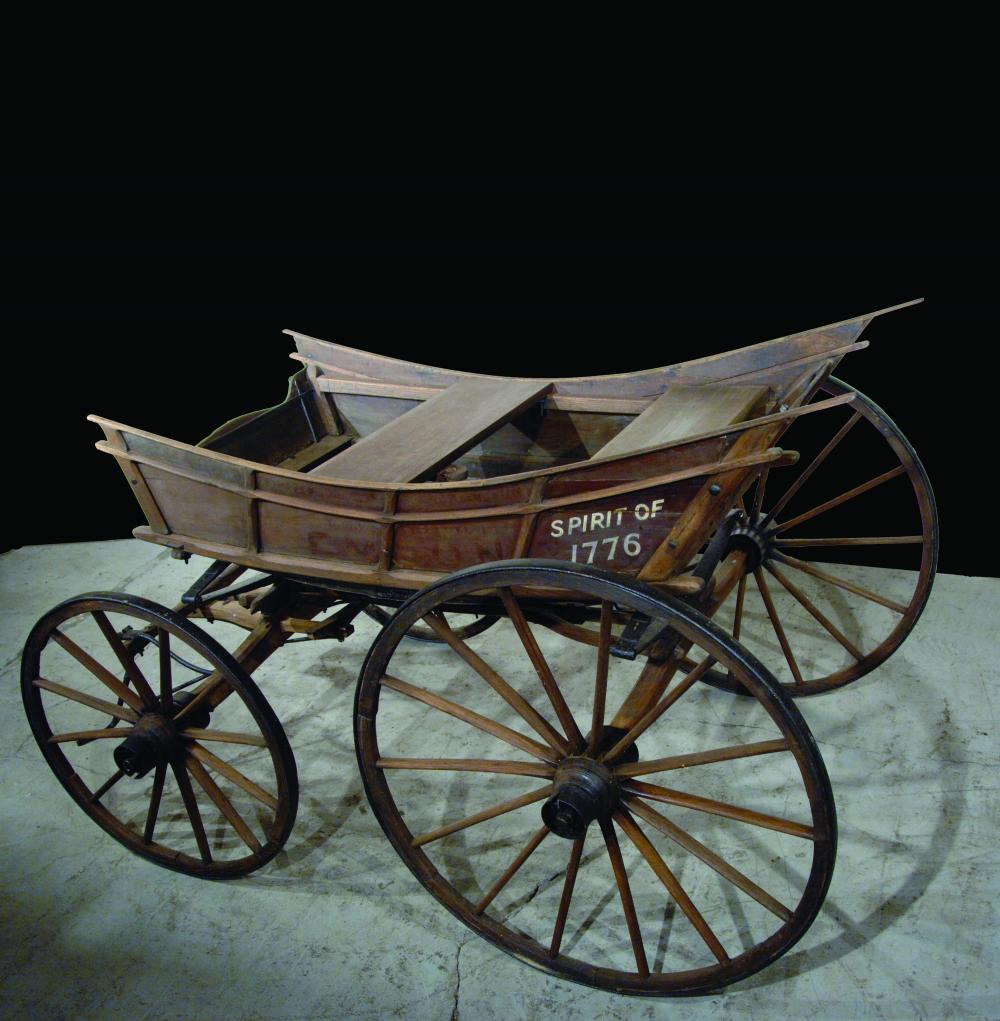
Women's Suffrage Wagon
Photo Credit: New York State Museum
Suffrage activists used this c. 1840 wagon as a prop and speaker’s platform. August 26, 2020, marks the centennial of the passage of the 19th Amendment, which constitutionally guaranteed adult women the right to vote.
NYSM H-2007.21.1
Guiding Questions:
- What is suffrage?
- Why would the New York women reference 1776 to support their cause?
- How could a wagon be used to send a message?
For more information about suffrage:
- Visit the NYSM online exhibit: http://www.nysm.nysed.gov/votes-for-women(link is external)
- Watch "Field Trip to the NYSM: Suffrage Wagon & Susan B. Anthony House 2020 Quilt Project": https://youtu.be/-MisjRjGvl0
Banner

This banner, which hung at 9 Madison Place in Albany, New York, went up on March 22, 2020—the first day “New York on Pause” went into effect. Meagan Fitzgerald created the banner because she was “overwhelmed with gratefulness for all of those working on the front lines and for the Governor for keeping a sense of calm during a highly anxious period.”
The COVID-19 pandemic has affected all aspects of daily life in every part of New York State. As collecting institutions, the State Museum, Library, and Archives are working to document and collect materials related to the pandemic and its effects on state and local government, institutions, and everyday individuals, with special focus given to communities whose histories are traditionally underrepresented. If you have objects, stories, or photographs that document this pandemic that you would like to donate, please let us know.
New York State Museum Collections
Virtual Field Trips to the New York State Museum
Join us for our "Facebook Live Field Trips to the New York State Museum" every Tuesday, Wednesday, and Thursday at 1:00 p.m. (EDT). Visit with NYSM educators, scientists, and historians as they take you behind the scenes of some of the museum's exhibits and collections to highlight cool finds and facts from New York State!
View Live on Facebook at 1pm
Our Live Field Trips can be viewed from the NYSM Facebook page: www.facebook.com/nysmuseum. If you don't automatically see the video at 1:00 p.m., continue to refresh the page until it appears (usually within 2-3 minutes).
View Later on the NYSM YouTube Channel:
Can't connect to Facebook? No problem! Every Vitural Field Trip is available on demand on YouTube anytime after 5:00 p.m. on the day of filming. NYSM YouTube Channel: www.youtube.com/nysmuseum

Virtual Summer Programs at the NYSM
Throughout the summer, we are making our most popular programs available to you online via Facebook Live! In addition to our Field Trips to the NYSM, we are adding new arts and science demonstrations, gallery tours, storytelling, and more! Programs will run either at 10am or 1pm, so check the program calendar for dates and times!
View Live on Facebook
All of our Virtual Programs can be viewed from the NYSM Facebook page: www.facebook.com/nysmuseum. If you don't automatically see the video at its scheduled time., continue to refresh the page until it appears (usually within 2-3 minutes).
View Later on the NYSM YouTube Channel:
Can't connect to Facebook? No problem! All of our Virtual Program are available on demand on YouTube anytime after 5:00 p.m. on the day of filming.
NYSM YouTube Channel: www.youtube.com/nysmuseum
Mineralogy
The New York State Museum’s Mineralogy Collection constitutes the world’s largest and most complete array of New York State minerals. Species from most classic, depleted, and new collection sites are represented. The mineral collection contains specimens used for public display, education, and research.
Magnetite

This massive specimen displaying crystal faces on its top is from the Mineville group of mines in Essex County. Magnetite is an iron ore, and as its name suggests, it is magnetic.
NYSM 20130
Garnet

Garnet is the official gem of New York State. Displayed here is a single garnet crystal from the Gore Mountain deposit in Warren County. It is one of the largest specimens collected, though individual crystals up to one meter in diameter have been recovered there.
H1483
Fluorite

This group of green cubes of fluorite is from the Macomb fluorite mine, St. Lawrence County. The term fluorescence comes from the discovery that fluorite typically glows under short-wave and long-wave ultraviolet light.
C14294
Guiding Questions:
- What can minerals be used for?
- How do minerals grow so large?
To learn more about the minerals of New York State, visit:
- www.nysm.nysed.gov/research-collections/geology/collections(link is external)
- www.nysm.nysed.gov/exhibitions/ongoing/minerals-new-york-0(link is external)
- www.nysm.nysed.gov/publications/record(link is external)
Meet the NYS Museum’s curator of geology and get a behind the scenes look at the geology collection: www.youtube.com/watch?v=u_DvGHgEsiY(link is external)
Try this fun "rock candy" activity at home:
www.nysm.nysed.gov/education/home-work/minerals(link is external)
Great Blue Heron

(Ardea herodias), mounted skeleton
This skeleton was prepared and mounted by Oswego-based science educator Sy Lloyd in 2007. Mr. Lloyd spent his retirement years traveling to area schools, using his skeleton collection to teach students about birds. He donated 10 mounted bird skeletons to the State Museum in 2018.
NYSM ZO-19339

(Ardea herodias), adult female
This specimen was mounted in 1900 by the taxidermist Fred Barker, and was sold to the New York State Museum for the 1912 opening of the new Zoology Hall in the Education Department Building on Washington Avenue. Since the Museum moved to its current home, this specimen has become part of the ornithology research collection.
NYSM ZO-19580
Fun Fact
Some people wonder why the knees of long-legged wading birds bend in the opposite direction from our own knees. A close look at this heron skeleton reveals that the knee joint, which bends just like our knees, is actually tucked up close to the body. It is the ankle joint which bends forward like a human ankle.
Guiding Questions:
- Why do you think the Great Blue Heron have such long necks and legs?
- Do any other birds have long necks and legs?
Meet the NYS Museum ornithologist and see the exhibition on birds:
www.youtube.com/watch?v=ctuKfhPvTIc(link is external)
Find some fun facts about NYS birds:
www.nysm.nysed.gov/exhibitions/ongoing/bird-hall(link is external)
See the biology collection storage:
www.youtube.com/watch?v=KFms-9hy5KY
Perforated Jug

This stoneware jug was discovered in the bottom of a 19th-century cistern and functioned as an early water filtration system in downtown Albany. The cistern collected rainwater and cleaned it as particulates settled to the bottom while going through a series of baffles, or panels used to control water flow. In the final stage of the process, water was filtered through a layer of charcoal before entering the jug through small holes. A pipe inserted in the top of the jug was then used to draw the clean water to the surface.
Water Filtration System
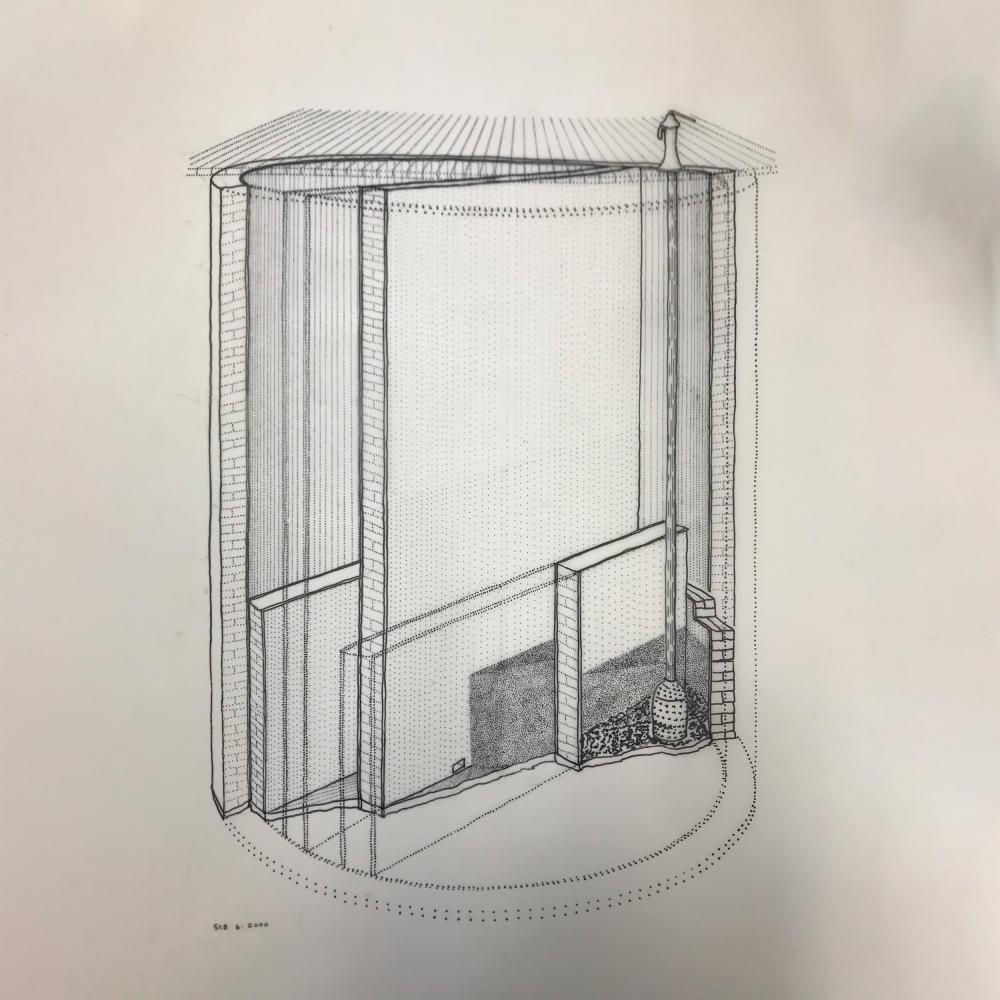
Illustration of water filtration by Sylvie Browne.
Guiding Questions:
- Why would water need to be filtered in the 19th century?
Learn more about archeology:
www.nysm.nysed.gov/research-collections/archaeology/crsp
Philip Johnson Sculpture
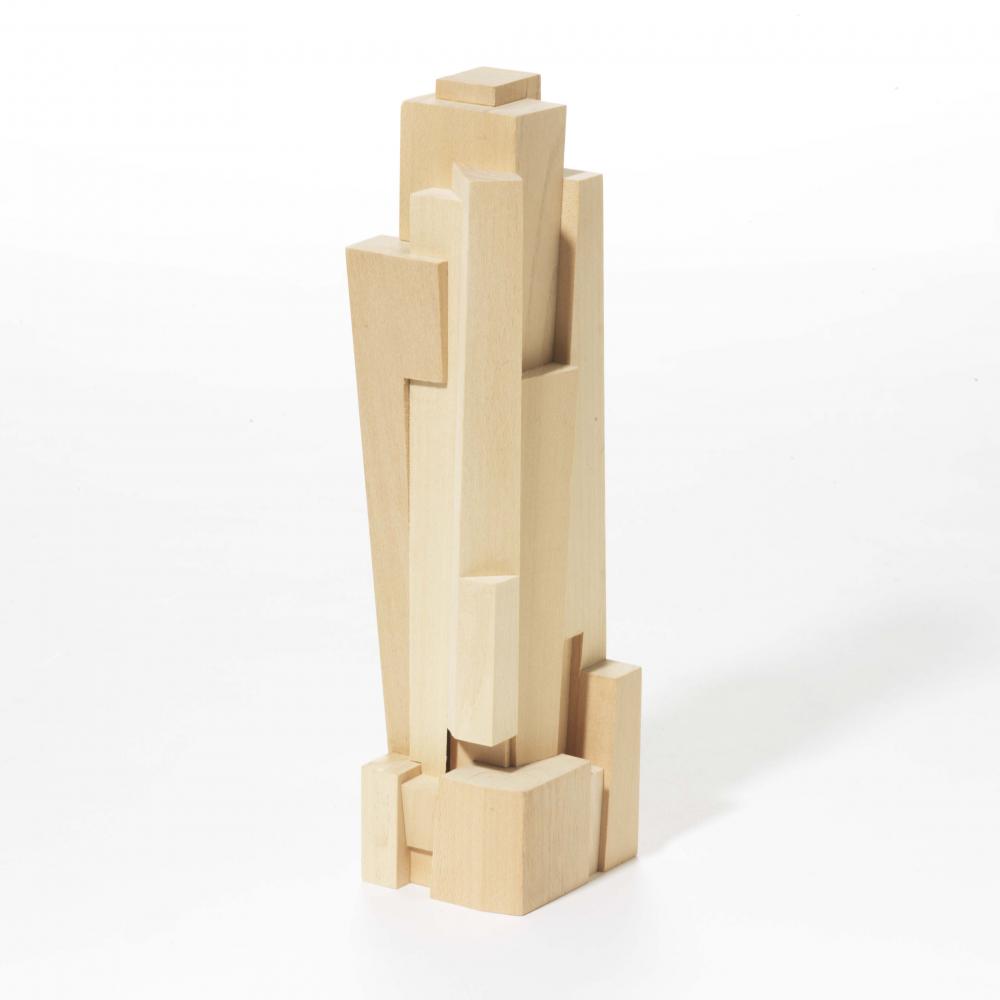
Philip Johnson (1906–2005)
Habitable Sculpture, 2001
Wood
Philip Johnson (1906–2005), one of the great architects of the 20th century, is known for designs that include the Seagram Building (1956, working with Ludwig Mies van der Rohe), the AT&T Building (1984, now the Sony Tower), and the Urban Glass House (opened 2005)—all located in New York City.
In 2000, Antonio (Nino) Vendome, a New York City real estate developer and owner of Nino’s Restaurant (which provided thousands of free meals to workers at Ground Zero after 9/11), asked Johnson to submit a proposal for a residential building. Ever innovative, Johnson, who stated, “I create sculpture and art,” came up with the design seen here. The building was first conceived as a sculpture, then divided into habitable units. Although construction was never realized, Johnson said, “It is the best building I ever designed. It is my last opportunity in New York to do something good for the city and something good for art.”
New York State Museum Collections
Guiding Questions:
- Why would an architect build a large model of a building?
Home-work: Educational Activities from the NYSM that You Can Do from Home!
Seneca Ray Stoddard
Seneca Ray Stoddard (1844-1917) was one of the first artists to capture the natural beauty of the Adirondacks through photography. He was instrumental in making the Adirondacks “forever wild” as a publicly protected area.
Check out our online exhibit Seneca Ray Stoddard Capturing the Adirondacks here: https://exhibitions.nysm.nysed.gov/srs/
AT HOME ACTIVITY:
Make your own pinhole “camera” viewer!
Materials: Shoebox or cereal box, wax paper, scissors, thumbtack, glue stick or tape, and a blanket.
INSTRUCTIONS:
Use a thumbtack to make a pinhole in the center of one of the small faces of the box. On the opposite side of the box from the pinhole cut a 2-inch square to use as an eye hole. Cut your wax paper into a 3-inch square and tape over your 2-inch eye hole.
How it works: The pinhole camera is a simple camera without a lens that creates a “camera obscura” effect. This effect is a naturally occurring optical phenomenon where the light travels from the pinhole through the dark box to show an image that is both reversed and inverted. It is the same process that real cameras use! Cover your head and camera with a blanket with the pinhole peaking out of the blanket, and look through the wax paper eyehole. Keep steady until you see an upside-down image.
OUTDOORS ACTIVITY:
Nature Walk: Stoddard believed that nature should be appreciated and protected. Find a local nature trail to explore with your family. What activities are people enjoying outside? How can we preserve the natural land around us?
Uncle Sam Monument Maquette
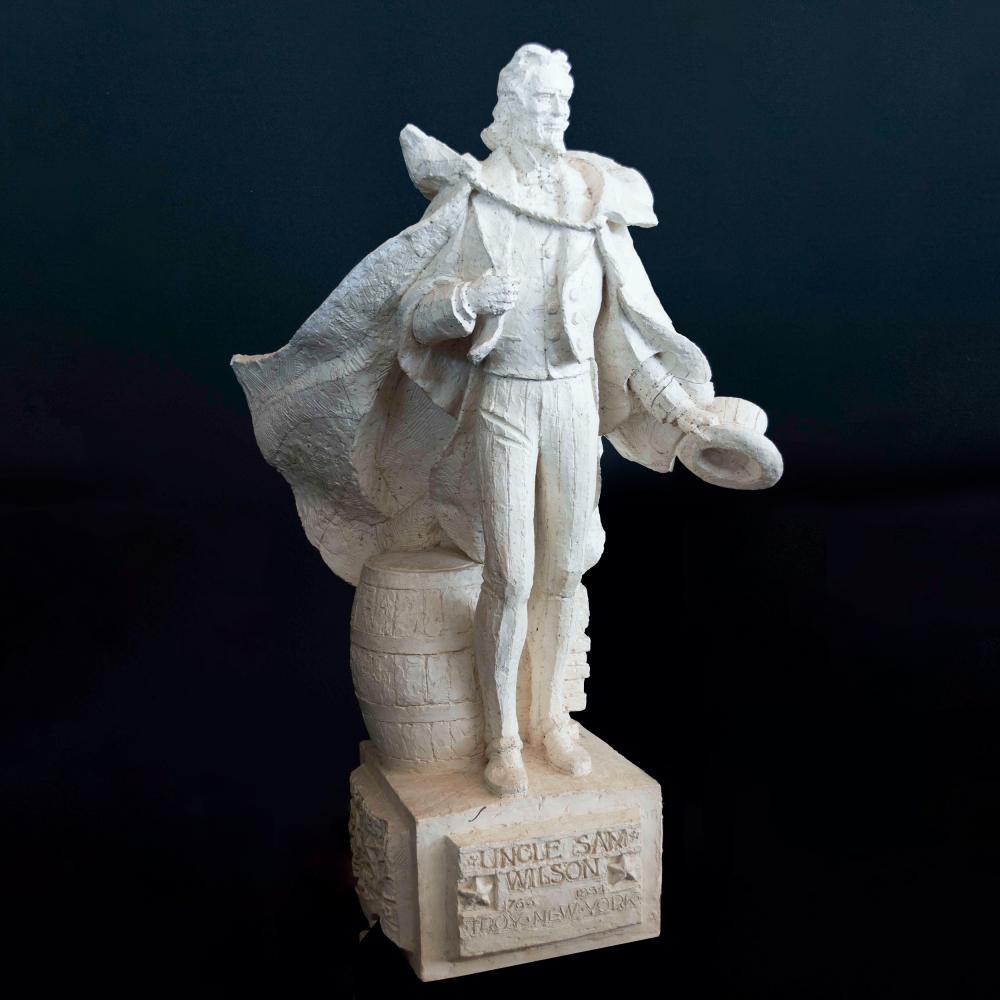
K. George Kratina (1910–1980)
Uncle Sam Monument Maquette, c. 1980
Plaster
This is a model for a monument to Sam Wilson, the original “Uncle Sam,” which was erected in 1980 in Troy, Rensselaer County. According to local folklore, Troy native Samuel Wilson was nicknamed “Uncle Sam.” When the War of 1812 broke out, Wilson worked as a meat packer and made shipments to the United States Army. Rations of fresh meat were rare, and when the soldiers asked who had supplied it, “Uncle Sam” was the answer. It was joked that the “U.S.” stamped on the barrels of meat stood for Uncle Sam. The “United States” and “Uncle Sam” soon became synonymous.
NYSM H-1983.33.1
Guiding Questions:
- What do you think the artist is showing about Uncle Sam?
- Why would an artist create a statue of a person?
To see other depictions of Uncle Sam, visit:
https://exhibitions.nysm.nysed.gov/WWI/index.html
Peacocks Fighting
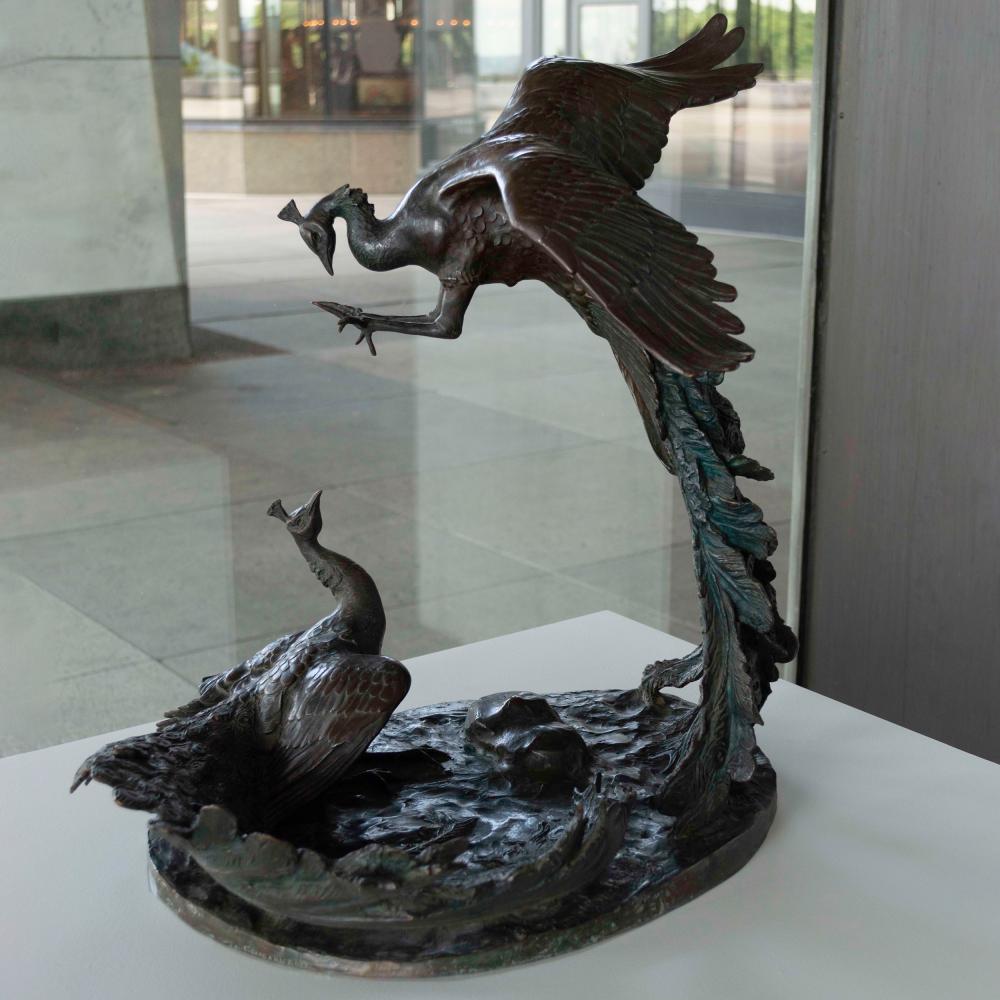
Anna Vaughn Hyatt Huntington (1876–1973)
Peacocks Fighting, 1934
Bronze casting, E. Gargani & Sons Foundry, New York
Anna Vaughn Hyatt Huntington arrived in New York City in 1902 with a dream of creating monumental sculptures. Her small works like this one, cast by foundries around the city, were affordable for both individuals and museums, and established her as a sculptor.
Huntington was known for her ability to capture the motion and posture of her animal subjects, a focus inspired by her father, zoologist and paleontologist Alpheus Hyatt. Huntington was ultimately successful in large-scale commissions, including her 1915 equestrian sculpture Joan of Arc (located at Riverside Drive and 93rd Street), the first public monument by a woman in New York City.
NYSM, H-1943.27.2
Guiding Questions:
- Why would the artist depict animals?
- What would you depict in a piece of art?
- What obstacles do you think Anna Hyatt Huntington overcame to become the highly successful female artist we recognize?
Learn more about another sculptor who depicted animals:
http://www.nysm.nysed.gov/exhibitions/henry-dispirito-stonemason-sculptor
The Historic Woodstock Art Colony: Arthur A. Anderson Collection
Long before the famous music festival in 1969, Woodstock, Ulster County, was home to what is considered America’s first intentionally created, year-round arts colony—founded in 1902 and still thriving over 100 years later. Unlike other colonies, artists in Woodstock have worked in a remarkable range of styles and media. Here we present a sample of sculpture: a lively greyhound puppy by Grace Mott Johnson, Gertrude Vanderbilt Whitney’s portrait of her daughter, an almost abstract bird by John Flannagan, and a geometric abstraction by Edward Chávez. All are part of the generous gift of the Historic Woodstock Art Colony collection from Arthur A. Anderson.
New York State Museum Collections

Edward Chávez (American, 1917–1995)
Abstraction, n.d.
Bronze

John Flannagan (American, 1895–1942)
Maternal Bird, n.d.
Bronze
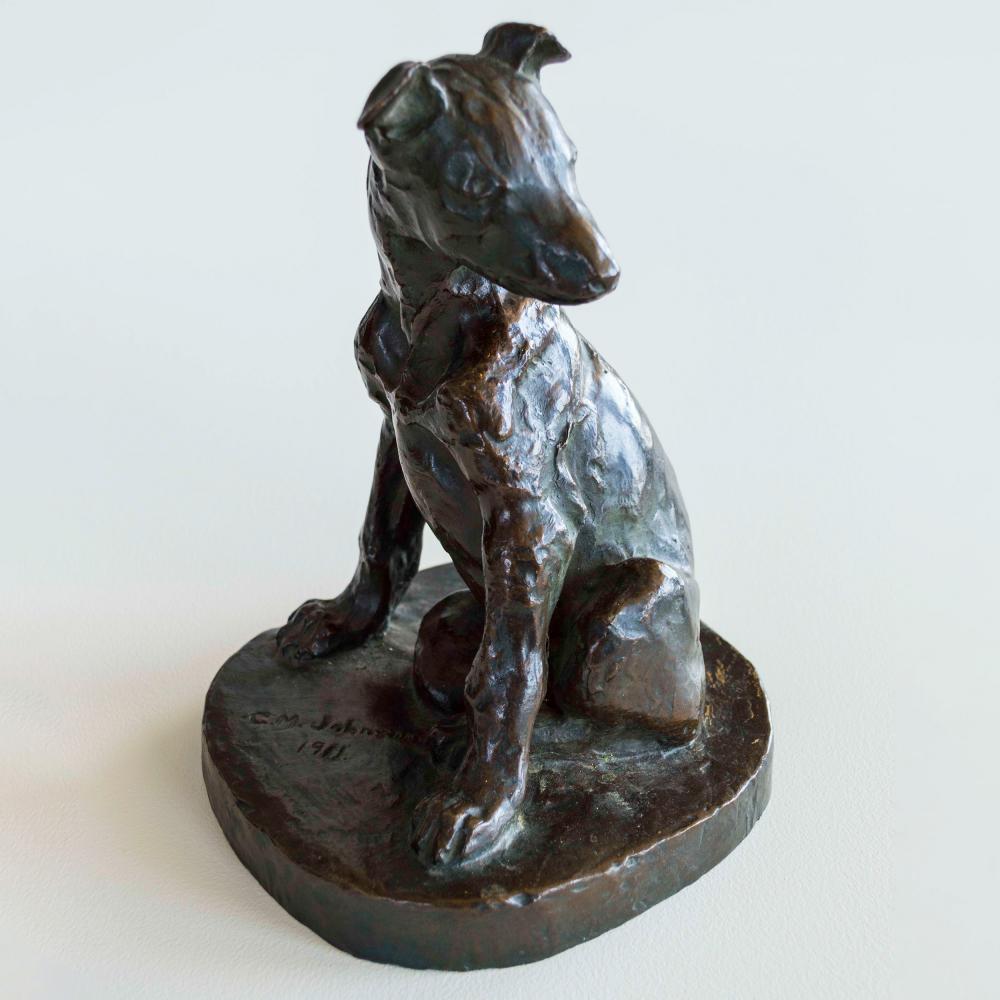
Grace Mott Johnson (American, 1882–1967)
Young Greyhound (Greyhound Pup), 1911
Bronze

Gertrude Vanderbilt Whitney (American, 1875–1942)
Young Girl, or Wallflower, 1913
Plaster with patina finish
Guiding Questions:
- Why would an artist choose to create a sculpture instead of a painting?
- Why would creating a sculpture be difficult?
- What do the sculptures look like?
Learn more about the Arthur A. Anderson collection:
www.nysm.nysed.gov/exhibitions/arthur-anderson-collection(link is external).
Temple Hill Mastodon Femur
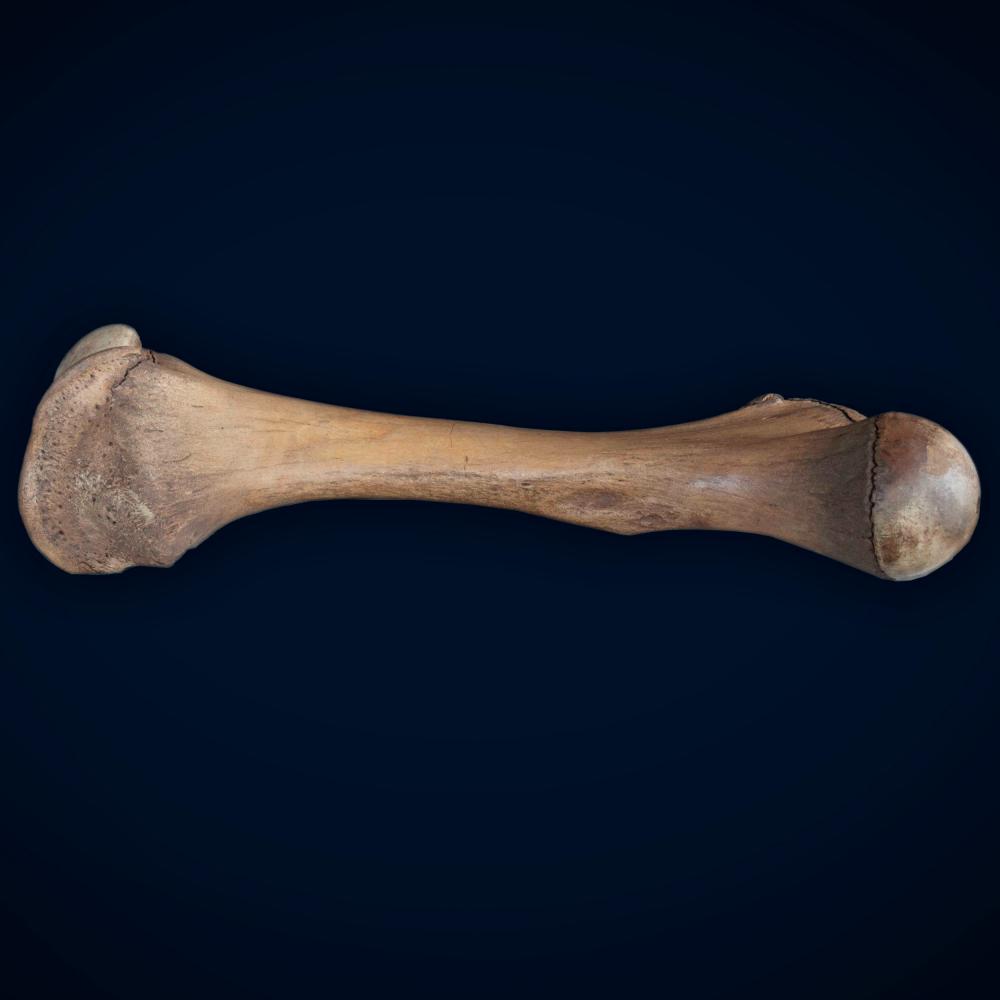
(Mammut americanum), femur, right side
The Temple Hill Mastodon was found in 1921 in Orange County. It was mounted and placed on exhibit alongside the Cohoes Mastodon at the New York State Museum until 1976. At 15' 1" long and 9' at the shoulder, nearly 1 foot taller than the Cohoes Mastodon, it is one of New York’s largest mastodons. Carbon dating shows that the mastodon last lived about 12,800 years ago.
NYSM VP-100
On Display
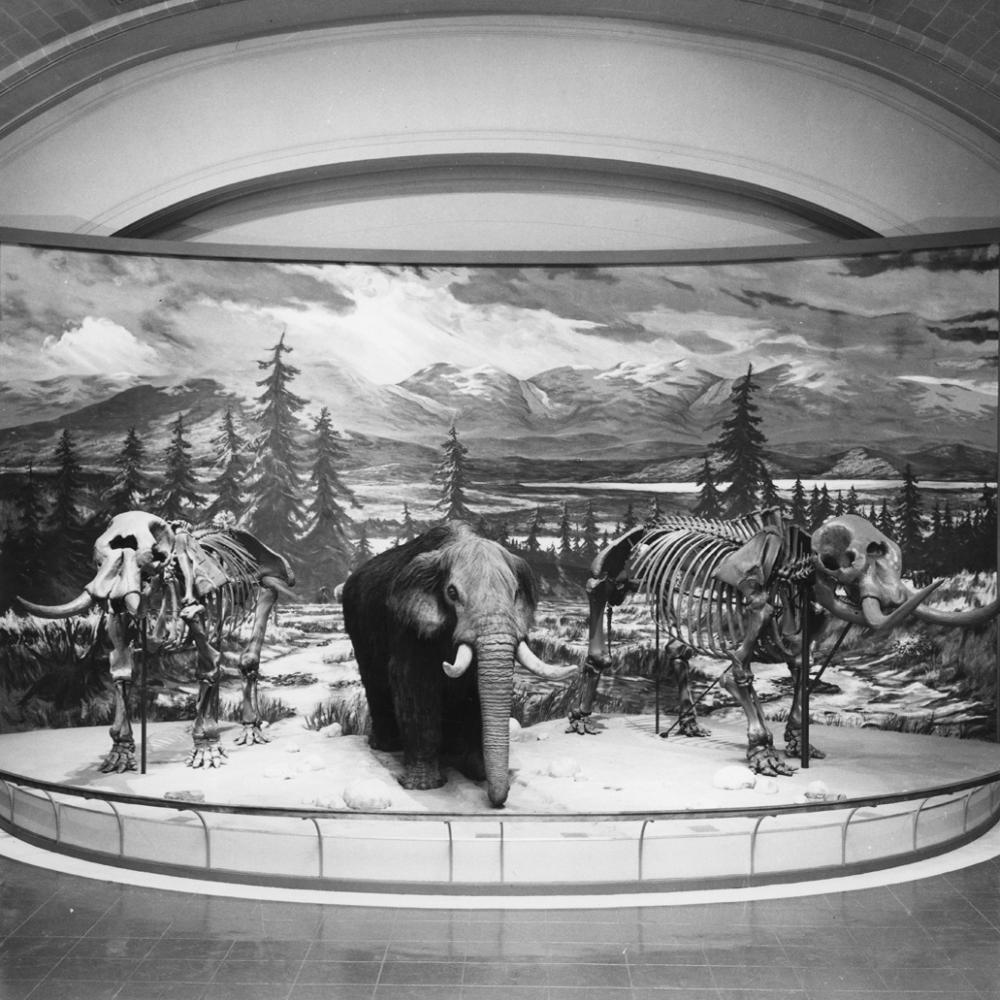
The Temple Hill Mastodon (right side) exhibited with the Cohoes Mastodon around 1960 in the old Museum.
Guiding Questions:
- What animals are related to mastodons?
- Where is the femur in the body?
Learn more about Mastodons and Ice Age animals at the following sites:
- www.nysm.nysed.gov/exhibitions/ongoing/cohoes-mastodon-0(link is external)
- www.youtube.com/watch?v=i39JeOW5Ucg(link is external)
- www.youtube.com/watch?v=Xyjwz2UYWtU(link is external)
- www.youtube.com/watch?v=eQiPtvwzWgA(link is external)
- www.nysm.nysed.gov/common/nysm/files/ice_age_mammals_colonize_new_york_0.pdf

Color Our Collections!
Download this printable coloring page and get creative with this object from the NYSM Collections!
Summer Fun Fridays
The NYS Museum invites you to get creative using everyday objects to make unique art projects, crafts and activities! Each Friday, a staff member will guide you with an activity demonstration or post directions to help you make something special!
Access this activity at 10am from:
Facebook: www.facebook.com/nysmuseum
YouTube: www.youtube.com/nysmuseum
Gilboa Tree Stump
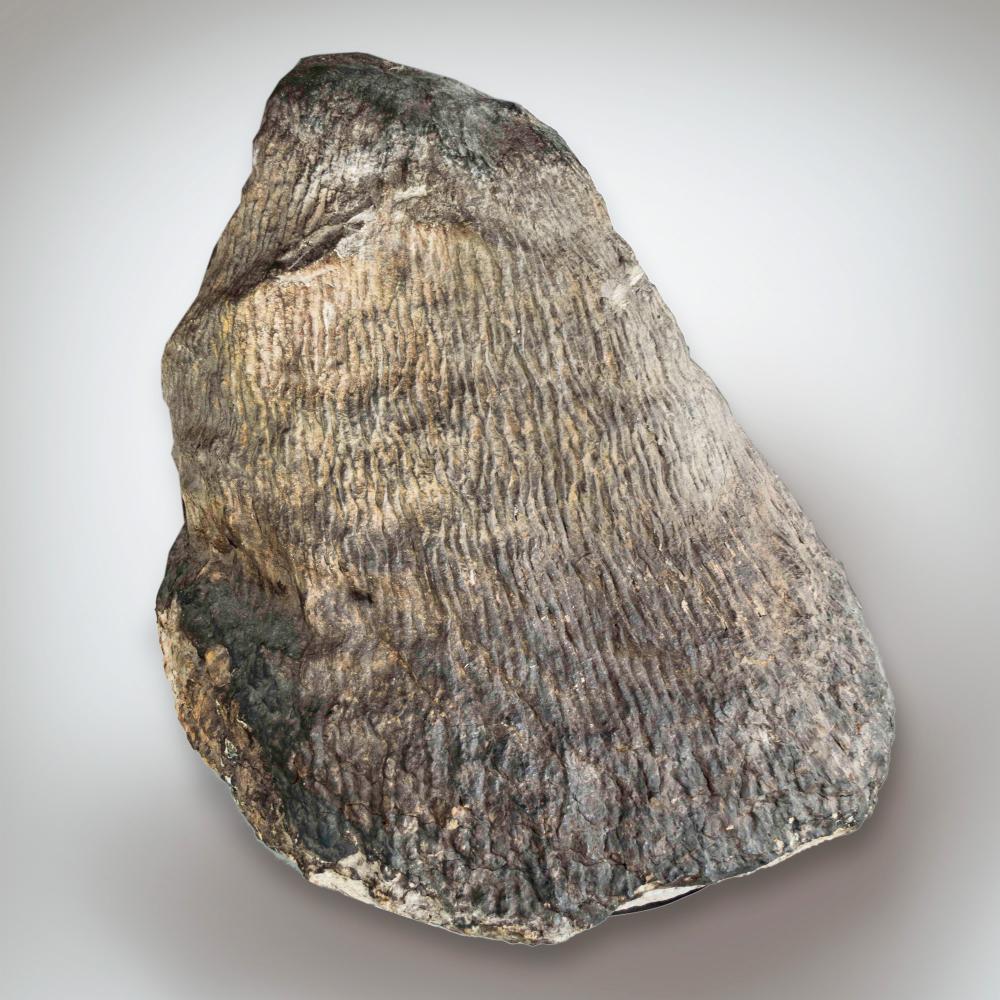
New York is home to two of the world’s oldest known fossil forests. Trees like the one represented by this stump grew about 385 million years ago in a large forest community in the region of Gilboa, Schoharie County.
Guiding Questions:
- What do you think the Gilboa trees looked like?
Meet the New York State Paleontologist and learn more about the Gilboa forest:
Stromatolite

This large mound is a trace fossil called a stromatolite. It formed when mats of bacteria repeatedly grew up through layers of sediment. It was found in Lester Park just outside of Saratoga Springs. There, 490 million years ago, these mounds grew upward in shallow water and provided a safe haven for snails and trilobites that lived among them. At 3.5 billion years old, stromatolites from Australia are the oldest undisputed fossils known on Earth.
Guiding Questions:
- How could the stromatolites provide protection for snails and trilobites?
Learn about and plan a trip to Lester Park:
www.nysm.nysed.gov/research-collections/geology/resources/lester-park
Eurypterid Reconstruction

This giant beast is a reconstruction of a eurypterid (yer-ip-ter-id) or sea scorpion. They used to swim in shallow seas across the globe over 400 million years ago. The model displayed is approximately 100 years old and had originally been exhibited in the Museum when it was located in the Education Department Building on Washington Avenue.
Eurypterid Fossil
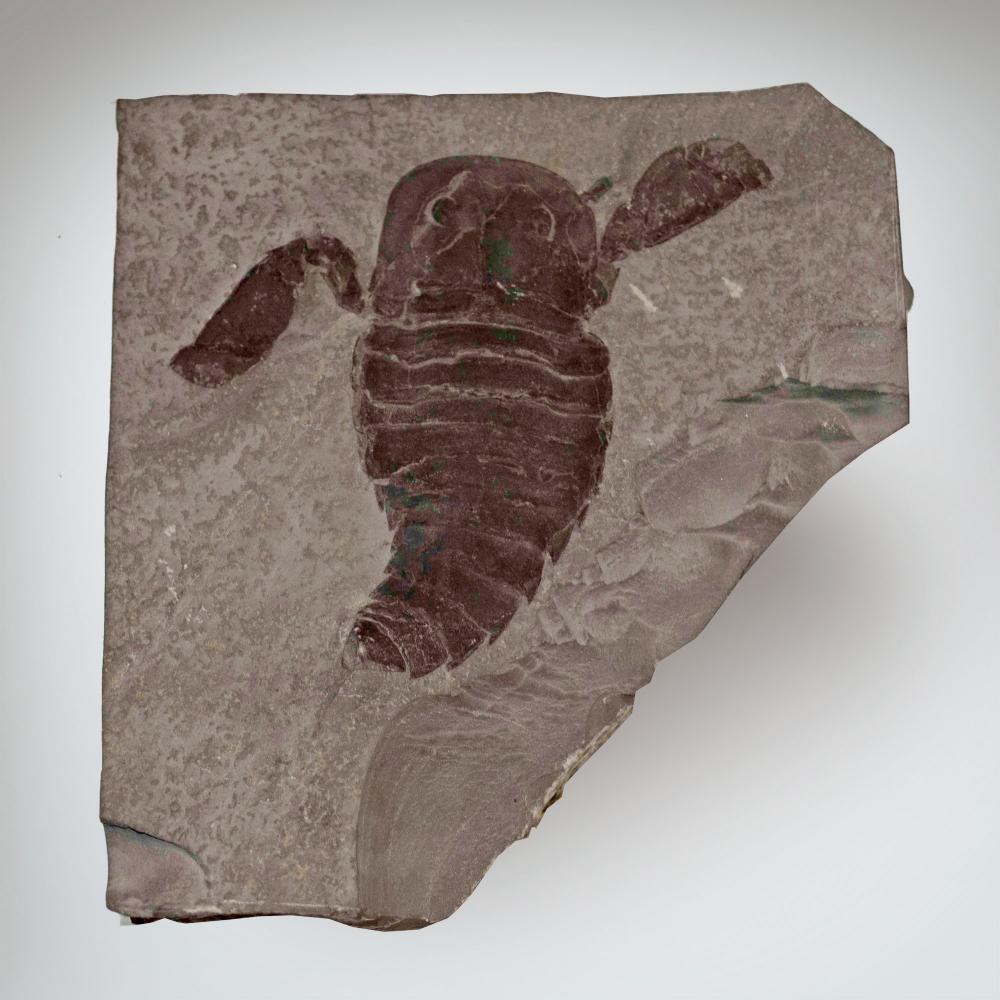
The small fossil specimen next to it is Eurypterus remipes, a species of eurypterid. It is the State Fossil of New York. It became our State Fossil in 1983 and was selected because these rare fossils occur in great numbers in rocks found near Buffalo, Erie County.
Guiding Questions:
- Why do you think the eurypterid was called a sea scorpion?
- What advantages did the eurypterid have when looking for food?
Learn more about fossils at:
www.youtube.com/watch?v=GT3p9SQoKUU&feature=youtu.be(link is external)
Try this fun activity at home:
www.nysm.nysed.gov/education/home-work/fossils
Color Our Collections
Download this printable coloring page and get creative with this object from the NYSM Collections!
State Museum Opens Exhibition Featuring Artwork of the Historic Woodstock Art Colony
The New York State Museum will open The Historic Woodstock Art Colony: The Arthur A. Anderson Collection on November 10. On display through December 31, 2019, the exhibition features over 100 artworks – including paintings, lithographs, sculpture and works on paper – from the major collection of artwork of the historic Woodstock Art Colony that collector Arthur A. Anderson donated to the State Museum in 2017. This exhibition introduces to the public for the first time just a sample of the highlights of this extraordinary collection, which represents a body of work that together shaped art and culture in New York and forms a history of national and international significance.
Long before the famous music festival in 1969, Woodstock, New York, was home to what is considered America’s first intentionally created, year-round arts colony—founded in 1902 and still thriving over 100 years later. Collecting the remarkable range of work produced there was Anderson’s focus for three decades, resulting in the largest comprehensive assemblage of its type. The artists represented in it reflect the diversity of those who came to Woodstock, including Birge Harrison, Konrad Cramer, George Bellows, Eugene Speicher, Peggy Bacon, Rolph Scarlett and Yasuo Kuniyoshi, among many others. Anderson donated his entire collection—some 1,500 objects by almost 200 artists—to the State Museum.
“This exhibition presents an extraordinary opportunity for State Museum visitors to see a variety of artwork that highlights an important chapter of New York’s art history,” said Board of Regents Chancellor Betty A. Rosa. “We’re grateful to Arthur Anderson for donating the collection to the Museum, which allows this remarkable collection of artwork to be seen, appreciated and researched by students and adults for generations to come.”
“Thanks to Arthur Anderson, the State Museum has a collection of historic artwork that represents the culture, history and artistic direction of talented Woodstock artists,” said State Education Commissioner MaryEllen Elia. “The exhibition invites children and adults to view these unique and inspirational artworks and explore how these artists were at the center of artistic development in New York in the 20th century.”
“We are deeply grateful to Arthur Anderson for his generosity and foresight in donating this exceptional collection to the State Museum,” said Mark Schaming, Deputy Commissioner of Cultural Education and State Museum Director. “The exhibition showcases spectacular artworks by some of New York and America’s influential artists of the 20th century. We are pleased to share this collection with New Yorkers and explore Woodstock’s history as an innovate center of artistic development in New York.”
“Ever since I began spending quality time in the Hudson Valley, I have been enamored with the historic Woodstock Art Colony,” said donor Arthur Anderson. “Over the course of three decades, my collection grew to 1,500 works by 200 artists, with an emphasis on George Bellows and his Woodstock circle. After considering various permanent homes for the collection, it became clear to me that the best place was the New York State Museum. The collection’s new home at the State Museum helps re-introduce the Historic Woodstock Art Colony into the American art canon. It also, I hope, motivates others to donate their treasures for public appreciation and education that express the culture and history of New York State.”
The public is invited to attend an opening reception for the exhibition on Saturday, November 10 from 1:00 – 3:00 p.m. The reception will begin with light refreshments at 1:00 p.m., followed by an exhibition tour led by senior historian and curator Karen Quinn at 2:00 p.m. Donor Arthur Anderson will attend the reception.
The Woodstock story begins in 1902, when Byrdcliffe was established as a year-round artists’ colony focusing on the Arts and Crafts movement. The utopian community drew furniture craftsmen, painters, printmakers, photographers, ceramicists, and other artisans to an environment that emphasized individual work over mass production. In 1906, the Art Students League of New York, one of the country’s most important and progressive art schools, moved its summer school to Woodstock, bringing some 200 students a season to the area. The Woodstock Artists Association was founded in 1919 by artists of differing mindsets but unified in their quest for a centralized exhibition space.
Throughout the 20th century, and now into the 21st century, Woodstock attracted and continues to attract a range of artists working in a variety of media and approaches ranging from realism to abstraction – something that sets Woodstock apart from other art colonies that flourished for a limited time and were centered on a single style.
Photos of select artworks included in the exhibition are available on the Museum’s website.
The State Museum is a program of the New York State Education Department’s Office of Cultural Education. Located at 222 Madison Avenue in Albany, the Museum is open Tuesday through Sunday from 9:30 a.m. to 5:00 p.m. It is closed on the Fourth of July, Thanksgiving, Christmas, and New Year's Day. Admission is free. Further information about programs and events can be obtained by calling (518) 474-5877 or visiting the Museum website.
Phone: (518) 474-1201
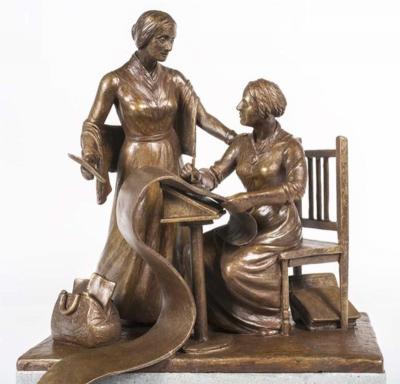
Model of the Stanton and Anthony statue.
Photo credit: Glenn Castellano of the New-York Historical Society
Model of Statue Honoring Elizabeth Cady Stanton and Susan B. Anthony
In celebration of New York State History Month and in commemoration of the 101st anniversary of women's suffrage in New York State, the Museum is proud to display a model of a statue honoring Elizabeth Cady Stanton and Susan B. Anthony. The statue will be unveiled in New York City's Central Park in 2020—the first statue in the park to honor a woman.
In 2013, longtime women's rights activists Pam Elam and Coline Jenkins formed the Statue Fund to create the first statue in Central Park that both honors and depicts real women. Sculpture Meredith Bergmann's design was chosen out of several entries and honors Stanton and Anthony, two leaders at the forefront of the women's suffrage movement. The working model of the statue will be on display at the State Museum in the West Hall Corridor through March 31, 2019.
State Museum Hosts Taste NY Holiday Market on December 2, 2018
Visitors can shop at 30 “made in New York” food and beverage vendors at the New York State Museum’s Taste NY Holiday Market on Sunday, December 2 from 11:00 a.m. – 4:30 p.m. Admission is free.
Vendors will offer samples and sales of chocolates; cheese; maple products; hand-crafted beer, wine, spirits and cider; and other edible gifts. All participating vendors produce their products in New York State. There will also be cooking demonstrations, educational activities and a chocolate fountain station courtesy of We Do Fondue and Price Chopper/Market 32. For more information, including a list of vendors, visit the Museum’s website.
Following is a schedule of demonstrations and educational activities at the event:
- Lavada Nahon – Culinary Historian (11:00 a.m. – 4:30 p.m.): Enjoy learning about the diverse foodways of New Netherland and early New York. Explore how the lives and cultures of the Dutch mixed with those of the English, enslaved Africans, French, Germans, Jews and others to create a vibrant foundation found nowhere else in colonial America.
- Second Regiment of the Albany County Militia – Colonial Foodways (11:00 a.m. – 4:30 p.m.): Explore 18th century food in both the military and the home front. Enjoy everything from beer to bread and learn how our founding mothers and fathers ate during the American Revolution.
- Paul Supley – Chocolate Historian (11:00 a.m. – 4:30 p.m.): Enjoy historic foodways at their sweetest with culinary historian Paul Supley of Van Wyckes Chocolate House. Van Wyckes Chocolate House explores the importance of chocolate in the 18th century through hands-on engagement. Discover the historical uses of chocolate as a medicine, a breakfast food and a pleasurable treat. Explore the material culture behind the making of chocolate and take the opportunity to discuss with Mr. Supley the different ways 18th century New Yorkers enjoyed one of our favorite guilty pleasures.
- Cooking Demo with Chef Michael Lapi (1:00 – 2:00 p.m.): Focusing on fresh ingredients from local farms in the Mohawk Valley, Chef Lapi will cook up a recipe perfect for holiday entertaining.
The annual Holiday Tree Lighting and Fireworks Festival at the Empire State Plaza will also be held on December 2.
Taste NY is an initiative that highlights the quality, diversity, and economic impact of New York’s food and beverage industry. Taste NY provides an opportunity for New York growers and producers to receive increased exposure of their products to consumers, restaurateurs, retailers, wholesalers, and distributors.
The State Museum is a program of the New York State Education Department’s Office of Cultural Education. Located at 222 Madison Avenue in Albany, the Museum is open Tuesday through Sunday from 9:30 a.m. to 5:00 p.m. It is closed on the Fourth of July, Thanksgiving, Christmas, and New Year's Day. Admission is free. Further information about programs and events can be obtained by calling (518) 474-5877 or visiting the Museum website.
Phone: (518) 474-1201
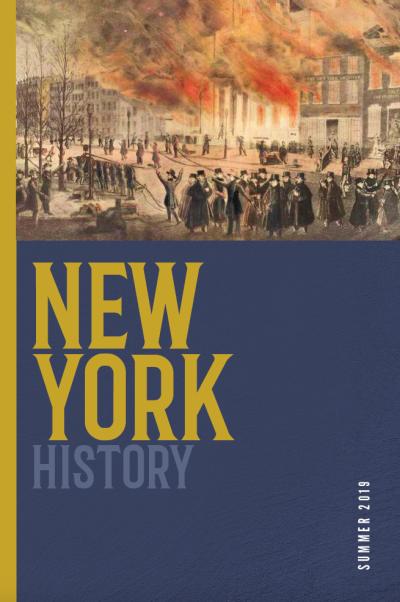
New York History Journal
Subscribe to NYHJ
To view information about the latest issue, or to learn how to subscribe to the New York History Journal, please visit Cornell University Press: https://www.cornellpress.cornell.edu/new-york-history/
In partnership with Cornell University Press who will now publish New York History, Dr. Robert Chiles, Senior Lecturer in the History Department, University of Maryland, New York State Historian Devin Lander and New York State Museum Chief Curator of History Dr. Jennifer Lemak will serve as co-editors of the journal. Aaron Noble, Senior Historian and Curator, will serve as the Reviews Editor.
The following experts on New York State History make up the journal's Advisory Board.
Paula Baker
Ohio State University
Marsha E. Barrett
University of Illinois Urbana-Champaign
Thomas D. Beal
SUNY Oneonta
Patricia Bonomi
New York University
Jennifer Burns
University at Albany
Kelly Yacobucci Farquhar
Montgomery County Department of
History and Archives
Leslie E. Fishbein
Rutgers University-New Brunswick
James D. Folts.
New York State Archives
Michael Galban
Ganondagan State Historic Site
Timothy Gilfoyle
Loyola University Chicago
Susan Goodier
SUNY Oneonta
Georgette Grier-Key
Eastville Community Historical Society
Kenneth T. Jackson
Columbia University
Lisa Keller
Purchase College SUNY
D.L. Noorlander
SUNY Oneonta
Timothy J. Shannon
Gettysburg College
Robert W. Snyder
Rutgers University-Newark
Ivan D. Steen
University at Albany
Thomas S. Wermuth
Marist College
Michael J. McGandy (Ex-Officio)
Cornell University Press
All interested authors should consult the submission guidelines below:
New York History Article Submission Guidelines
Since 1932, New York History (ISSN 0146-437x) has served as the foremost scholarly journal on the state’s past. New York History, now under the leadership of the Cornell University Press, and working closely with staff from the New York State Museum, seeks to unify the diverse field of New York State history and meet the needs of a growing historical community that includes scholars, public historians, museum professionals, local government historians, and those seeking an in-depth look at the Empire State’s history.
New York History strives to promote and interpret the state’s history through the publication of historical research and case studies dealing with New York State, as well as its relationship to national and international events. New York History, published twice a year, presents articles dealing with every aspect of New York State history, and reviews of books, exhibitions, and media projects with a New York focus. The Editorial Board actively solicits articles, essays, reports from the field and case studies that support this mission.
Submitted articles should address, in an original fashion, some aspect of New York State history. Articles that deal with the history of other areas or with general American history must have a direct bearing on New York State history. It is assumed that the article will have some new, previously unexploited material to offer or will present new insights or new interpretations. Suggested length is 20-30 double spaced pages (or between 6,000 and 9,000 words), including footnotes. All submitted articles must include a 100-word abstract summarizing the article and providing keywords (no more than 10). Authors must submit articles electronically, with all text in Word and all tables, figures, and images in formats supported by Microsoft Windows. Provision of images in proper resolution (no less than 300 dpi at 5” x 7”), securing requisite permissions, and the payment of any fees associated with images for articles are all the responsibility of the author. New York History employs, with some modification, footnote forms suggested in the Chicago Manual of Style.
Author's Checklist
Before submitting, please download the Author’s Checklist located here to review our submission standards: new_york_history_authors_checklist.pdf
In its review section, New York History assesses selected scholarly press publications with subject matter directly related to the history of New York State. The journal also reviews films and videos, digital and electronic media productions, exhibits, and performances. We do not accept unsolicited reviews, but we do welcome suggestions for material to review. If you are interested in becoming a reviewer, please contact us via email at NYHJ@nysed.gov.
All submissions can be sent directly to the journal’s editors at NYHJ@nysed.gov. The Editorial Board will process submissions as quickly as possible; three to six months should be allowed for a thorough reading. New York History does not pay for author’s articles.
Subscriptions:
Subscriptions to New York History can be done through Project Muse at https://www.press.jhu.edu/cart/for-sale?oc=3729 or by contacting Cornell University Press at nyhjournal@cornell.edu
Curator's research at Albany, NY archaeological sites featured in latest issue of national magazine
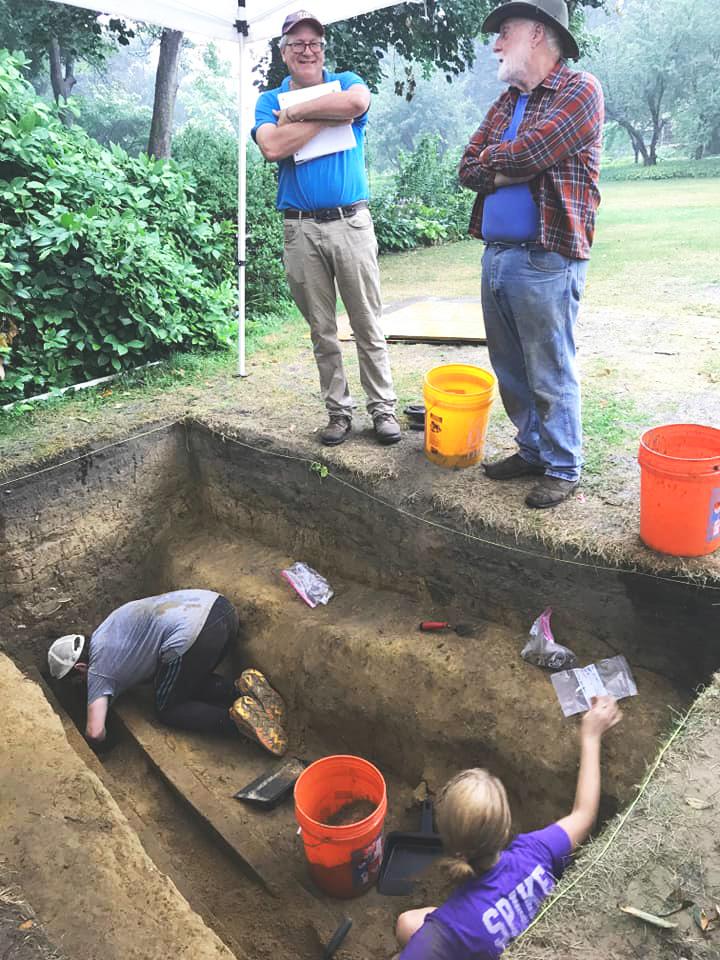
The museum's curator of historical archaeology, Michael Lucas, and project manager of The Archaeology of Slavery in the Hudson Valley, is featured in the Winter 2018-19 issue of American Archaeology in an article entitled, The End of Slavery in New York.
For the last two years, in collaboration with Marilyn Masson of SUNY Albany, Lucas has been co-director of excavations at the Ten Broeck Mansion, a large estate built in 1798 in the heart of the Arbor Hill neighborhood of Albany, NY. The wealthy owners of the mansion were known slave owners, with census records indicating ten slaves lived on the estate in 1800. Due to Northern opposition and increasing stigma associated with slave ownership, most New York slaves were freed voluntarily in the 1810s. An 1817 law mandated all adult slaves be freed by 1827, and emancipated slaves did not move great distances from their places of enslavement. As a result, an urban community of freed blacks formed in Arbor Hill, only two blocks from Ten Broeck Mansion. It is this transition - from slavery to freedom - Lucas and his collaborators hope to elucidate through archaeological investigations.
American Archaeology is a quarterly publication of the Archaeological Conservancy.
For further information, please contact Dr. Michael Lucas, michael.lucas@nysed.gov.
PICTURED ABOVE: Dr. Michael Lucas, Curator of Historical Archaeology (left) and Marty Pickands, retired museum archaeologist (right) overlooking excavation by SUNY Albany field school students -- photo courtesy of Derek J. Healey
State Museum Hosts "New York State's Great Places and Spaces" on January 12
Representatives from over a dozen New York State historic sites and cultural organizations will provide educational hands-on activities, unique artifacts to explore and information about upcoming events during the annual “New York State’s Great Places and Spaces” program on Saturday, January 12 from noon to 4:00 p.m. at the New York State Museum.
A guided tour of The Historic Woodstock Art Colony: The Arthur A. Anderson Collection will be held at 1:00 p.m., followed by a Hudson Valley art project inspired by the exhibition. A guided tour of Enterprising Waters: New York’s Erie Canal will be held at 3:00 p.m.
Participating organizations include: Capital District Civil War Round Table; Crailo State Historic Site; Friends of the Pine Bush Community, Inc; Hudson Mohawk Industrial Gateway; John Brown Farm State Historic Site; Johnson Hall State Historic Site; The National Museum of Racing and Hall of Fame; New Windsor Cantonment and Knox’s Headquarters State Historic Site; Roosevelt Presidential Library and Museum; Saratoga National Historic Park; Schoharie Crossing State Historic Site; Schuyler Mansion State Historic Site; Shaker Heritage Society; New York State Archives; New York State Library; and the Underground Railroad History Project of the Capital Region, Inc.
The State Museum is a program of the New York State Education Department’s Office of Cultural Education. Located at 222 Madison Avenue in Albany, the Museum is open Tuesday through Sunday from 9:30 a.m. to 5:00 p.m. It is closed on the Fourth of July, Thanksgiving, Christmas, and New Year's Day. Admission is free. Further information about programs and events can be obtained by calling (518) 474-5877 or visiting the Museum website.
Phone: (518) 474-1201
State Museum Hosts Two Geology and Paleontology-Themed Programs in February
The New York State Museum will host two geology and paleontology-themed programs in February: The Rock and Fossil Fun Fair on February 16 and 17 and the Gem, Mineral and Fossil Show and Sale on February 23 and 24.
The Rock and Fossil Fun Fair will be held on Saturday, February 16 and Sunday, February 17, 2019 from 10:00 a.m. – 1:00 p.m. Children can mine for minerals, forage for fossils, experiment with a river replica and participate in more than 10 hands-on geology and paleontology activities. Visitors are encouraged to bring their rocks and fossils from home for identification from Museum scientists. This program is free admission; donations are appreciated.
The 26th Annual James Campbell Memorial Gem, Mineral and Fossil Show and Sale will be held on Saturday, February 23 and Sunday, February 24, 2019 from 10:00 a.m. – 5:00 p.m. More than 30 vendors from throughout the region will display and sell gems, minerals, fossils and jewelry. Admission is $5 (cash only); children ages 12 and under are free. This event is co-sponsored by the Capital District Mineral Club and the New York Academy of Mineralogy. All proceeds benefit the Museum’s mineral acquisition fund.
The State Museum is a program of the New York State Education Department’s Office of Cultural Education. Located at 222 Madison Avenue in Albany, the Museum is open Tuesday through Sunday from 9:30 a.m. to 5:00 p.m. It is closed on the Fourth of July, Thanksgiving, Christmas, and New Year's Day. Admission is free. Further information about programs and events can be obtained by calling (518) 474-5877 or visiting the Museum website.
Phone: (518) 474-1201
Black Citizenship in the Age of Jim Crow
Ongoing Exhibition
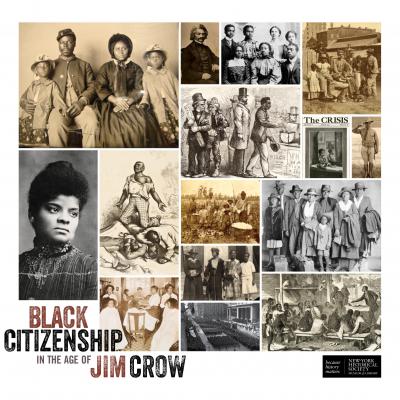
Black Citizenship in the Age of Jim Crow details the national story of the struggle for black equality after the end of slavery and through the Jim Crow era. This poster exhibition created by the New-York Historical Society Museum and Library will be on view in the State Museum’s main lobby through April 28. In addition, artifacts from the State Museum’s African American history collection will also be on display from February 5 through March 3.
Black Citizenship in the Age of Jim Crow explores the struggle for full citizenship and racial equality that unfolded in the decades after the Civil War. While Black Americans gained new liberties after the Civil War and the end of slavery, by the early 1900s these liberties had been sabotaged by a repressive racial system known as Jim Crow. The exhibition features eight posters with images of artifacts and documents that chronicle the long strides forward, bruising setbacks, and heroic struggle for equality that took place during these years.
New York Historical Society Resources & Educator Guide
Classroom materials and an educator guide for the Black Citizenship in the Age of Jim Crow exhibition(link is external), developed by the New-York Historical Society Museum and Library, is available for teachers from the New-York Historical Society website. The curriculum materials include primary and secondary resources, classroom activities, and discussion questions.
View: Educator Guide from the New-York Historical Society Museum and Library (PDF)
State Museum Displays Poster Exhibition and Artifacts in Recognition of Black History Month
The New York State Museum will open a poster exhibition on February 5, Black Citizenship in the Age of Jim Crow, detailing the national story of the struggle for black equality after the end of slavery and through the Jim Crow era. In recognition of Black History Month, this poster exhibition created by the New-York Historical Society Museum and Library will be on view in the State Museum’s main lobby through April 28. In addition, artifacts from the State Museum’s African American history collection will also be on display from February 5 through March 3.
Black Citizenship in the Age of Jim Crow explores the struggle for full citizenship and racial equality that unfolded in the decades after the Civil War. While Black Americans gained new liberties after the Civil War and the end of slavery, by the early 1900s these liberties had been sabotaged by a repressive racial system known as Jim Crow. The exhibition features eight posters with images of artifacts and documents that chronicle the long strides forward, bruising setbacks, and heroic struggle for equality that took place during these years.
“As we commemorate Black History Month, we remember and honor the achievements, sacrifices and struggles of African Americans throughout our nation's history," said Board of Regents Chancellor Betty A. Rosa. "Although some progress has been made, intolerance and discrimination still persist in our society. One of the goals of our My Brother's Keeper initiative is to create culturally diverse and engaging environments that foster respect and trust. Let us work collaboratively to build equity not only in our educational system but in society as well."
“When we remember and learn from the past, we can make our future better and brighter,” said State Education Commissioner MaryEllen Elia. “This exhibition at the State Museum prompts us to learn about a chapter in our nation’s past between the Civil War and World War II when African Americans’ rights were not respected. As we learn from this exhibition, we salute and honor the African Americans of the past and present who lead us forward and demonstrate the true meaning of progress and equality.”
“Although slavery was abolished soon after the end of the War, African American men, women and children’s liberties were challenged by the Jim Crow era,” said Regent Roger Tilles, Co-Chair of the Board of Regents Cultural Education Committee. “With this exhibition at the New York State Museum, visitors will learn about the challenges African Americans faced following the Civil War and the struggle for equality that continues to today.
“During Black History Month, we reflect and honor African Americans’ achievements and contributions, despite injustices of the past and present,” said Regent Judith Johnson, Co-Chair of the Board of Regents Cultural Education Committee. “Cultural organizations throughout the state host programs and exhibitions that share the history and stories of African Americans not just during Black History Month but every month of the year. I encourage students to study the triumphs and struggles of African Americans throughout our country’s history and celebrate diversity – the very thing that makes our country and society strong.”
Classroom materials and an educator guide for the Black Citizenship in the Age of Jim Crow exhibition, developed by the New-York Historical Society Museum and Library, are available for teachers. The curriculum materials include primary and secondary resources, classroom activities and discussion questions.
The Black Citizenship in the Age of Jim Crow poster exhibition is based on a larger exhibition currently on view at the New-York Historical Society through March 3, 2019. Lead support provided by the National Endowment for the Humanities: Exploring the human endeavor. Major support provided by the Ford Foundation, Crystal McCrary and Raymond J. McGuire, and Agnes Gund.
The State Museum is a program of the New York State Education Department’s Office of Cultural Education. Located at 222 Madison Avenue in Albany, the Museum is open Tuesday through Sunday from 9:30 a.m. to 5:00 p.m. It is closed on the Fourth of July, Thanksgiving, Christmas, and New Year's Day. Admission is free. Further information about programs and events can be obtained by calling (518) 474-5877 or visiting the Museum website.
Phone: (518) 474-1201
State Museum Launches Online Educational Guide About New York's Dutch History
The New York State Museum has launched an online resource for educators about New York’s Dutch history, including an educational guide, photos of historic artifacts and artwork, and video interviews with content experts. Funded through a generous grant from the Dutch Culture USA program administered by the Consulate General of the Netherlands in New York, the educational guide provides five lessons that introduce students to Fort Orange (present-day Albany, NY) and the world of New Netherland, the first Dutch colony in North America.
The educational guide’s lesson topics include: Native American daily life before Dutch arrival, trade and global commerce, archaeology, and economical and political tensions. In these lessons, students use digital images of archaeological collections, archival material and artwork to learn about Fort Orange and New Netherland in the 17th century and develop skills for analyzing and interpreting primary sources.
“This educational resource is a treasure trove of primary source material, photos and videos, and engaging lessons for teachers to use to educate children about what New York State was like in the 17th century,” said Board of Regents Chancellor Betty A. Rosa. “We’re proud to provide this to educators across the state and hope students and teachers alike discover and learn about New York State’s Dutch history.”
“Studying New Netherland is essential to students’ understanding of the history and development of New York State,” said State Education Commissioner MaryEllen Elia. “Now teachers can use the wealth of information and research available at the New York State Museum, Library and Archives in the classroom and make this important chapter of our history come alive for New York’s students.”
“This educational guide continues our work in sharing the story of New York’s colonial past and how the Dutch’s influence and impact in the 17th century continues through today,” said Deputy Commissioner of Cultural Education and State Museum Director Mark Schaming. “The State Museum, Library and Archives’ holdings of artifacts and documents related to New York’s Dutch history are unrivaled and allow us to provide this extraordinary educational resource.”
“We highly commend the Fort Orange educational guide, a platform provided by the New York State Museum,” said The Netherlands Cultural Attaché to the United States, Joost Taverne. “This educational resource makes the Dutch history of New York easily accessible for all teachers and students. The Dutch legacy of diversity, trade and tolerance is still present in New York State today and will help students understand what makes New York so unique in the history of the USA.”
In the coming year, video interviews with experts will be added to the lessons, including interviews with: Dr. Charles Gehring, Director of the New Netherland Research Center; Dr. Janny Venema, Associate Director of the New Netherland Research Center; Dr. Michael Lucas, Curator of Historical Archaeology at the State Museum; Dr. Paul Huey and the late Joseph McEvoy, retired archaeologists from the New York State Office of Parks, Recreation and Historic Preservation; and artist Len Tantillo. Additional support for the educational guide was provided by the New York State Archives Partnership Trust.
Fort Orange was the first permanent Dutch settlement in New Netherland, built as a trading post by the West India Company in 1624 at the present-day location of Albany, making the city the oldest continuously occupied European settlement in the United States, north of Virginia. Fort Orange was located at the nexus of the lucrative beaver-pelt trade. Between 1624 and 1664, the fort’s role in the development of New Netherland evolved from a point of contact and trade between Native Americans and Europeans, to an enclosure with dwellings and private enterprises, and finally an abandoned space consumed by the development of Albany.
The State Museum is a program of the New York State Education Department’s Office of Cultural Education. Located at 222 Madison Avenue in Albany, the Museum is open Tuesday through Sunday from 9:30 a.m. to 5:00 p.m. It is closed on the Fourth of July, Thanksgiving, Christmas, and New Year's Day. Admission is free. Further information about programs and events can be obtained by calling (518) 474-5877 or visiting the Museum website.
Phone: (518) 474-1201
State Museum Presents "Women of Science" Program on March 9
“Women of Science” on Saturday, March 9, 2019 from 11:00 a.m. – 3:30 p.m. This free program invites visitors of all ages to meet Museum scientists and learn more about their work, current research projects and museum collections.
Throughout the day visitors can meet over a dozen scientists, engage in hands-on educational activities, complete an activity booklet, and attend short talks and “Ask a Scientist” panels. A schedule of talks is listed below:
- 11:00 a.m. - “Ask the Scientist” for Families
What does a typical day in the life of a museum scientist look like? Please bring your questions and join Dr. Daria Merwin, archaeologist, to learn about the opportunities and challenges of becoming a scientist.
- 11:45 a.m.- The Science of Fossils: What to Do When You Find Them
Fossils can be used to determine how creatures lived, how they changed over time, and what they were like when they were alive. Join state paleontologist Dr. Lisa Amati and learn how to study animal and plant fossils.
- 12:30 p.m. - Diversity Gradients, Birds and Parasites
State Museum Ornithology Fellow Naima Starkloff talks about the diversity patterns of malaria-causing parasites in a group of birds in North America.
- 1:15 p.m. - A Day in the Life of an Entomologist/Evolutionary Biologist
Dr. Julie Urban, Research Associate Professor at Pennsylvania State University, will discuss the field and lab components of the research she conducts with planthopper insects.
- 2:00 p.m. - Not All Anthropologists are Archaeologists! The Adventures of a Cultural Anthropologist at the State Museum
Anthropology is the study of human beings, our past and our present. So what does it look like to study human beings today doing everyday human being things? Join Dr. Gwen Saul, cultural anthropologist, for an introduction to cultural anthropology and the contemporary Native art collection at the State Museum.
- 2:30 p.m. - “Ask the Scientist” Panel Discussion featuring all participating scientists
Visitors of all ages are invited to meet State Museum scientists and ask them what it’s like to be a scientist.
Participating scientists include: Dr. Christina Reith, Dr. Daria Merwin, Kristin O’Connell, Susan Winchell-Sweeney, Jessica Vavresek and Sarita Morse from Archaeology; Lisa Anderson, Andrea Lain, Jessica Campbell, and Julie Weatherwax from Bioarchaeology; Naima Starkloff from Ornithology, Diana Hurlbut from Botany; Dr. Gwendolyn Saul from Cultural Anthropology; Dr. Denise Mayer from Malacology; Kathleen Bonk from Geology; Dr. Lisa Amati from Invertebrate Paleontology; Jessica Watson from Zooarchaeology; and Dr. Julie Urban from Pennsylvania State University’s Department of Entomology (former research doctoral student at the State Museum).
The State Museum is a program of the New York State Education Department’s Office of Cultural Education. Located at 222 Madison Avenue in Albany, the Museum is open Tuesday through Sunday from 9:30 a.m. to 5:00 p.m. It is closed on the Fourth of July, Thanksgiving, Christmas, and New Year's Day. Admission is free. Further information about programs and events can be obtained by calling (518) 474-5877 or visiting the Museum website.
Phone: (518) 474-1201
State Museum Adds New Artworks to Contemporary Native American Art Collection
The New York State Museum today announced the addition of 14 new artworks to its contemporary Native American art collection. Building on an initiative launched in 1986 and now numbering more than 160 artworks, the contemporary Native American art collection is an impressive assemblage of work showcasing the breadth of Native artistic skills and craftsmanship.
In accordance with the mission of the collection, each artist is a citizen of an Indigenous nation whose ancestral lands are located in what is now New York State. The artists and their work include:
- 1687 War, acrylic on paper, by Peter Jemison (Seneca)
- Quilled leather pouch and knife sheath, 17th century replica, by Jamie Jacobs (Tonawanda Seneca)
- Dan Nanamkin at Standing Rock, from the series We Are Still Here, photograph print by Camille Seaman (Shinnecock)
- Christian Branden Weaver at Shinnecock Pow wow (Portrait), from the series We Are Still Here, photograph print by Camille Seaman (Shinnecock)
- Three Sisters, acrylic on canvas, by Erwin Printup Jr. (Cayuga)
- Never Alone, beadwork on watercolor, by Dawn Dark Mountain (Oneida Nation, WI) and Karen Ann Hoffman (Oneida Nation, WI)
- Three Sisters, carved stone sculpture, by Scott Hill (Oneida Nation, WI)
- Hawk, antler carving, by Hayden Haynes (Seneca)
- Tadodaho, wampum belt replica, by Tony Gonyea (Onondaga)
- Journey: The Red and Black Experience in the New World, quilt, by Faye Lone (Tonawanda Seneca)
- Beaded pin cushion and bird, by Grant Jonathan (Tuscarora)
- Beaded regalia (cuffs, hat, belt), by Reva Fuhrman (Stockbridge Munsee Mohican)
“These artworks not only speak to Native American and New York history but also represent Native American culture today,” said Board of Regents Chancellor Betty A. Rosa. “We’re grateful to the artists for sharing their heritage with the people of New York. Now generations of New Yorkers to come will learn from and appreciate these artworks.”
“Adding new artworks to the State Museum’s contemporary Native American art collection is much more important than simply growing this collection,” said State Education Commissioner MaryEllen Elia. “The collection is a commitment to support emerging and established Native American artists and to share Native American culture with New Yorkers of all ages.”
The Contemporary Native American Art Collection is part of the State Museum’s Ethnology collection. The new artworks will significantly contribute to future exhibitions, educational programming and research publications. Included in the collection are examples of beadwork, sculpture, quillwork, regalia, carvings, paintings and textile art. The collection reflects the broad range of artwork from Native artists using multiple mediums and techniques and addresses historic and contemporary subject matter relevant to all New Yorkers.
Photos of some of the newly acquired artworks are available on the State Museum’s website.
The State Museum is a program of the New York State Education Department’s Office of Cultural Education. Located at 222 Madison Avenue in Albany, the Museum is open Tuesday through Sunday from 9:30 a.m. to 5:00 p.m. It is closed on the Fourth of July, Thanksgiving, Christmas, and New Year's Day. Admission is free. Further information about programs and events can be obtained by calling (518) 474-5877 or visiting the Museum website.
Phone: (518) 474-1201
Local Students Compete in Capital Region History Day at State Museum on March 23
Over 100 Capital Region students will compete in the annual Capital Region History Day competition at the New York State Museum on Saturday, March 23. The public is invited to view the students' public exhibitions of their contest submissions from 12:00 – 1:00 p.m. as well as the awards ceremony from 3:30 – 4:15 p.m. Don Wildman, host of the Travel Channel’s “Mysteries at the Museum”, will distribute awards to the winners.
The New York State Education Department’s Office of Cultural Education is the regional coordinator for the Capital Region contest of the National History Day competition. Students in grades 6-12, working individually or in groups, conduct research and present their findings in one of the five following formats: exhibit, documentary, paper, website or theatrical performance. The national theme for this year’s competition is “Triumph and Tragedy”. Students’ exhibitions will be on display on the Museum’s 4th floor for the public to view from 12:00 – 1:00 p.m.
Winners will be announced at an awards ceremony at the State Museum’s Clark Auditorium from 3:30 – 4:15 p.m. State Museum representatives, State Historian Devin Lander, and host of the Travel Channel’s “Mysteries at the Museum” Don Wildman will distribute awards to the top two winners in each category. An additional winner will receive the New York State Archives Partnership Trust Award and a one-year subscription to New York Archives magazine for best use of historical records. The top two winners in each category proceed to the state competition in Cooperstown, NY on April 29. Winners of the state competition have the opportunity to move on to the national level competition at the University of Maryland in June.
Each year, more than half a million students, encouraged by thousands of teachers and parents nationwide, participate in the National History Day program. The program makes history come alive for America's youth by engaging them in the discovery of the historic, cultural and social experiences of the past.
The State Museum is a program of the New York State Education Department’s Office of Cultural Education. Located at 222 Madison Avenue in Albany, the Museum is open Tuesday through Sunday from 9:30 a.m. to 5:00 p.m. It is closed on the Fourth of July, Thanksgiving, Christmas, and New Year's Day. Admission is free. Further information about programs and events can be obtained by calling (518) 474-5877 or visiting the Museum website.
The State Education Department’s Office of Cultural Education (OCE), housed in the Cultural Education Center, operates three major institutions with stewardship responsibilities for collections — the New York State Museum, State Library, and State Archives — and the Office of Educational Television and Public Broadcasting and the Summer School of the Arts. Further information about OCE programs and events can be obtained by visiting the OCE website.
Phone: (518) 474-1201
Email: nysmpress@nysed.gov
Malacology & Partnerships in Science
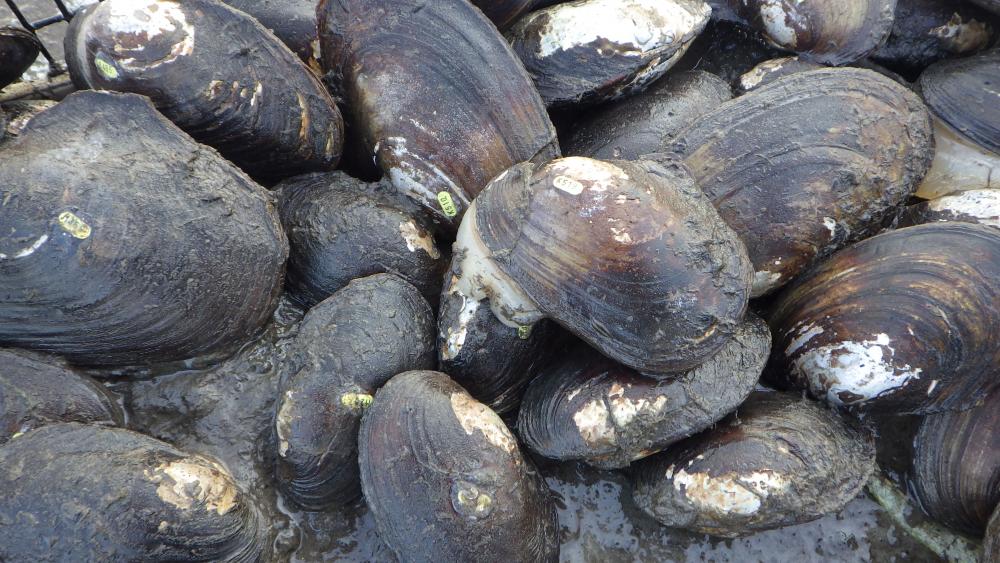
Challenges in science often require solutions from across various disciplines and involve collaborations between diverse agencies. A recent agreement between the New York State Department of Environmental Conservation (NYSDEC) and Arconic to protect habitat and freshwater mussels in the Lower Grasse River in Massena, NY, is an example.
View Press Release: https://content.govdelivery.com/accounts/NYSDEC/bulletins/295e0dc
Providing expertise across various disciplines, scientists, engineers, and managers from the NYSDEC, St. Regis Mohawk Tribe, NYSM have been working to salvage and preserve founder populations to ensure that the diverse and abundant freshwater mussel communities in the Lower Grasse River will continue to thrive after the Superfund remediation project disrupts the river bottom where the mussels live. Mussels were tagged prior to release so scientists can track survival during future monitoring efforts. Live long and prosper Wonderful Mussels!
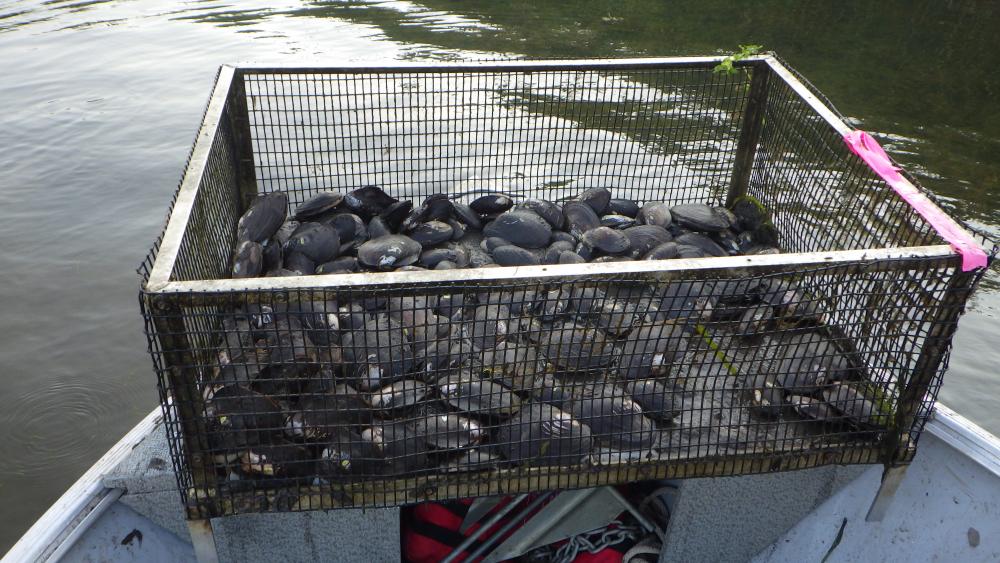
Mussels from areas where dredging was to occur were collected by divers and held in cages for up to 3 years so they would not be destroyed by the dredging operations.

Mussel were tagged prior to release so they can be tracked during future monitoring efforts.
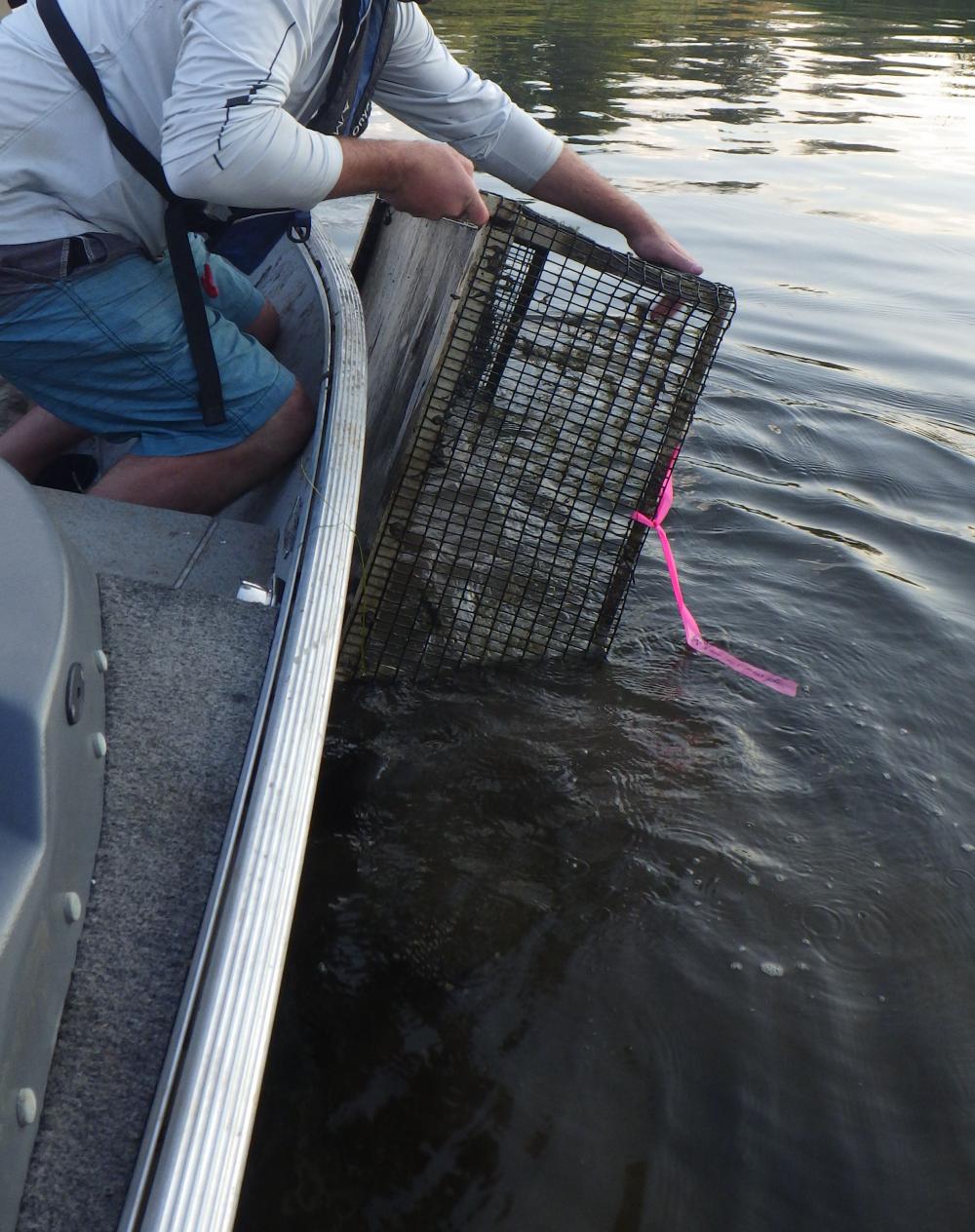
The caged mussels were released back into areas after remediation was complete.
State Museum Presents “Women of Science” Virtual Programming in August
The New York State Museum will present “Women of Science” programming on Facebook Live and YouTube through the month of August. Viewers can virtually meet Museum scientists, learn about their research through filmed presentations, and post questions which will be answered by the scientists themselves.
More than a dozen scientists will treat viewers to hands-on educational activities and deliver short talks.
All programs will be at 1:00 p.m. on Facebook and will later be available on YouTube.
A schedule of talks is listed below:
- Wednesday, August 12 – Cultural Resource Survey Program (CRSP) with Christina Reith
CRSP provides research and assessment of archaeological and architectural resources for other state agencies. Join Dr. Christina Reith, Co-Director, CRSP in this look at the Smith-Holloway site located in the Schoharie Valley of New York. The site contains several different occupations with the most prevalent being the Transitional and Early Woodland occupations. Dr. Reith will share the artifacts that came from the site and discuss how these artifacts will be used in the future for research and public outreach.
- Wednesday, August 19 – Caring for Unique Records in the Geologic Open File, New York State Museum with Kathleen Bonk
A geology technician at the New York State Museum, Kathleen Bonk is responsible for the Open File Collection, a unique collection of geology-related archival records. Hear how Kathleen cares for this small-but-significant archive through processing and preservation. Explore the importance of these materials and how she makes the materials in her care available to researchers onsite and remotely.
- Thursday, August 20th – Archaeology with Dr. Daria Merwin
CRSP provides research and assessment of archaeological and architectural resources for other state agencies. Join Dr. Daria Merwin, Co-Director, CRSP, as she explores shipwrecks. Did you know that New York has hundreds of shipwrecks that can be found in rivers, lakes, the ocean, and even on land? Dr. Merwin will address underwater and maritime archaeology and explore what these amazing sites can tell us about the past.
- Tuesday, August 25th – Geo-Physical Testing at the Douw 1 Site, Papscane Island, NY with Susan Winchell-Sweeney & Kristin O’Connell
Archaeology is an important tool when investigating the lives of enslaved people living in the Hudson Valley. Discover how the archaeological remains of a house constructed by Volkert P. Douw, a prominent politician during the mid- to late- 1700s, provide insight into the individuals that may have occupied the site including people enslaved by Douw in the 18th century. As part of a larger project to study the impact of slavery in the Hudson Valley, the New York State Museum, in collaboration with the Open Space Institute and Stockbridge-Munsee Mohican Tribal Preservation Office, undertook both a controlled surface artifact collection and a magnetic susceptibility (MS) survey at the Douw Site. MS is a non-invasive geophysical technique that is becoming increasing more popular for archaeological investigations in the United States.
- Wednesday, August 26th – Fossils in the Field with Dr. Lisa Amati, Sarita Morse, and Kathleen Bonk
What do scientists do when they are “out in the field”? Enjoy this video from the field with State Paleontogist Dr. Lisa Amati and collections technicians Sarita Morse and Kathleen Bonk as they show how they collect fossils, research the area they are studying, and conduct work outside. Learn about the process of collection and hands-on research that helps the New York State Museum increase collections, make discoveries, and share the rich and exciting paleontological history of New York State with you!
Participating scientists include: Dr. Christina Reith, Dr. Daria Merwin, Kristin O’Connell, Susan Winchell-Sweeney, Sarita Morse, Kathleen Bonk, and Dr. Lisa Amati.
The State Museum is a program of the New York State Education Department’s Office of Cultural Education. Located at 222 Madison Avenue in Albany, the Museum is currently closed. It is closed on the Fourth of July, Thanksgiving, Christmas, and New Year's Day. Admission is free. Further information about programs and events can be obtained by calling (518) 474-5877 or visiting the Museum website.
-30-
Phone: (518) 474-1201
The New York State Museum is open and happy to welcome you back!
In accordance with new safety guidelines, visitors will notice that we’ve adjusted our hours and days of operation, some galleries and exhibit features are temporarily closed, and we have new safety rules in place. We’ll also be limiting the number of visitors allowed in galleries at one time. Thank you for your cooperation as we work together to stay safe and healthy.
New Temporary Hours
Open Monday through Friday, 10 am–4 pm
Closed Saturdays and Sundays.
Closed all state-observed holidays.
Please help stop the spread of COVID-19 by following these safety rules:
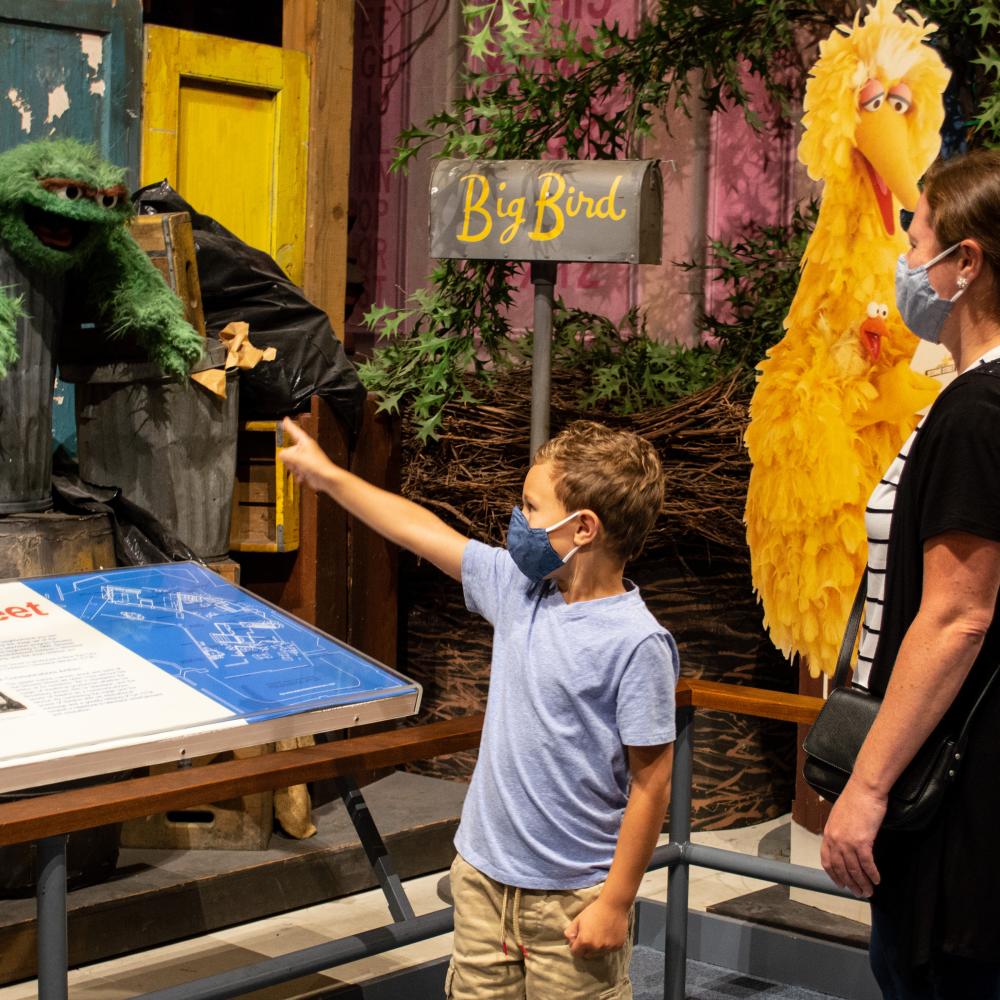
- Stay home if you’re feeling sick.
- Wear a mask covering your nose and mouth. This is required for all individuals over the age of 2 and medically able to tolerate a face mask.
- Properly discard any soiled disposable protective gear in trash receptacles.
- Keep a distance of 6 feet from others who aren’t in your household.
- School groups, tour groups, and other non-family-based groups of more than 10 are currently not accommodated.
- Follow good hand-cleaning hygiene and cough/sneeze practices.
- Please don’t touch exhibits.
Galleries Open for Visitors
- New York Metropolis—The World Trade Center, Henry DiSpirito: Stonemason to Sculptor, Ice Ages, Black Capital: Harlem in the 1920s, Minerals of New York, Art for the People: Decorated Stoneware from the Weitsman Collection, and more!
- Adirondack Hall—Adirondack Wilderness, Beneath the City: An Archaeological Perspective of Albany, “a small fort, which our people call Fort Orange,” Minerals of New York, and more!
- West Gallery—Tonalism: Pathway from the Hudson River School to Modern Art
- Bird Hall
- Fire Engine Hall
We’re also offering an OUTDOOR experience, Windows on New York: http://www.nysm.nysed.gov/exhibitions/windows
Temporary Closures
Discovery Place, South Hall Galleries (including the Mastodon, and Native Peoples of New York), and the 4th Floor Terrace Gallery/Carousel, and some other exhibition features are closed. We apologize for the inconvenience and thank you for your patience.
State Museum Launches Portal to Online Educational Resources and Activities
The New York State Museum today launched the Portal to Online Educational Resources & Activities that brings together many of the museum’s resources, including links to the popular virtual “Fieldtrips,” digital collections, online resources, and many fun activities for kids derived from the museum’s research and collections. The Portal provides opportunities for educators, caregivers, and students looking for engaging and educational activities that can be done from home.
“The New York State Museum is a wealth of resources for those looking to explore our State’s rich history and culture,” said Board of Regents Vice Chancellor T. Andrew Brown. “By expanding the resources that are available online during the COVID pandemic, we are opening the Museum up to students and families.”
“As we all continue to look for new and exciting ways to engage students in learning amidst this pandemic, these online resources provide wonderful options for educators and parents alike whether from home or in the classroom,” said Interim Commissioner Betty A. Rosa. “For many students across the state, a field trip to the State Museum is a thrilling part of their school year. Thanks to these virtual field trips and learning resources, we are able to allow teachers to keep the Museum’s vast collections and resources in their lesson plans even while the Museum is closed to visitors.”
The portal resources and activities are updated often to provide new resources and direct access to online content. Throughout the school year, educational resources for educators and caregivers including NYS Learning Standards supporting online lessons, content-created publications, and virtual activities will be added. These resources will support the work of educators, engage students in the research and collections of the New York State Museum, and connect the real-world work of scientists and historians with the NYS Learning Standards.
Portal Resources & Activities
360 Degree Virtual Field Trips
- The Rotunda Murals - Learn more about the 36 paintings, created by Albany artist Will Hicok Low, that complement the State Education Building Rotunda’s architectural nobility and its aura of intellectual enlightenment. Museum Educator, Carly Benedict leads this tour of the beauty and meaning of these groundbreaking murals.
- The Replica Liberty Bell - Gifted by President Harry Truman in 1950, the New York State’s “Liberty Bell” is an exact replica of the original Liberty Bell located in Philadelphia. Museum Educator, Anna Doren, showcases the history behind the creation of this replica and how it came to be a featured element at the New York State Education Building.
- Regents Room of the State Education Building - Located inside the NYS Education Building, this elaborately decorated room is the meeting place for the Board of Regents. Join Museum Educator Ben Russell as he highlights the Regents history and the room’s design.
- The Rotunda at the NYSED - Explore the NYS Education Building where Museum Educator, Carl Morrone, highlights the building's history and unique architectural elements. Designed by renowned architect and New York City native Henry Hornbostel, the Education Building was the first major building constructed in the United States solely as a headquarters for the administration of education.
Educational Resources
- Women’s Suffrage Commemoration Resources – “Votes for Women: Celebrating New York’s Suffrage Centennial” honors the centennial of women’s suffrage in New York State and raises awareness of the struggle for equal rights up through the present day.
- NYSM Women of Science Programming – This August, we are taking our popular Women of Science program online! During several virtual sessions, you will be able to learn from female scientists and staff about their area of study, collections, and career paths.
- Fun Activities – Videos and downloadable activities for fun at home. Families can “color the collections” with coloring sheets inspired by exhibits and artifacts from the museum’s collections or watch a video from our museum education department about topics inspired by the museum and then make a craft activity at home.
- Teacher Guides & Activities for Students – The New York State Museum offers educational opportunities for learners of all ages and abilities. Through online educational resources, children, families, educators, and students can experience the art, science, and history of New York State in a fun and engaging way. NYSM Teacher Guides meet New York State Learning Standards.
- NYSM Videos – Learn about the research and collections of the New York State Museum through videos from scientists, historians, and educators.
These resources and more can all be found in one place on the NYSM Portal to Online Educational Resources & Activities.
The State Museum is a program of the New York State Education Department’s Office of Cultural Education. Located at 222 Madison Avenue in Albany, the Museum is currently closed. It is closed on the Fourth of July, Thanksgiving, Christmas, and New Year's Day. Admission is free. Further information about programs and events can be obtained by calling (518) 474-5877 or visiting the Museum website.
Phone: (518) 474-1201
State Museum Exhibits Special Installations in Honor of Women's History Month and the Centennial Passage of the 19th Amendment
The New York State Museum will exhibit three special installations in honor of Women’s History Month and the centennial of the passage of the 19th Amendment, which ended the exclusion of voters on the basis of sex. Open March 10 through April 26 the Museum will exhibit the 2020 Quilt Project, the Central Park Women’s Monument maquette, and a 1913 suffrage wagon.
“In March we celebrate Women’s History Month and this year we also we commemorate the centennial of the passage of the 19th Amendment,” said Board of Regents Chancellor Betty A. Rosa. “This exhibition is a learning opportunity for all of us, especially our children and students, to appreciate the immense contributions that women and men before us have made to champion women’s rights. We continue that advocacy and work today as we work toward equity and opportunity for all.”
“We’re honored to open this special exhibition that highlights significant achievements for women’s rights,” said Interim State Education Commissioner Shannon Tahoe. “We hope the thousands of visitors to the Museum will view these unique artifacts and reflect on our ancestors’ fight for equal rights – an extraordinary effort that continues to today.”
The 2020 Quilt Project is a collaborative textile art project initiated by the National Susan B. Anthony Museum & House in Rochester, New York. The 2020 Quilt celebrates the achievements women have made in fighting for equal rights, but also addresses “unfinished business,” or rights yet to be won. Fabric arts, traditionally seen as a women’s activity, have a long history of being used to protest.
The Central Park Women’s Monument maquette is the first version of a model for a statue that is scheduled to be unveiled in New York City’s Central Park on August 26, 2020. Women’s rights activists Pam Elam and Coline Jenkins formed the Statue Fund to create the first statue in Central Park that both honors and depicts real women. Sculptor Meredith Bergmann’s design was chosen out of 91 entries. The final design represents three major leaders in 19th-century women’s rights movement: Sojourner Truth, Elizabeth Cady Stanton, and Susan B. Anthony.
The centerpiece of the main lobby exhibit is a large wooden wagon that was once covered in suffrage banners and hand-painted signs as suffrage activists used the wagon as both a prop and a speaker’s platform between 1913 and 1917, when New York State awarded women the vote. This suffrage wagon is part of the Museum’s permanent collection.
These special installations honor the centennial of the passage of the 19th Amendment to the U.S. Constitution in 1920, which ended the exclusion of voters on the basis of sex. In 1917 New York State granted women the right to vote, helping to shift the national conversation toward passage of the Amendment. New York-based suffragists played an important role in the national fight for women’s suffrage.
The public is invited to attend a reception on Saturday, March 28 from 1:00 – 3:00 pm celebrating the 2020 Quilt Project. Visitors can enjoy light refreshments followed by a talk by State Museum curator and historian Ashley Hopkins-Benton at 2:00 pm.
Photos are available for download on the Museum’s website.
The State Museum is a program of the New York State Education Department’s Office of Cultural Education. Located at 222 Madison Avenue in Albany, the Museum is open Tuesday through Sunday from 9:30 a.m. to 5:00 p.m. It is closed on the Fourth of July, Thanksgiving, Christmas, and New Year's Day. Admission is free. Further information about programs and events can be obtained by calling (518) 474-5877 or visiting the Museum website.
Phone: (518) 474-1201
Educational Resources
For all of the educators, caregivers, and students looking for engaging and educational activities to do right from home, look no further! This portal brings together many of the museum’s resources, including links to our virtual “Fieldtrips,” digital collections, online resources, and fun activities for kids based on the museum’s research and collections. Content on this page will be updated often, so be sure to check back for new information and activities!
UPCOMING PROGRAMS
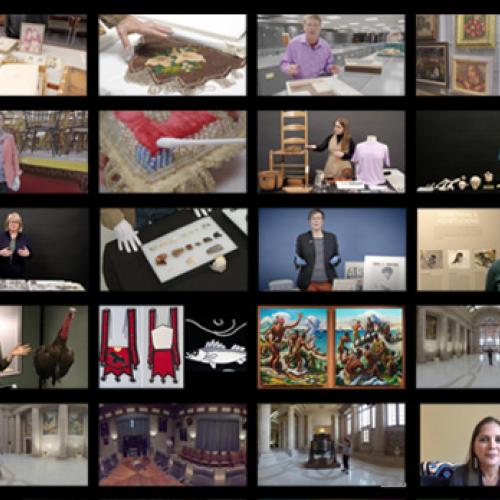
Never miss a moment of NYSM virtual programming! Access our most recent virtual field trips, guided tours, collection highlights, and educational programs for all ages.
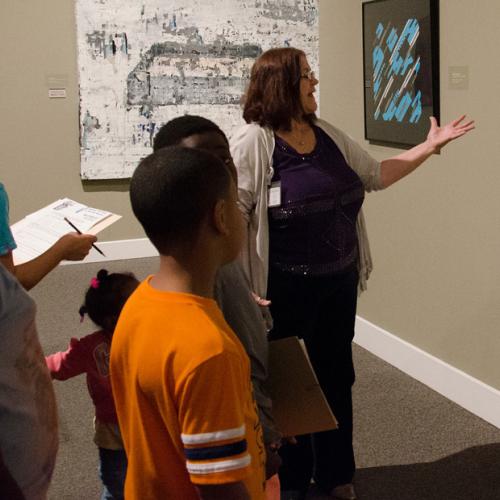
Find lesson plans for activities about Fort Orange and Women's Suffrage, as well as other educational links and resources, all available from our main NYSM education page.
NYSM VIDEOS
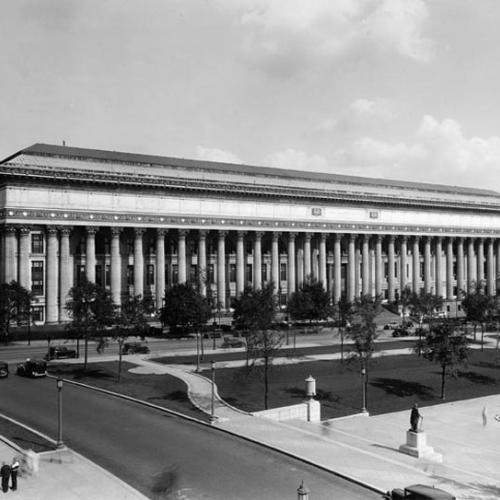
Join NYSM Educators as they take you on 360 degree tours of the New York State Education Building! From the Rotunda and Regents Room to the replica Liberty Bell, learn all about the history and architecture of this historic state building.
A Museum Moment
EDUCATOR RESOURCES
The New York State Museum is celebrating LGBTQ+ history as we highlight some of our collections that tell the stories of LGBTQ+ New Yorkers and share additional educational resources.

Join the NYSM in commemorating the important role women have in the history of our state. Access videos, educational activities, and more through this comprehension resource page.
Women's History Month Online CTLE Credit for Educators

Explore the 360 Gallery Tour of the NYSM's exhibition, Votes For Women: Celebrating New York’s Suffrage Centennial, and earn 1 credit hour of Continuing Teacher and Leader Education (CTLE).
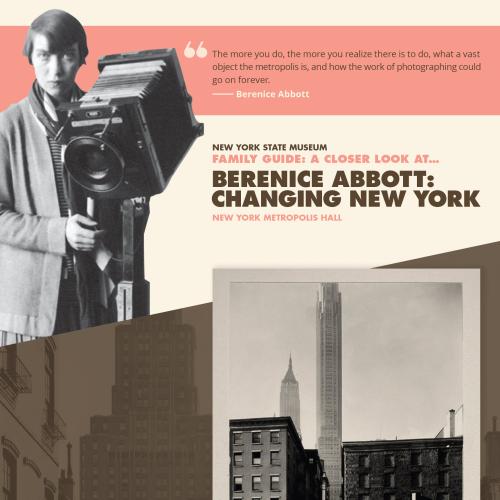
Explore the work of this ground-breaking photographer with the children in your life through the Family Guide, “A Closer Look at Berenice Abbott: Changing New York.” This online feature helps young photographers and art historians learn about Abbott, engage with her photographs, and document their own changing communities.
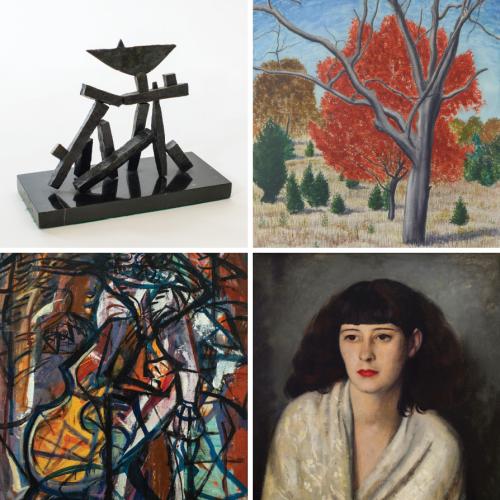
Learn more about the history and art of the Woodstock Art Colony through downloadable Educator Guides and Google Classroom lessons.
Votes for Women Educator’s Guide and Graphic Organizer (PDF)
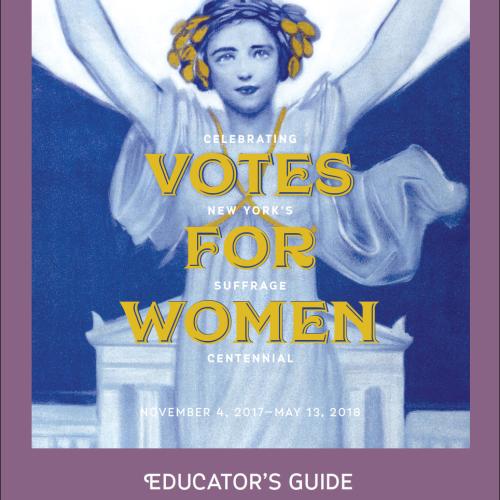
Educators using this guide will know that students depart with a basic understanding of how suffragists and advocates fought for women’s rights in New York, and how these efforts and techniques impacted national women’s rights movements.

Access to educational resources, videos, and activities about the experiences of Black New Yorkers is available throughout the year.
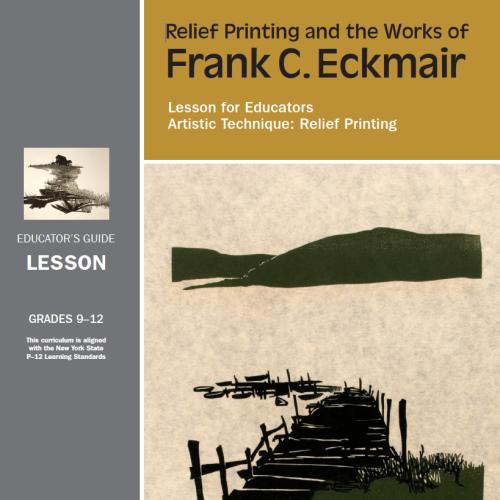
This lesson encourages students to gain a basic understanding of printmaking. Students will use observation skills to evaluate, discuss, and connect to the art of printmaker Frank C. Eckmair. They will experiment with techniques and create their own linocut print; learn how to care for materials and use tools in a safe and responsible manner; and make connections between process and meaning.
Your students will want to fly through these new science/ELA curriculum materials that accompany the exhibit Birds of New York!
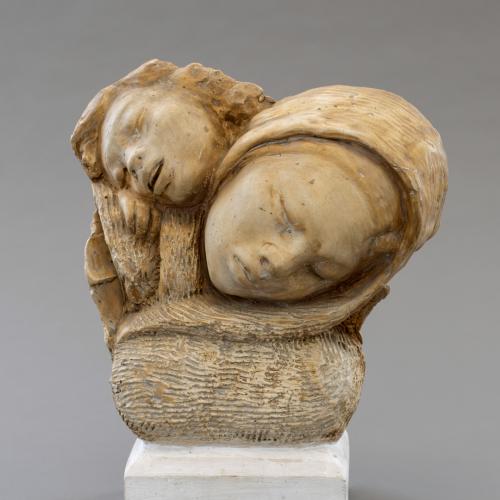
Learn more about the sculptor Henry DiSpirito and his experiences both as an artist and as an immigrant to the United States through two recently added Educator Guides and a video presentation by NYSM Historian Ashley Hopkins-Benton.
FUN ACTIVITIES
"Home" Work!
These themed activities are perfect for educators, caregivers, and students looking for fun ways to stayed engaged at home.
COMMUNITY
Connect with PBS!
Resources for Young Children on Race, Racism, and more:
https://www.wxxi.org/education/resources-young-children-race-racism
Explore films and new specials focused on race:
https://www.pbs.org/articles/2020/06/racism-in-america/
Teachers! Check out these free standards-aligned videos, interactives, and lesson plans:
https://ny.pbslearningmedia.org/
Starting a conversation about race can be difficult. The Smithsonian National Museum of African American History and Culture created the online portal "Talking about Race" with tools for individuals, caregivers, and educators. We hope these resources can continue the dialogue. https://nmaahc.si.edu/learn/talking-about-race
The New York State COVID-19 Documentation Initiative coordinates the documentation of the state’s response to the COVID-19 pandemic.
The New York State Board of Regents (“the Regents”) charters museums in New York State as educational corporations and has governing authority over these incorporated organizations. Orgranizations with questions regarding deaccession regulations can review this document or contact Chartering.
Home-work: Educational Activities from the NYSM that You Can Do from Home!
Fun with Architecture
Educators, Caregivers, and Students! Enjoy these architecturally-focused activities from Museum Instructor, Kat Morehouse at home.
New York State has some really awesome architecture. If you were designing a city, what would your buildings look like?
Check out the Empire State Plaza in Albany, an icon of 20th century Modernist Architecture with this online exhibit: http://exhibitions.nysm.nysed.gov/Plaza50/
Look at New York City through the eyes of photographer Bernice Abbott who captured “Changing New York” in the 1930’s while working on a WPA project with this online exhibit: http://exhibitions.nysm.nysed.gov/abbott/pageflash.html
ACTIVITY: Design your own city!
Draw the layout of your city or try your hand at a 3D model using blocks or other objects you have at home.
Home-work: Educational Activities from the NYSM that You Can Do from Home!
Whale-tastic Educational Activities
The NYSM Right Whale was featured in the FaceBook Live Field Trip to the NYSM with archaeologist, Daria Merwin. (View the field trip here: https://youtu.be/Ihr2cqfcIuA)
Enjoy the following related activities and information below:
The whaling industry was a booming business in New York State in the late 18th and early 19th century. Whales like the North Atlantic Right Whale were hunted and used for their blubber (fat that could be rendered into oil) and baleen (bristly plates used for filter feeding). Overhunting lead to the decline of the Right Whale population and consumers moved towards replacing whale-products with other options like kerosene. Now, the North Atlantic Right Whale is listed as an endangered species under the Endangered Species Act. Image below from the New York State Museum is a 38-foot skeleton of a Right Whale.
ACTIVITIES:
Calculate:
Measure out 38 feet to see just how long a Right Whale is. Another baleen whale, the Blue Whale — the world’s largest creature ever known — is in life about ten feet longer than twice as long as this Right Whale skeleton displayed here. Calculate how many feet long a Blue Whale would be. Then using a tape measure create a “Blue Whale” to compare side by side with the Right Whale skeleton.
Experiment:
Blubber is how the Right Whale stays warm in ice-cold water. We can try a fun experiment at home: fill 2 bowls with ice water, fill a Ziploc bag with shortening and insert another Ziploc bag to keep your hand clean, now at the same time put your bare hand into one bowl and your hand in the shortening bag in the other bowl. Can you feel the difference? Is one colder than the other?
Explore:
View museum artifacts that were made with using whale products like whale oil lamps here: https://www.youtube.com/watch?v=1tXqdVVdNVk
NYSSA Summer Performance Schedule
The New York State Summer School of the Arts, comprised of seven component summer residential schools, is supported and administered by the State Education Department. NYSSSA’s goal is clear: to provide intensive, pre-professional training programs for New York State’s most gifted and motivated young artists who are considering careers in the arts or entertainment industries. Over 400 high school students participate in the program every year.
We invite you to see this wonderful program in action. Below is a complete schedule of concerts and events that the Summer School of the Arts will be hosting. All events are free and open to the public. For additional information about NYSSA, please visit: http://www.oce.nysed.gov/nysssa
DATE SCHOOL LOCATION Friday, July 26 - 2:30pm Ballet National Museum of Dance Saturday, July 27 - 10am-2pm Theatre SUNY Alfred Sunday, July 28 - 2:30pm Choral Studies Concert at Chautauqua Institution Amphitheatre Friday, August 2 - 1pm Visual Arts SUNY Fredonia Rockefeller Arts Center Friday August 2 - 4pm/7:30pm Choral Studies SUNY Fredonia's Rosch Hall Saturday August 3 - 1pm Choral Studies SUNY Fredonia's Rosch Hall Saturday, August 3 - 7pm Dance Skidmore College Sunday, August 4 - 2pm Orchestral Studies Skidmore College Ladd Concert Hall Friday, August 9 - 9am-4pm Media Arts SUNY Alfred Friday, August 9 - 7pm Dance Skidmore Dance Theatre Saturday, August 10 - 2pm Orchestral Studies Skidmore College Ladd Concert Hall Saturday, August 10 - 1pm Dance Skidmore Dance Theatre Saturday, August 17 - 2:00 pm Orchestral Studies SPAC"Focus on Nature XV" Exhibition on Display at Roberson Museum and Science Center in Binghamton
Focus on Nature XV, a nature-based artwork exhibition featuring 87 illustrations by 69 artists, will be on display at the Roberson Museum and Science Center in Binghamton, NY from July 21, 2019 – January 20, 2020. The exhibition, which is organized by the New York State Museum, celebrates natural and cultural history illustration and the talented artists who create a connection between science and art.
Focus on Nature is a biennial exhibition of scientific, natural and cultural history. Since its inception in 1990, the exhibition has reflected the standards, materials, and skills of contemporary natural and cultural history illustrators. It has increased awareness of a genre that requires scientific accuracy for publications, interpretive nature centers, as well as many research and educational purposes. A five-member jury of artists and scientists select the artwork for each exhibition based on the illustration’s scientific accuracy and uniqueness, educational value and artistic quality. Artists featured in the exhibition are from countries around the world, including Australia, Brazil, Canada, Germany, Netherlands, Norway, Portugal, Saudi Arabia, Spain, Switzerland, Taiwan, the United Kingdom, and the United States. An exhibition catalog with artist commentary is available on the State Museum website.
“Focus on Nature encourages visitors to learn about the animals and plants around us through art,” said Board of Regents Chancellor Betty A. Rosa. “People of all ages, especially students, will be interested in not only the artwork itself but also the artists’ thought process and approach to creating each piece.”
“These artworks are great examples of illustrations of the natural world by a group of very accomplished artists,” said State Education Commissioner MaryEllen Elia. “We’re proud to partner with the Roberson Museum to bring this nature-based art exhibition to Binghamton. The art showcased in the exhibit can serve as inspiration and encouragement for students to illustrate the natural environment and learn about the plants and animals in their community and beyond.”
“These pieces offer such a unique and intimate study of life on Earth,” said Natalie Shoemaker, Events & Marketing Coordinator at the Roberson Museum and Science Center. “We’re so excited and honored to host this stunning exhibition at the Roberson Museum and Science Center here in Binghamton, NY, and we hope these artworks can spark important conversations surrounding the life portrayed within.”
This year is the fifteenth iteration of the Focus on Nature exhibition and the illustrations reflect a variety of artistic formats and subjects. Notable illustrations include:
- Octopus (Keuppia species) by Esther van Hulsen – this painting of a 95-million-year-old octopus was painted with its own ink. The fossil of the octopus was found in Lebanon in such excellent condition that it was possible to obtain some ink. Octopus ink has historically been used on occasion for drawing and painting most notably by English paleontologist Mary Anning who made a similar drawing in the early 1800s.
- Gorgosaurus libratus, Lambeosaurus lambei by Christian Gerisch – this painting depicts two dinosaurs encountering each other in a riverbed in southeastern Alberta, Canada. Both animals seem unsure what to do. The scene is based on an assumption made by paleontologist Dr. David Hone. He theorized fully grown apex predators seldom go for large, healthy prey – a similar behavior observed in modern animals. The commonly depicted image of dinosaurs battling large prey animals would have been a rare sight, only happening in desperate circumstances.
- Aloe (Aloe species) by Dorothy DePaulo – this painting is created on drafting film, a semi-translucent plastic film that allows the artist to layer pieces of film. The artist wanted to draw the aloe plant in the dominant view with its native habitat, the Sonoran Desert of southwestern North America, in the background. To achieve this, two layers of drafting film were used with the aloe on the top layer and the desert scene in monotone on the underlaying film.
Photos of select artworks from the exhibition are available upon request. Please email nysmpress@nysed.gov.
The New York State Museum is a program of the New York State Education Department’s Office of Cultural Education. Located at 222 Madison Avenue in Albany, the Museum is open Tuesday through Sunday from 9:30 a.m. to 5:00 p.m. It is closed on the Fourth of July, Thanksgiving, Christmas, and New Year's Day. Admission is free. Further information about programs and events can be obtained by calling (518) 474-5877 or visiting the Museum website.
Roberson Museum and Science Center is open Wednesday through Thursday, Saturday, and Sunday from 12PM to 5PM, and Friday from 12PM to 9PM. The Museum is located at 30 Front Street, Binghamton, NY 13905. Admission information can be found by calling (607) 772-0660 or visiting the Roberson website.
Phone: (518) 474-1201
Louis Agassiz Fuertes, Illustrations for Birds of New York (1910-1914)
Natural History Illustration Collection
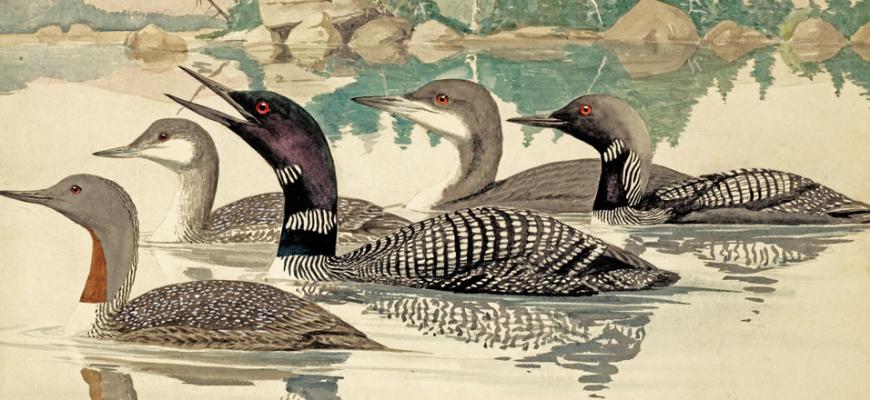
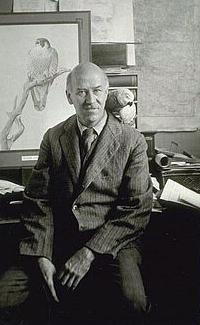
Housed in the historical archives in the Cultural Education Center are a series of bird paintings by Louis Agassiz Fuertes done for The Birds of New York by Elon Howard Eaton in 1910 (vol.1) and 1914 (vol.2). Although there are one hundred and six (106) plates in The Birds of New York, there are one hundred and eighteen (118) original paintings.
These are an important part of New York State's heritage not only because they were accomplished by a life-long resident of New York, but because historically, Fuertes is considered one of the world's greatest bird artists.
Ashley Bennett, SUNY Oswego, Leo, 2015, Mixed media
Best of SUNY Student Art Exhibition 2016
The Best of SUNY Student Art Exhibition presents artwork selected by a panel of jurors from the fall 2015 and the spring 2016 student art exhibitions at the State University Plaza in downtown Albany over the past academic year. The works on exhibit at the New York State Museum represent the wide range of media being studied by art students within SUNY and cover the traditional areas of drawing, painting, printmaking, ceramics, and sculpture, as well as digital imaging, photography, and mixed media installations.
The SUNY Student Art Exhibitions began in 2002 with the goal of bringing the accomplished work of SUNY’s student artists to a wider and more diverse audience. This mission continues with the ninth installment of the exhibition at the New York State Museum.
State Museum Scientists Publish New Research on Large Mammal Colonization and Extinction in New York After the Ice Age
New York State Museum scientists have completed research that reveals when and why large mammals—including caribou, mammoths, and mastodons—re-colonized and ultimately went extinct in New York State after the last Ice Age. This research may help scientists better understand how ecosystems formed and why certain species went extinct after the last Ice Age. Dr. Robert Feranec, the Museum’s curator of Pleistocene vertebrate paleontology, and Dr. Andrew Kozlowski, the Museum’s glacial geologist, co-authored the research that appears in the most recent issue of the journal “Quaternary Research” (Volume 85, Issue 2).
At the height of the last Ice Age, approximately twenty-five thousand years ago, the area that is now New York State was nearly entirely covered in ice. As the earth moved from a glacial climate to an interglacial climate and the ice melted, new land opened up to colonization by plants and animals. By carbon dating specimens in the State Museum collections as well as analyzing carbon dates of caribou, mammoths, and mastodons from other published research, Feranec and Kozlowski were able to determine the colonization and extinction patterns of those species following the last Ice Age.
Based on the carbon dates, a pattern in the timing of colonization emerges with caribou appearing first, about 17,000 years ago. Mammoths followed shortly thereafter, arriving when their preferred habitat, a tundra environment, was present in the state. A few thousand years later, mastodons then colonized the state when their preferred habitat, boreal forest, became present.
Interestingly, the scientists found that the pattern of extinction was opposite that of colonization. At the end of the Pleistocene epoch, about 12,000 years ago, mastodons went extinct in the state first, followed by mammoths. There are historical records of caribou in the state up to and during the Colonial period (about 200 years ago).
Paleontologists have long debated the cause of the end-Pleistocene extinction when over 50 species of large mammals went extinct in North America. Different arguments have focused on whether the extinction was caused by human-related impacts, such as over-hunting animals, by climate change and subsequent habitat change associated with the shift from a glacial period to an interglacial period, or by a combination of the simultaneous impacts of humans and climate.
Based on this study, at the time of their extinction in the state, the preferred habitats of both mammoths and mastodons were still present; therefore implicating that lack of food or preferred habitat alone could not have been significant contributors to their demise. However, about 1,000 years before these species go extinct, humans enter the state. Feranec and Kozlowski determined that while humans may not have been the only cause in the extinction of mammoths and mastodons in New York, and elsewhere in North America, they likely played a role in the extinction of many species.
Feranec and Kozlowski note that these results not only provide clues to life in the past, but also help provide a basis for understanding more modern concerns, such as the effects of current climatic change on species today and how those species will respond. This study illustrates the need and value of collections-based research to address modern societal issues.
The article is available for free through May 24, 2016 at: http://authors.elsevier.com/a/1Spf87eobDNef.
The State Museum is a program of the New York State Education Department’s Office of Cultural Education. Located at 222 Madison Avenue in Albany, the Museum is open Tuesday through Sunday from 9:30 a.m. to 5 p.m. It is closed on Thanksgiving, Christmas and New Year's Day. Admission is free. Further information about programs and events can be obtained by calling (518) 474-5877 or visiting the Museum website.
Department:
Phone: (518) 474-1201